


There’s a fascinating little moment tucked into Through the Looking-Glass (1871), the sequel to the 1865 Alice in Wonderland, when the formerly titular Alice finds a book in the formerly titular land, and realizes that she needs to use the now-titular optical device:
“.YKCOWREBBAJ
sevot yhtils eht dna, gillirb sawT’
ebaw eht ni elbmig dna eryg diD
,sevogorob eht erew ysmim llA
.ebargtuo shtar emom eht dnA
She puzzled over this for some time, but at last a bright thought struck her. “Why, it’s a Looking-glass book, of course! And if I hold it up to a glass, the words will all go the right way again.”
What she finds runs like this:
JABBERWOCKY.
’Twas brillig, and the slithy toves
Did gyre and gimble in the wabe;
All mimsy were the borogoves,
And the mome raths outgrabe.
“Beware the Jabberwock, my son!
The jaws that bite, the claws that catch!
Beware the Jubjub bird, and shun
The frumious Bandersnatch!”
He took his vorpal sword in hand:
Long time the manxome foe he sought—
So rested he by the Tumtum tree,
And stood awhile in thought.
And as in uffish thought he stood,
The Jabberwock, with eyes of flame,
Came whiffling through the tulgey wood,
And burbled as it came!
One, two! One, two! And through and through
The vorpal blade went snicker-snack!
He left it dead, and with its head
He went galumphing back.
“And hast thou slain the Jabberwock?
Come to my arms, my beamish boy!
O frabjous day! Callooh! Callay!”
He chortled in his joy.
’Twas brillig, and the slithy toves
Did gyre and gimble in the wabe;
All mimsy were the borogoves,
And the mome raths outgrabe.
Alice, like any child sucked into a nightmarish parallel universe full of talking caterpillars and such, has a little trouble with the poem. Brillig and slithy, galumphing and borogoves, mome and manxome and Jubjub and Jabberwocky?
Thankfully, Alice is later able to consult Humpty Dumpty (you know, from TV), and he provides her with some answers. “‘Brillig’ means four o’clock in the afternoon—the time when you begin broiling things for dinner.” “‘Slithy’ means ‘lithe and slimy.’” “To ‘gyre’ is to go round and round like a gyroscope. To ‘gimble’ is to make holes like a gimlet.” Naturally!
As this scene implies, Carroll’s poem is famous for spawning not just a really weird Tim Burton action sequence but also a host of fabulated words, words that began their lives signifying nothing real at all but then, by some stroke of magic, actually gluing themselves to meaning. The reason, I think, is that Carroll has a fine feeling for the architecture of English words: their Latinate and Anglo-Saxon ingredients, their possible alchemical portmanteau (Carroll, by the way, was the person who coined the word portmanteau, deriving it from a two-piece French article of luggage). He knew that any fake word has to seem at least half real. (In fact, gyre was already a real word before Carroll got his hands on it).
Take the titular creature: fugitive imagery still pulses in the word. This is a creature that jabbers (squawks and pesters, or perhaps pokes (as in jab)), is perhaps distantly avian (wocky evokes mockingbird), and, to judge from its long name, is mighty indeed. Insofar as the inimitable John Tenniel is any indication, the Jabberwocky is, indeed, a gigantic bug-dragon-bat.
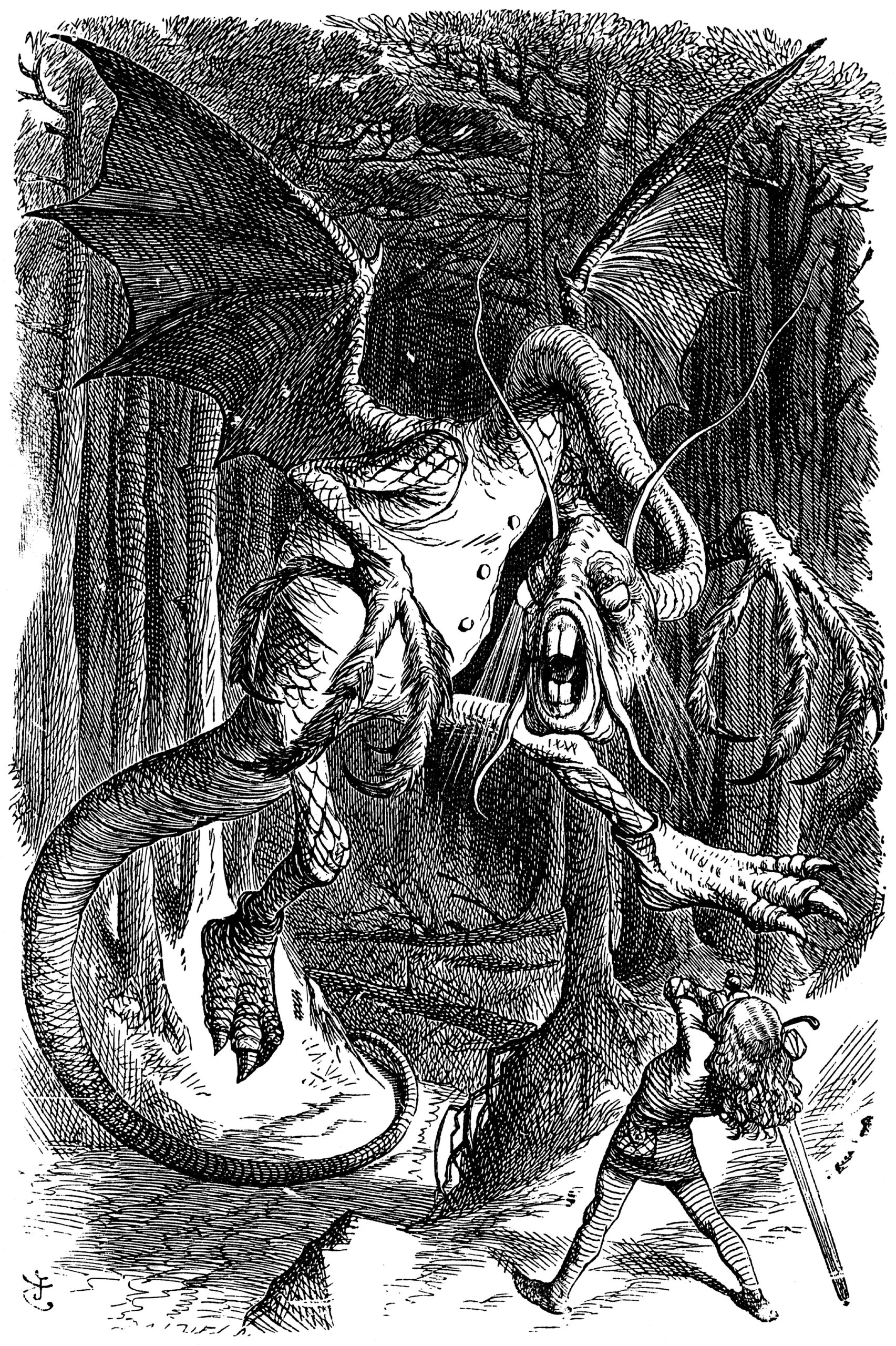
John Tenniel’s illustration of the Jabberwocky
It’s endlessly amusing and entirely unfitting, for that reason, that of the three Magic cards that quote Carroll, all three have entirely normcore names: Ancestral Recall, Diminish, and Pearled Unicorn.
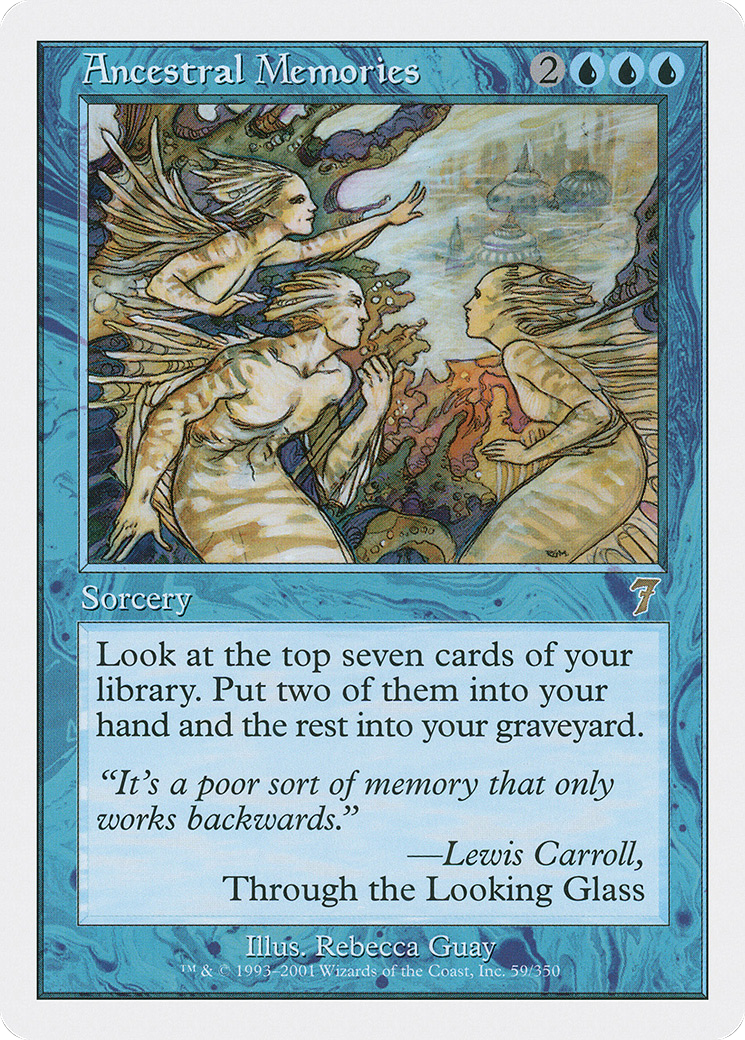
Ancestral Memories
All three are great flavor pulls, but none of them quite channel the intense nominative nuttiness that “Jabberwocky” models—and that so many Magic cards model.
***
The catalogue of Magic’s creatures is instructive.
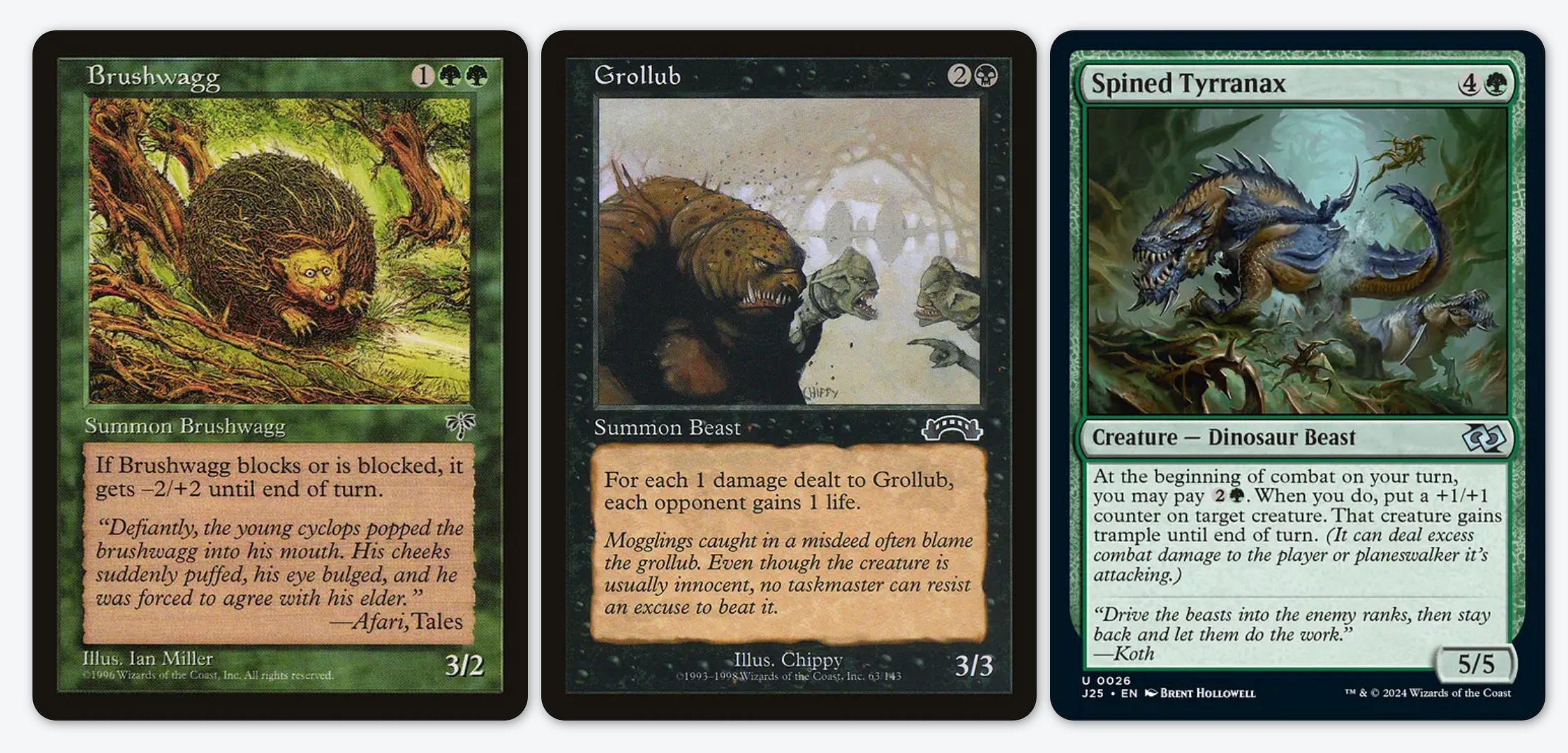
A Brushwagg, one can wager without looking, is a little guy who seems to like to shake around his big bushy spindly self—and so it is. So too for the Spined Tyrannax: the first part of its name evokes both a tyrannical ruler and the dinosaur of the same name, and the crunchy diphthong of the second word seems to evoke the clawing, clashing, smashing power of the creature itself. Grollub isn’t too shabby, either, with its messy evocation, but not outright mention, of grub and troll.
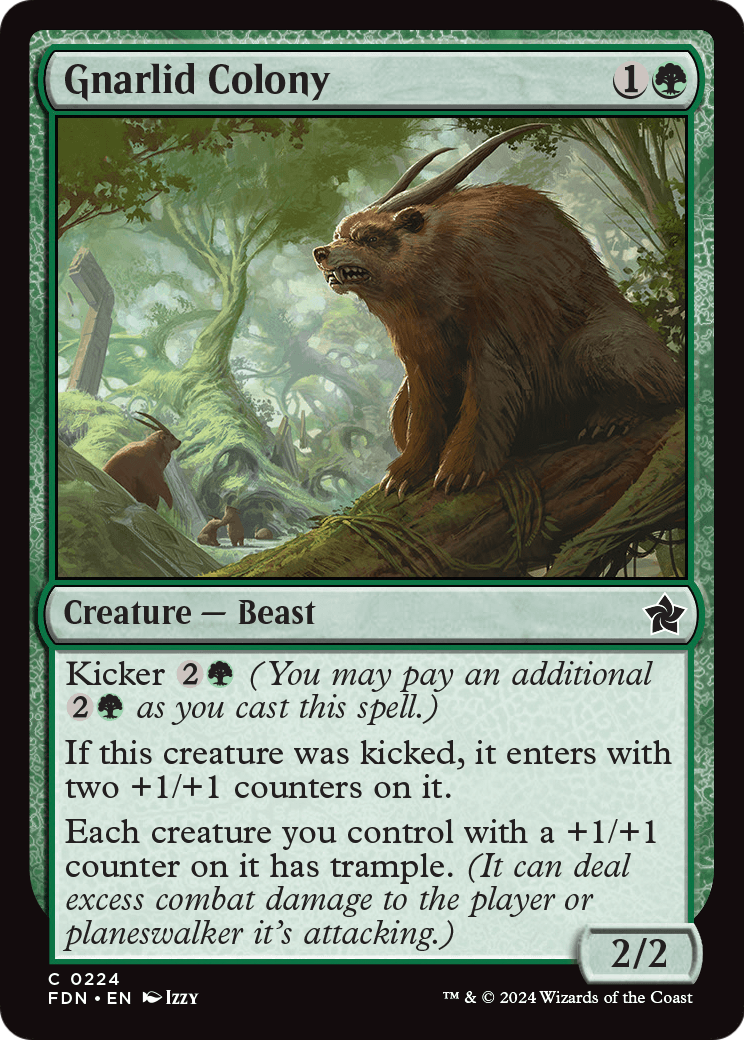
In other cases, simple suffixes do the heavy lifting. -id, for example, allows worldbuilders to nominalize words (turn non-nouns into nouns, in other words) or transmute their connotations: gnarlids (like Gnarlid Pack) turn the evocative verb gnarl, bespeaking twisting bark, into a name for the critters that traverse them, Carnassid bespeaks carnivorous hunger turned to life, and the Stratozeppelid injects real words, zeppelin and stratosphere, with a burst of organic grotesquery.
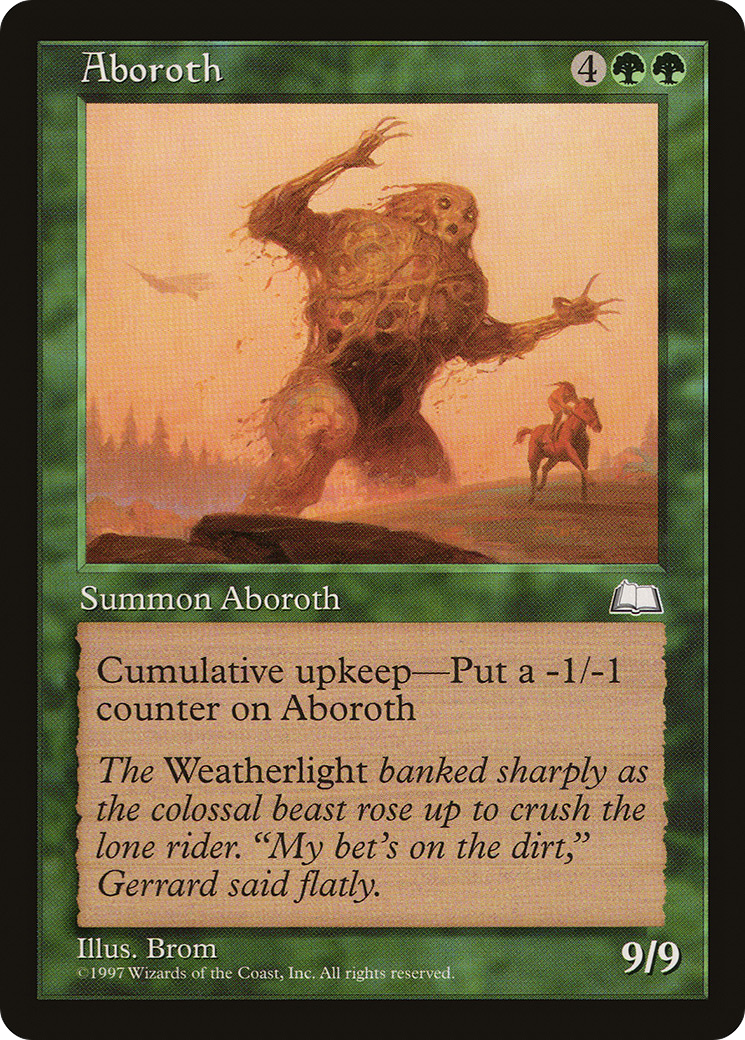
So too for -oth, which doesn’t so much nominalize as evoke the largeness of behemoth: see the extra super-big Meglonoth, the even-more-extra-super-big Elder Gargaroth, and the regular super big primeval tree-beast Aboroth.
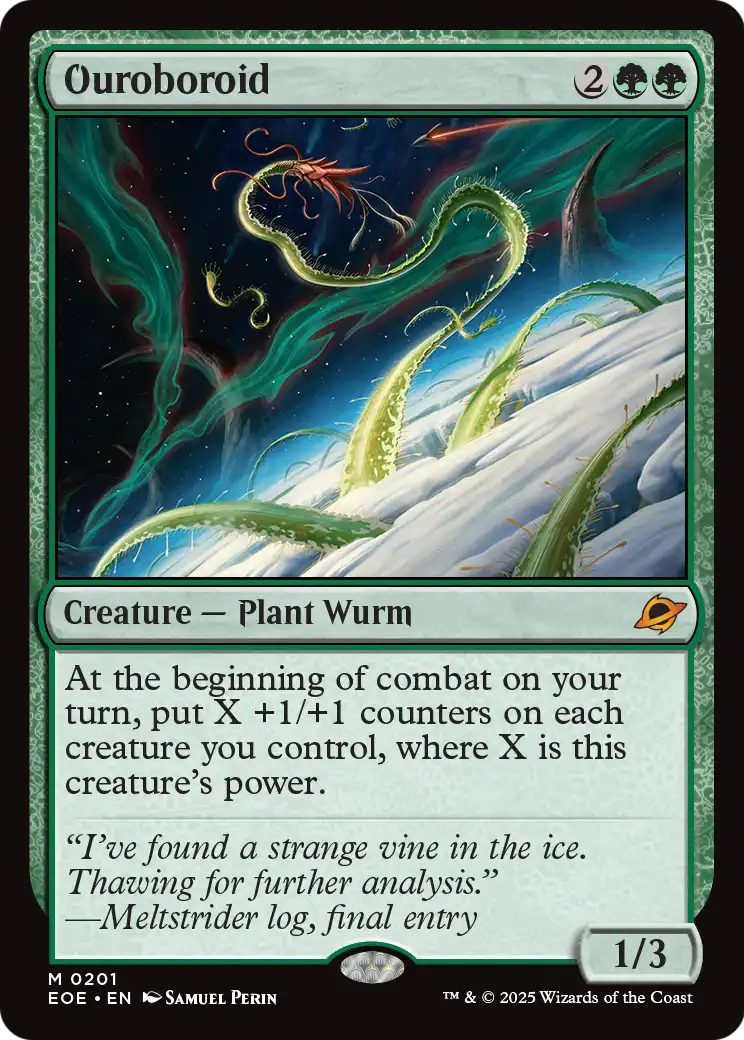
If you’re a mutantine flavor, might I recommend the self-coiling Ouroboroid, the sporing Mycoid Shepherd, and the guy with a face only your mother can love, Amoeboid Changeling.
Perhaps Magic’s most famous portmanteauists are Simic: the Aeromunculus, Plaxmanta, Lizrog, Pteramander, Omnibian. These, it bears saying, are a tad more obvious than the wordmashes of the Jabberwocky and Carnassid: they’re more playfully obvious, winking at their own overt mishmashing rather than remaining shrouded in mystery. Sharktocrab[/mtg_card is a great name, but it’s not a subtle one.
Although there are plenty of cool creatures whose names sound like elevated gibberish—like Erithizon, Gurzigost, and Kezzerdrix—I have to confess that it’s the portmanteaus that stick with me. To be sure, it takes skill to find a fantasy name that sounds both alien and plausible, but there’s even more elegance to telling a tiny little story with a name. There’s skill, as there is in Carroll’s Jabberwocky, of noticing the little whispers of meaning that might stretch like spiderweb filaments across language.
In a moment where we read more and more card names all the time, where there’s so much to keep track of and so much to jam into our brains, it’s worth appreciating these connections. It’s worth asking whether a creature from another world might just be on the other side of our card names.
For words like these have great power precisely in their inexplicability, their half-legibility. As Alice says of “The Jabberwocky”: “Somehow it seems to fill my head with ideas—only I don’t exactly know what they are!
Ryan Carroll (he/him) is a writer and Ph.D. candidate in English and Comparative Literature. On Substack as Dominarian Plowshare, he writes about Magic’s art, story, and experience. Outside of Magic, he writes on topics including 19th-century literature, information theory, television politics, and cliche.