


I don’t love Magic’s Universes Beyond products, but I am fascinated by them.
Magic is an exceptionally strange media franchise—and things get all the stranger when it tries to mix its own distributed-fantasy-slash-corporate-IP chocolate into other franchises’ distributed-fantasy-slash-corporate-IP peanut butter. What translates? What doesn’t? What seems locked in eternal struggle, a dialectical battle for aesthetic expression?
You can imagine that I’ve been having a field day with Marvel Super Heroes.
I’ve previously written about the interesting and often unfortunate tangles in card titles and art composition that arise from Magic meeting other media franchises, but looking at these new previews (insofar as anyone can really look at a constant blur of auroral sensation before their eyes), I realized there’s a third prong to the trinity of odd UB card design: flavor text.

Much has said about flavor text writ large, so I don’t propose to make the definitive statement about it. But I do think there’s something important we can learn about Magic—and also something strange and sad we can feel—from the flavor text in Hasbro and Disney’s forthcoming cardboard snog-sesh. And that strangeness has everything to do with quotation.
Words of Power
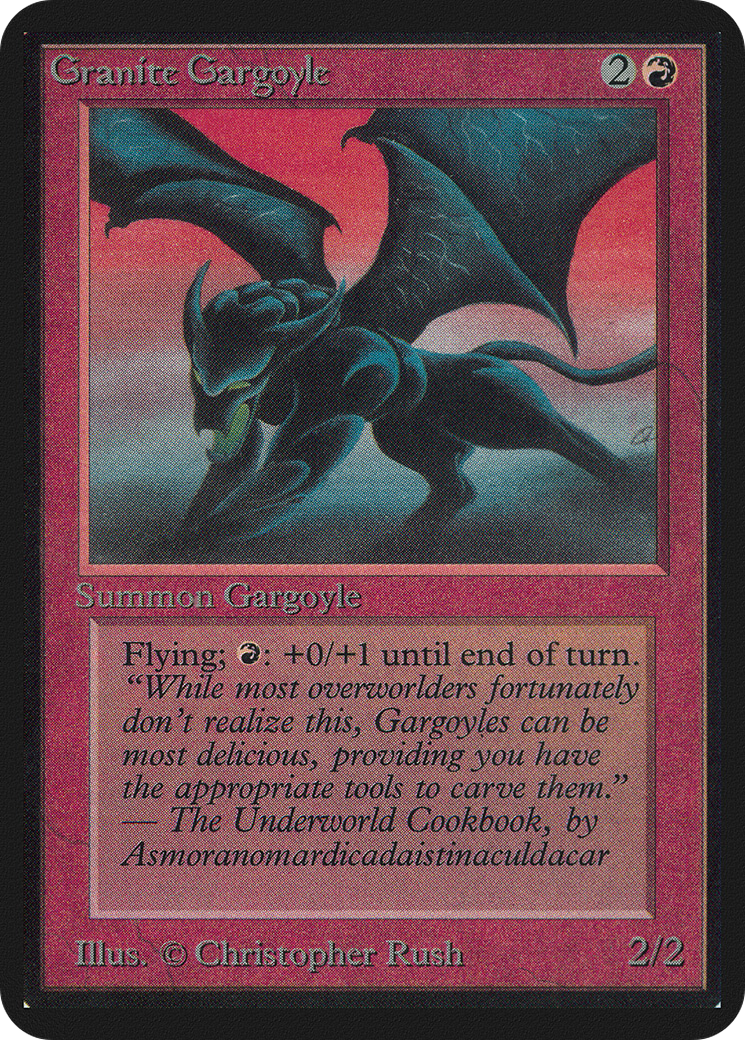
Quotational flavor text is as old as Magic. In Alpha, the comparative sparseness of much rules text meant that Benalish Hero, Air Elemental, and Bog Wraith[/mtg_card could do early work to fill early Dominaria with life; it also meant that cards like [mtg_card]Granite Gargoyle could use quotations to hint at a lived-in world, a world full of people who write and speak and think.
In the 30 years since, quotation has become a perennially dependable form of flavoring—evidenced in these charts I love to spend hours making for no reason (including time excluding, by hand, every real-world flavor text quotation–thanks, MTG.wiki!):
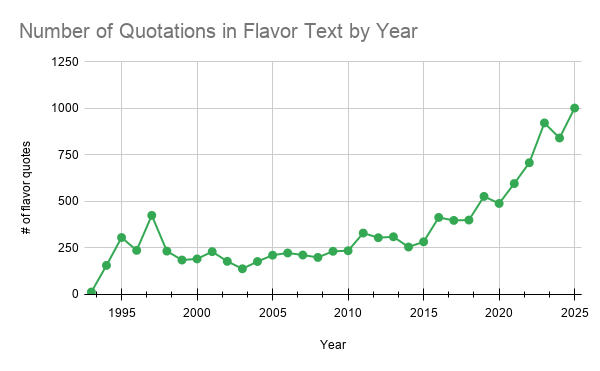
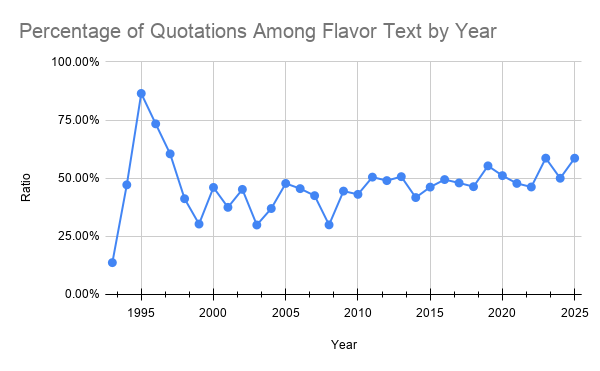
(Keep in mind that theses figures are accurate to the Marvel Super Heroes cards previewed as of Tuesday, June 9, the day I submitted this article. The numbers might change a little when the card image gallery has been filled in).
Although the raw number of quotations has surged along with Magic’s own roaring card production, the percentage of quotations among flavor text has stayed fairly stable, hovering generally around the 50% mark since 2011. It’s easy to understand why: while the voice of an omniscient narrator can provide lively glimpses into Magic’s high fantasy worlds, quotations allow for characters to speak for themselves—to give a sense of worlds that are genuinely lived-in.
But an even more interesting picture emerges when we confine our view to the last few spring and summer sets.
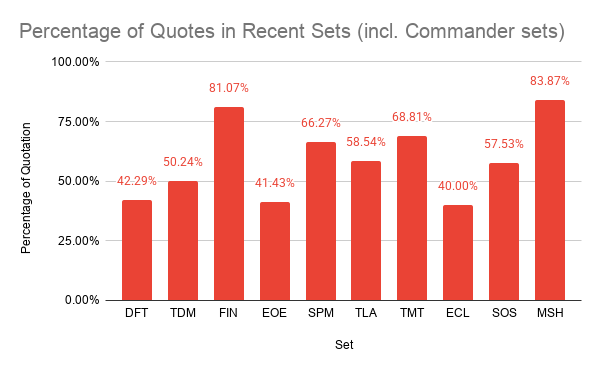
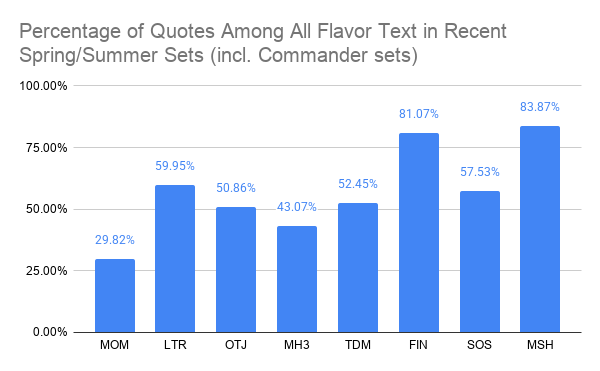
As these charts bear out, Universes Beyond sets have driven (though aren’t solely responsible for) a striking increase in the ratio of texts that use quotation rather than third-person description. The comparison is even more stark when we look at the April and June sets from the last few years. As we can see, quotation has shot up in recent spring/summer sets, with the share of quotations among flavored legends soaring above 80% in both Final Fantasy and Marvel (for context, nearly 60% of all cards in Marvel Super Heroes, Marvel Super Heroes Commander, or Marvel Super Heroes Jumpstart have quotations!).
In other words, quotation is taking a bigger and bigger bite out of all Magic’s flavor texts, particularly—and not surprisingly—when sets are based on existing properties.
To put these percentages into context, let’s consider the function of quoted flavor text. Here are some gems from the last few years that capture quoted flavor text at its best:
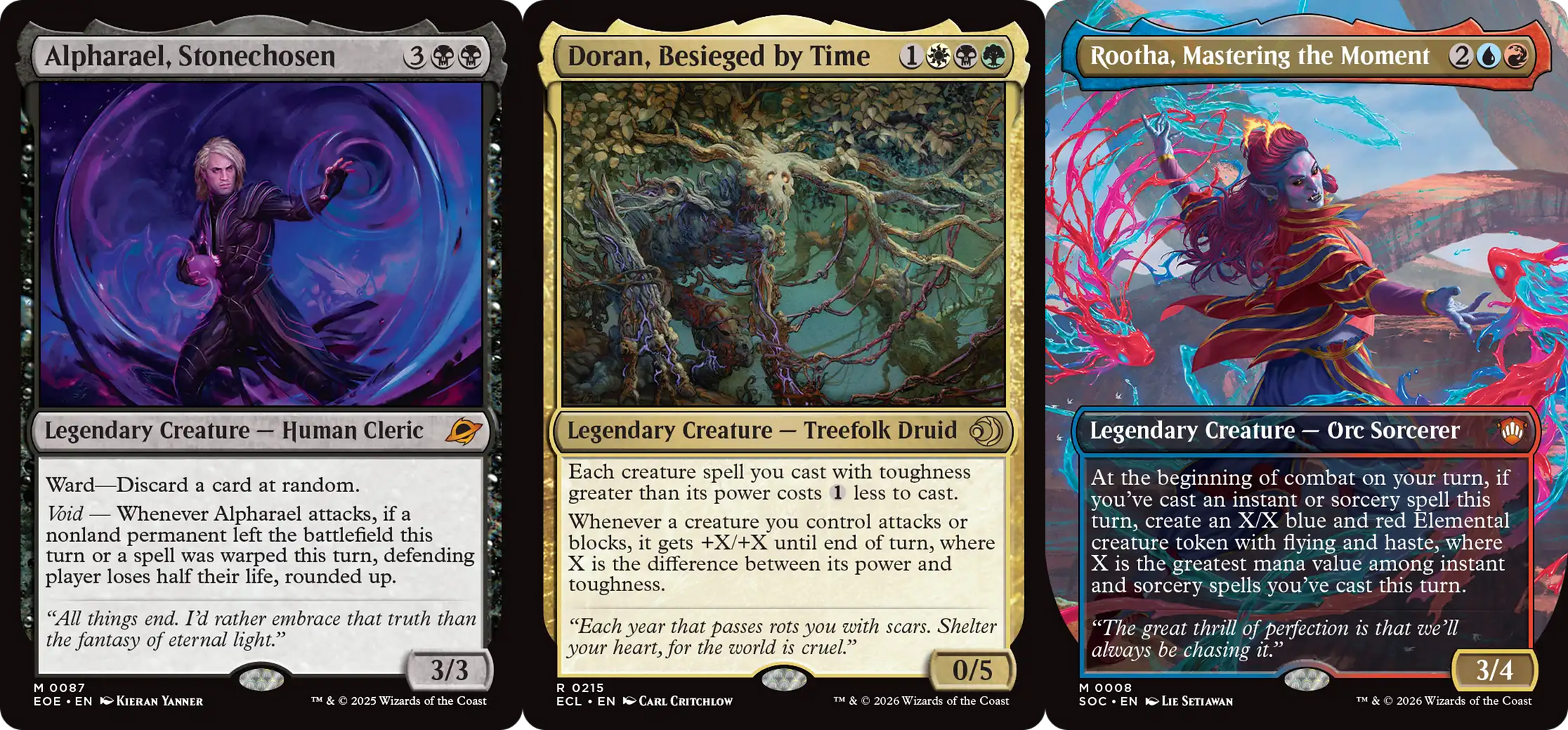
Although some of these lines are more effective than others, we should notice that all of them need to fulfill a particular discursive function: they need to tell the reader about a character they wouldn’t otherwise know, using the character’s own words. Although Doran and Rootha are returning characters, and although Alpharael features heavily in Magic’s web fiction, even the best-read Vorthoses don’t know everything there is to know—the characters simply haven’t appeared in that many works. Consequently, each card needs to introduce you to the character or some new element of them, whether by capturing a story beat (as in Rootha’s case) respinning an existing piece of flavor text (as in Doran’s), or articulating the character’s philosophy (as in Alpharael’s).
Marvel Super Heroes does something different, and far weirder. The very nature of the superhero genre is that iconography tells you almost everything you need to know: the Hulk wears shredded and chic purple shorts, has veins bulging out of his head, seems to be making a big mess when everyone’s just trying to have a good time, and the people around him are often losing it—so even if we haven’t seen a piece of Hulk Media™ before, we can get the sense that he’s a destructive, uncontrollable monster that may once have been human.
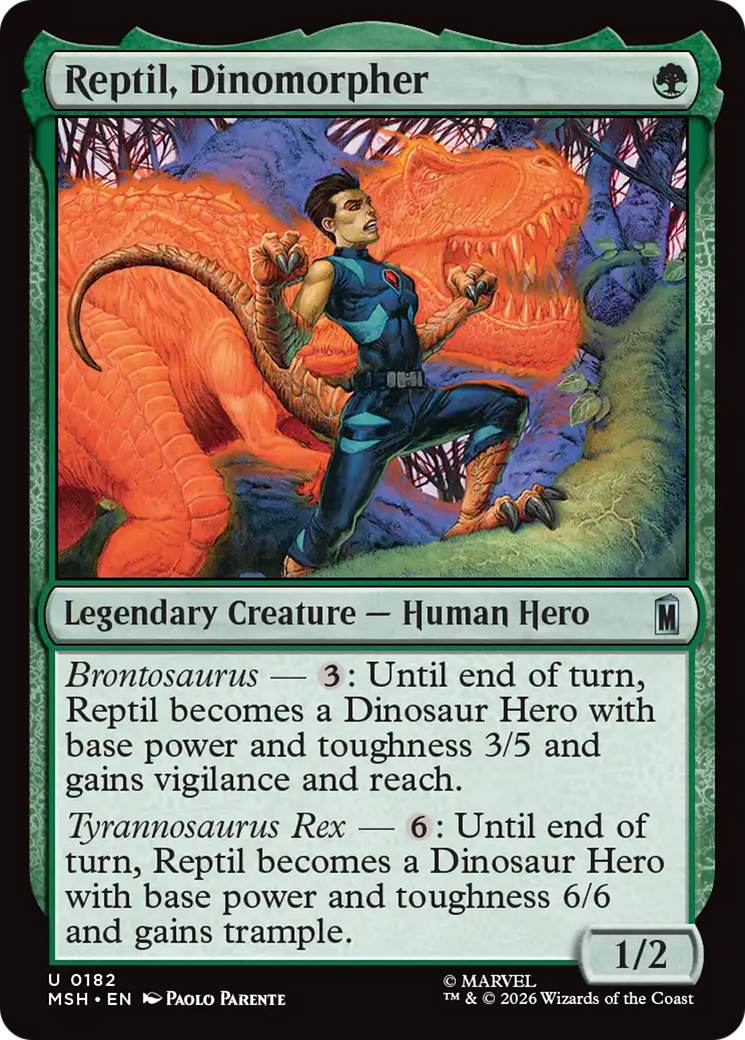
This is true, too, even with minor characters. Reptil has a human head and dinosaur claws, plus accent colors modeled on slash marks on his suit. Quicksilver wears a tight suit with a lightning bolt and zooms around his foes. Tigra has claws and a tail. You can basically guess their deal.
And even if you can’t, then at the very least the set presumes that you understand the visual vocabulary of the Marvel superhero universe. After all, the very existence of a Marvel Universes Beyond expansion depends on the presumption of buy-in: Wizards of the Coast figures that you know, at least vaguely, who the Avengers and the Fantastic Four are and what the vibe of a superhero is, otherwise they wouldn’t have made the set to begin with.
But there’s a problem. Precisely because comic book character’s visuals are so self-evident, how do you use words to evoke flavor when a character literally wears their life on their sleeve?
This conundrum is what makes the flavor text of Marvel Super Heroes so weird. Like Marvel’s Spider-Man, a great many pieces of flavor text in MSH basically reiterate exactly what a reader can already tell, either from a card’s art or from pre-existing knowledge about the character—in a bathetic way, rather than in a productive way.
Take, for example, the bizarre flavor on Black Panther, Vanguard, Captain America, Team Leader, and Doctor Doom, King of Latveria, which are so bizarre that I question whether they need to be there at all.
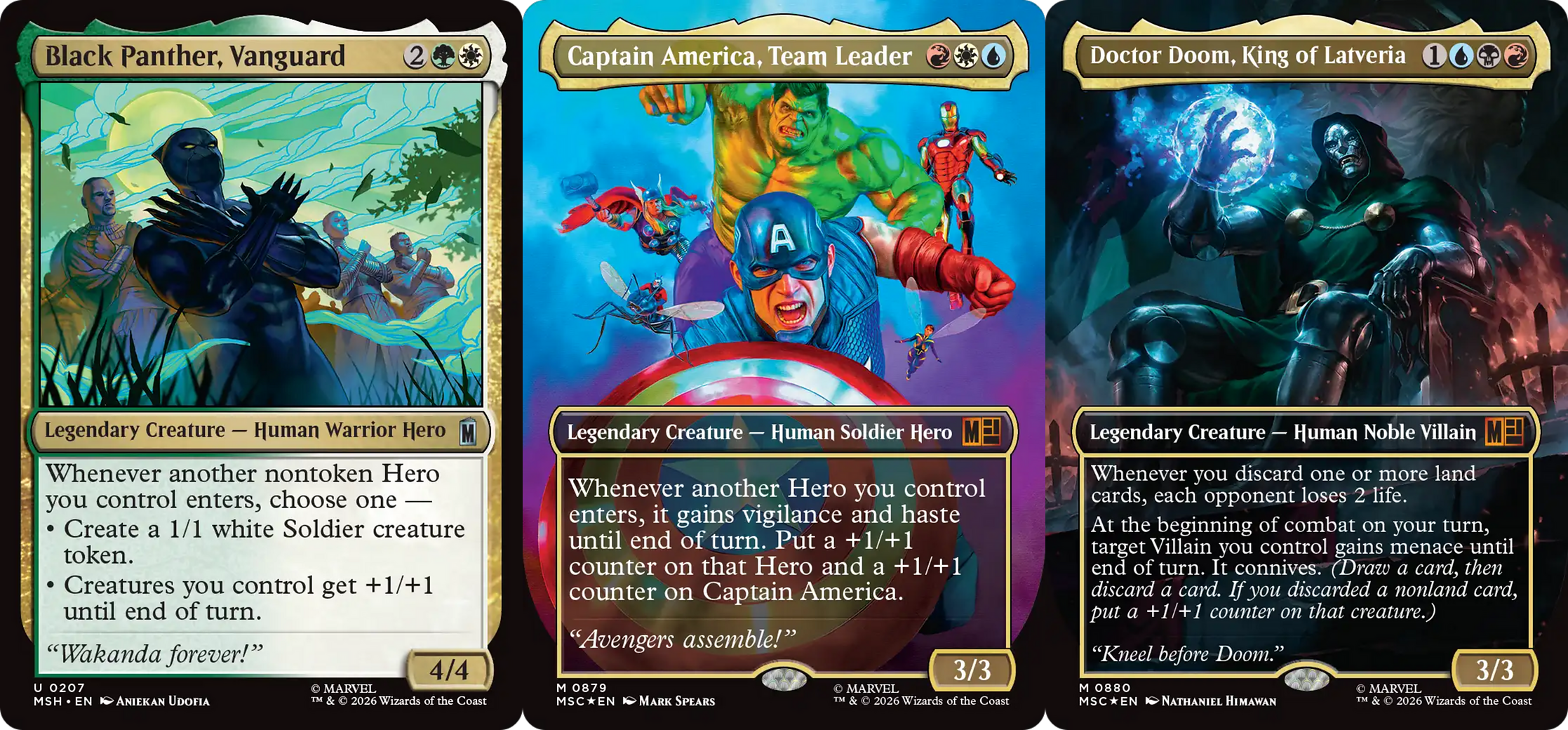
Now, in fairness, in-universe Magic has lines like these, as in Heroic Charge from Dominaria United, and they’re weak for the same reason: they’re catch-phrases, not pieces of worldbuilding. They may as well say “This is the card about Black Panther” or “This is the card about Benalia and Keld.” (Though in even more fairness, fewer audience members know about Benalia and Keld than about characters who have appeared in the 2nd, 4th, 13th, 19th, and 21st highest-grossing films of all time, so maybe it’s a little more permissible to have a “This is Benalia card”). In both cases, the cards tell us nothing more than what the card art and title already say.
Most MSH flavor texts aren’t as barebones as those, but the same aesthetic challenge appears macrocosmically over and over in this set: how do you give information about a character as though the audience doesn’t know who they are, even if they do? This is the case in more than a few MSH and MSC cards:
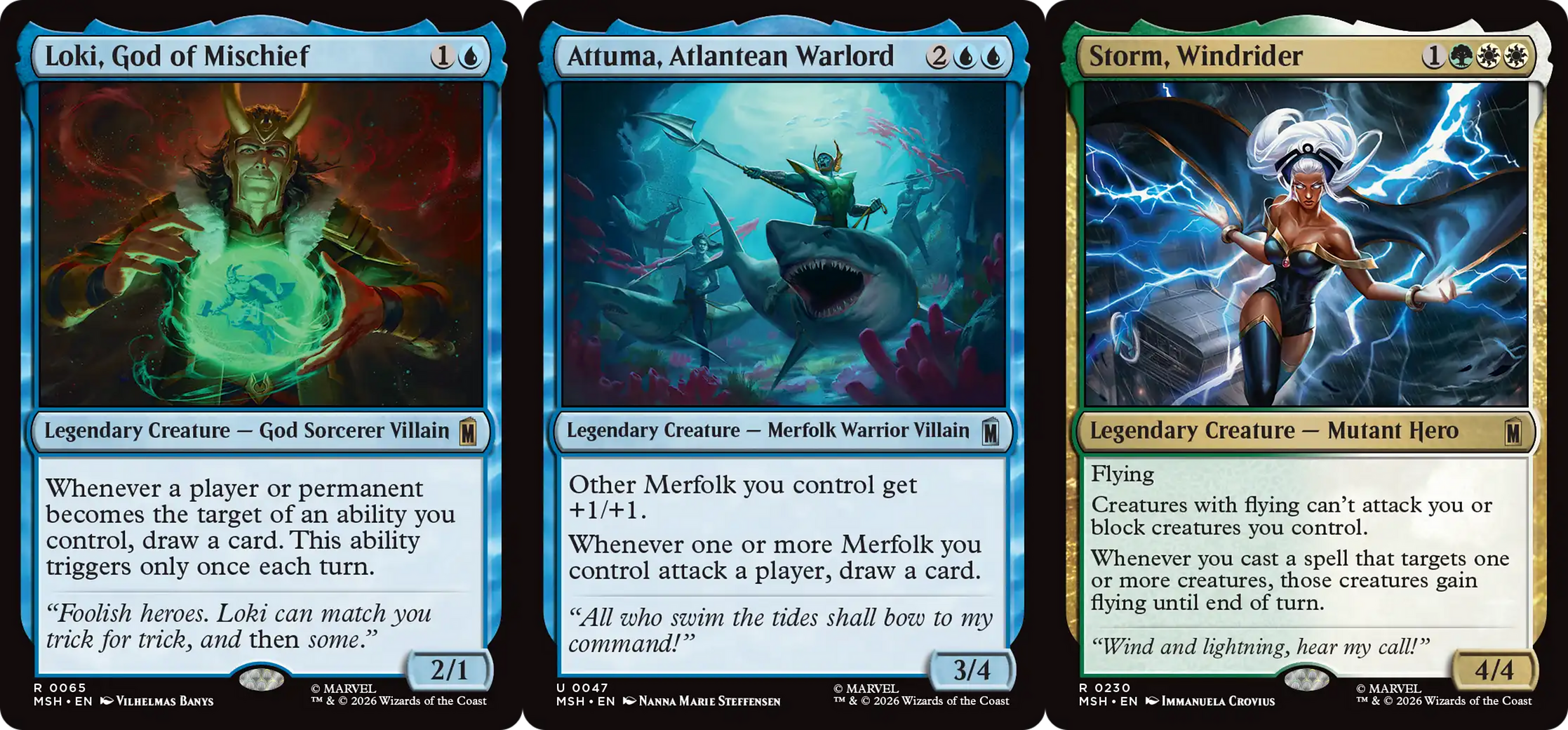
All these flavor texts (and others that I don’t quote but that doubtless belong on this list) add a bit more character than the ones I mentioned above, but they still depend on an implicit presumption: either you already know about this character or you don’t really need to know anything new about them. They articulate information that we either already know or could have readily gathered.
As Loki’s title reminds us, he is the god of mischief; his flavor text says that he, surprise, enjoys tricks. In Storm’s card art, she’s commanding wind and lightning (plus, her name is Storm) and wouldn’t you know it, her flavor text explains that she can communicate with wind and lightning. Attuma is an Atlantean Warlord and he appears to be underwater, and his flavor text quotes him saying that he’s going to be a warlord of people who live underwater.
Indeed, there’s a shocking number of cards whose flavor text, in drawing quotes from actual comics, do little more than restate the name of the character:
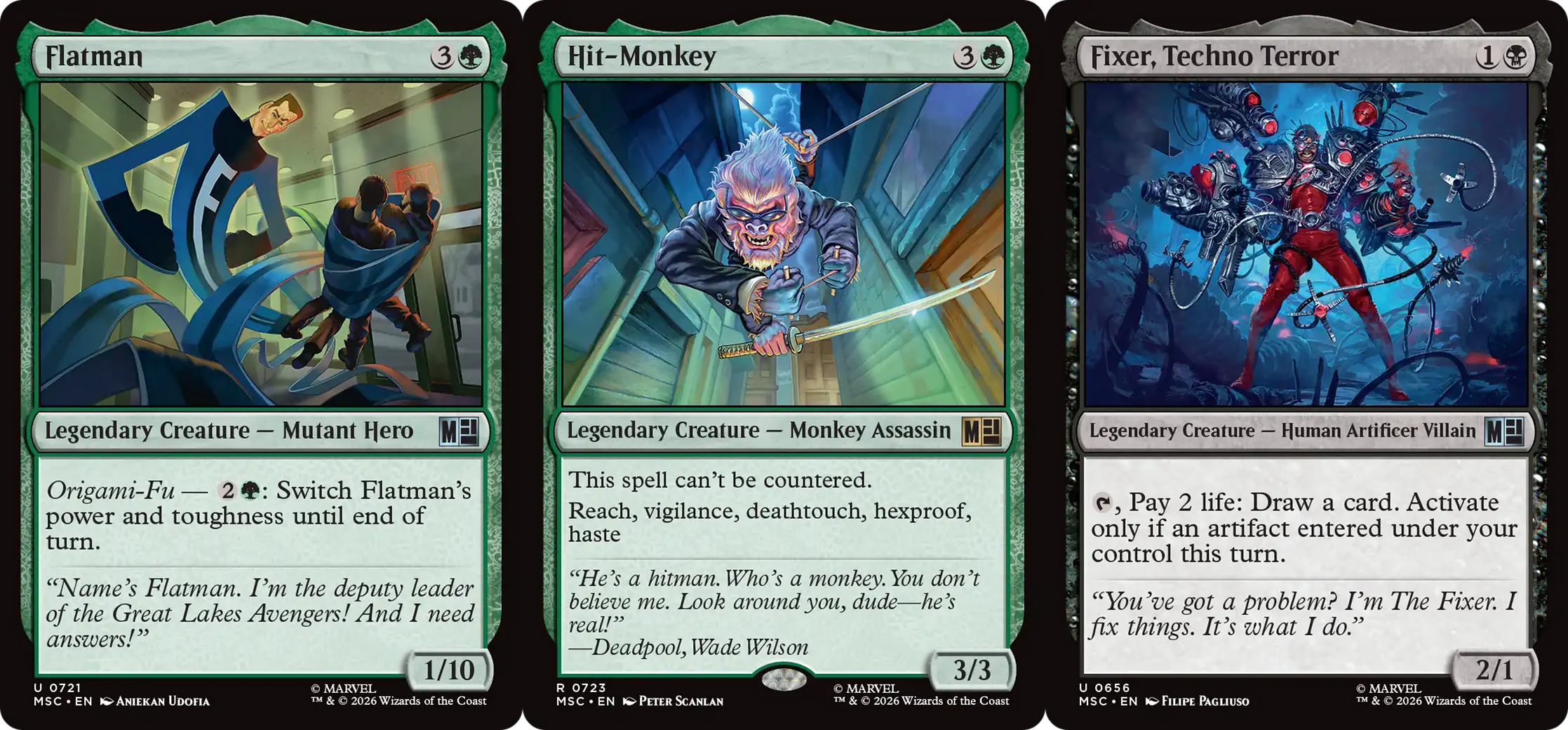
Notably, two of these texts are actually derived from comic books, neither of which are attributed on the cards. Flatman’s is from GLA #3, written by Dan Slott (though it misses that in Slott’s original, the words “deputy” and “Great Lakes” were written in subscript—a joke, since Flatman is trying to inflate his marginal status) and Hit-Monkey’s is adapted from Deadpool #20, written by Daniel Way. If this skeeves you out, good: we’ll return to it in a moment.
In the meantime, I want to note that whether or not these quotations worked in their original contexts, they certainly don’t work here. Transposed here, they serve no function other than to restate the exact information we can read from the card name and see in the image. As I suggested above, what’s the point of having flavor text if you’re just restating self-evident information?
To be clear, there’s a space for quotation in Magic cards. Yet given the vast overrepresentation of legendary creatures in Universes Beyond properties, quotations become a site of a funky aesthetic collision: Magic’s worldbuilding style relies on quoted flavor texts to tell us about characters who we wouldn’t otherwise know about, but superhero characters work precisely because they have such a strong visual economy–because we need very little to understand them very well. Magic’s flavor text here could have offered interesting views into these characters’ personalities or brought their powers to life through poetry, but instead, for whatever reason, they’re content to restate plainly obvious information.
For this reason, I find Marvel Super Heroes’ flavor text a little insidious: it rejects the possibility of showing the reader something new and instead takes the cards’ content as already ipso facto meaningful. It doesn’t really matter whether you discover anything new or not about a character or the world they belong to: as long as the flavor crosses the margin of basic legibility, it doesn’t need to immerse you, it just needs to serve up what you’ve seen before. You already know what Marvel superheroes are, and we know you aren’t going to ask any more questions.
Secret Identities
This section was originally going to be about some of the flavor text gems from MSH, and there certainly are some. Luke Cage, Power Man does cool work at building up a world outside of the card’s frame rather than merely restating the character’s name and powers, and Dark Ritual and Super Intelligence are really stellar at evoking the bombastic melodrama of 60s and 70s comic books.
This, again, was my initial aim for this section. But as I dug into more and more and more flavor text in this set, I was startled to find how much of it, including some of my favorites, were copied, without attribution, from the words of comic book writers themselves.
From what I can tell, this practice (or lack thereof) is fairly new to Magic, even in its recent metastasization into an intellectual-property clearing house. Up until 2023’s Lord of the Rings: Tales of Middle-earth, Magic’s outside-of-universe flavor text would either derive from (cited) real-world literary sources or from properties (like video games and TV series) with large and thus difficult-to-individually-credit writing teams. Lord of the Rings changed the formula by frequently drawing on a book series for its flavor text–though in that case, citing Tolkien on every card was unnecessary, since he was the only one writing the books.
Marvel Super Heroes does something different. The set’s flavor text verbatim copies, or lightly modifies, the work of multiple specific writers.
As I suggested, this issue is striking enough in the Marvel cards where the media transition doesn’t work, like Flatman. But it’s all the more unsettling in those contexts where, from an aesthetic point of view, it does work.
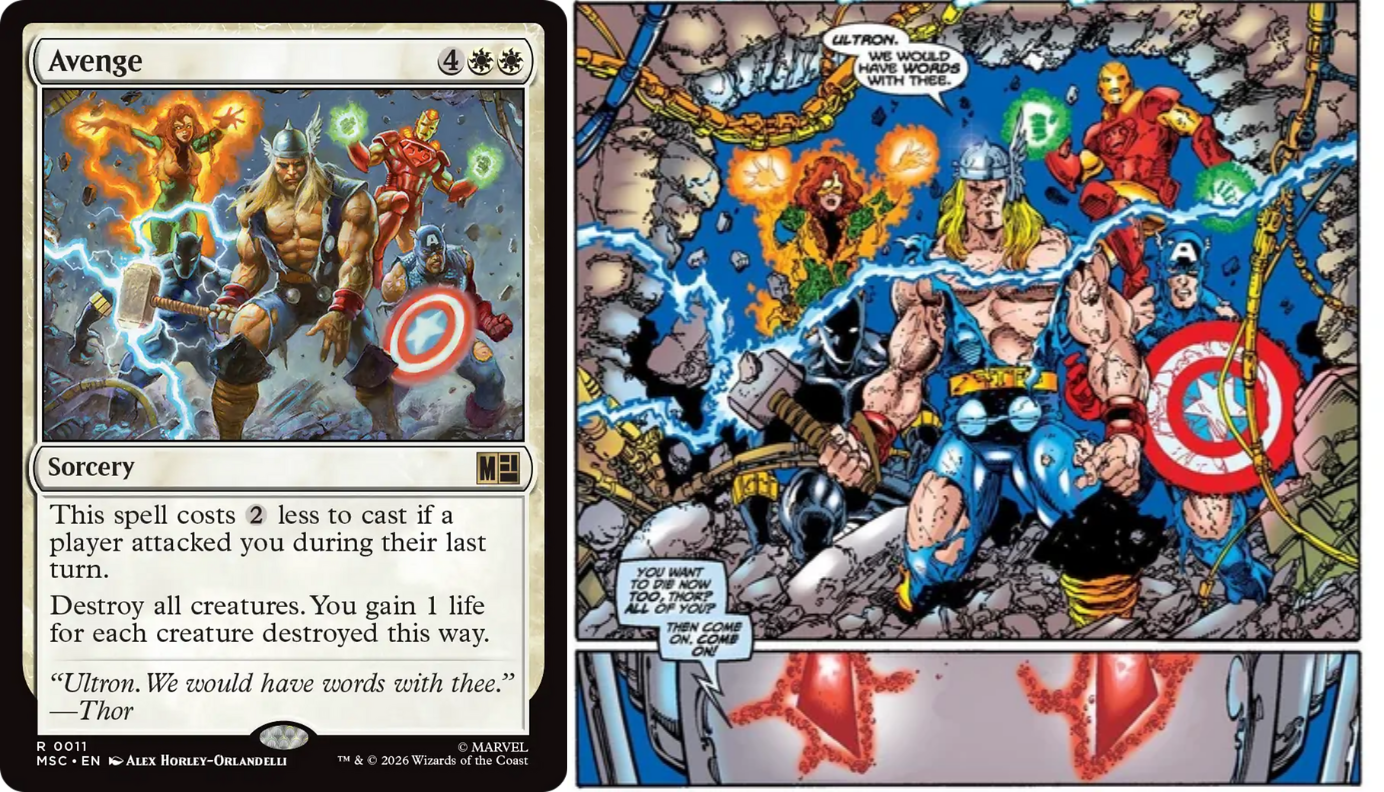
Some are iconic and easy enough to source, like Avenge, which copies Kurt Busiek’s words (and, it’s worth noting, George Pérez’s imagery) from Avengers #22 (1999). Others are harder, like the aforementioned lines from Slott’s GLA and Way’s Deadpool, though you can find them with some legwork. And some are vague enough that they’re nigh-on impossible to find, since most comic books aren’t text-searchable.
I’m sure this is all close-enough-to-perfectly legal–as the pernicious little “©MARVEL” at the bottom-right of each card announces, these images and words are proprietary to the corporation, not to the artists and writers who incarnated them in words and images. This is a media company’s aim, after all: to make you see their creative “property” not as a human-made product but as a mysterious phenomenon that falls out of the sky fully formed, impossible to question and invested with automatic authority over your wallet.
It’s more than a little unsettling, then, to rove across some of MSH’s very “best” flavor text.
Take, for example, the text for Iron Fist, Living Weapon.
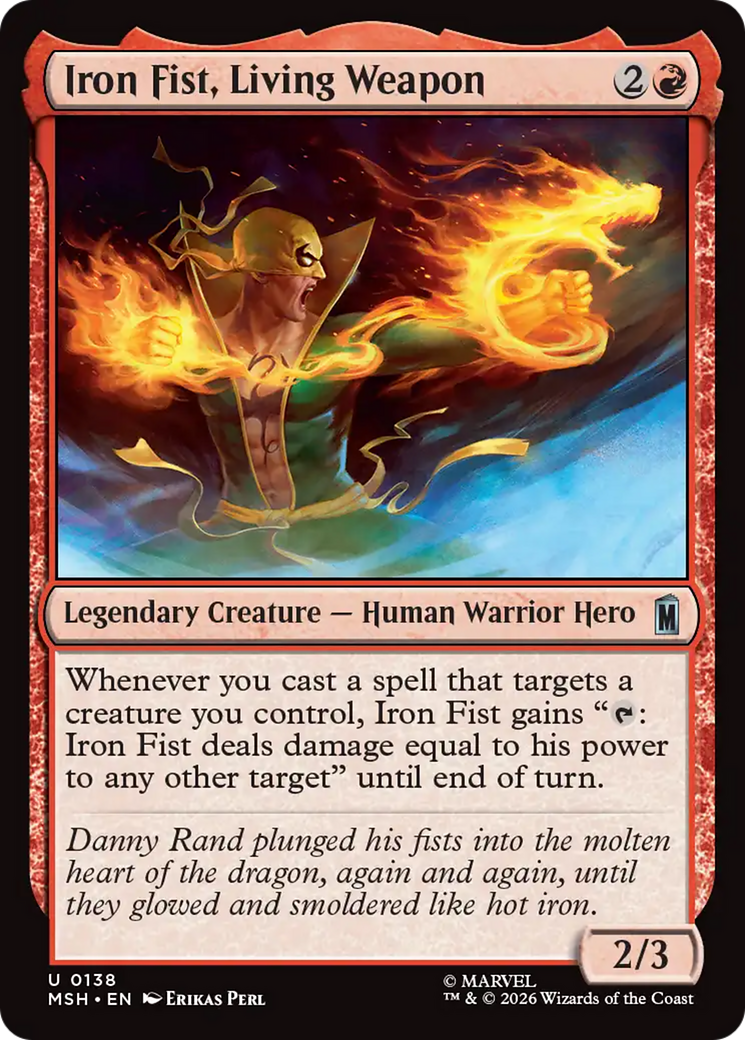
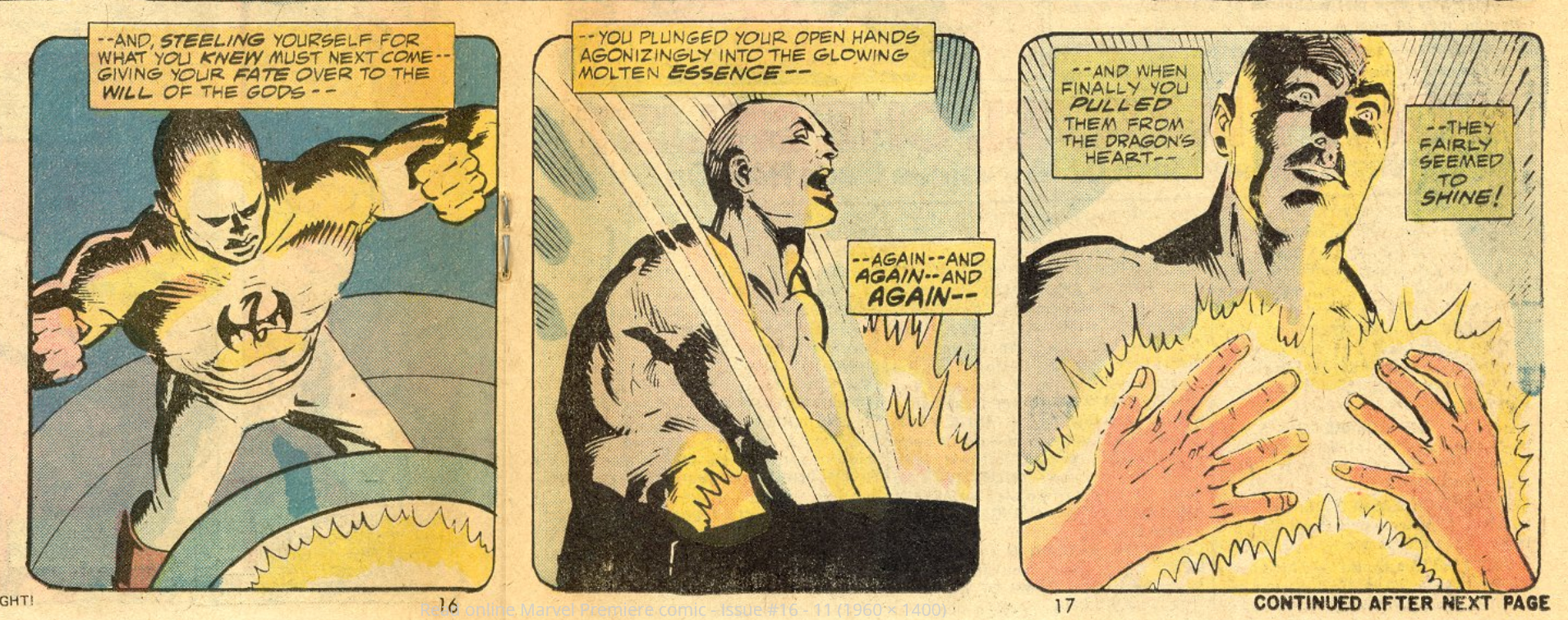
On its face, I love this. With its novelistic imagery and its kinetic rhythm, this text evokes the metaphysical transformation that underpins a superhero origin: reading it is like hearing the pulses of the superheroic cosmos come into order.
But after I wrote the line praising this line, I found in my research—that it interpolates bits from Len Wein’s Marvel Premiere #16, and that the phrase “Plunged his fists into the molten heart of the dragon” is quite similar to a line about Iron Fist that has circulated online for at least 25 years (it likely came from a particular comic before that, though I can’t trace it specifically). It’s a little startling: I like the flavor text in itself because it brings life to the character–but glimpse behind the curtain and that life flees into the wings.
The issue is even more egregious in another of my initial favorites, the Commander Party promo of Echo, Perceptive Prodigy:
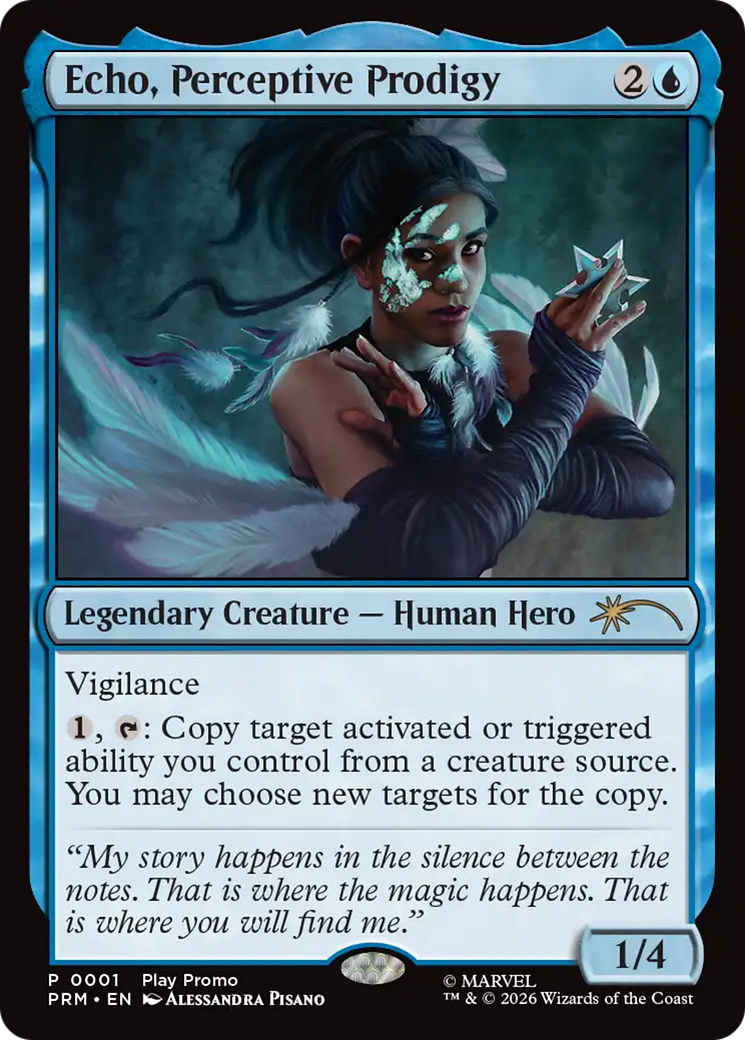
The opaque mixed metaphor (story/music/magic/location), the offbeat nested repetitions (happens/happens, That is where/That is where), the rhythmic flow (SIlence beTWEEN the NOTES, almost perfectly iambic)—this is poetry. There’s the sense of an actual living, feeling character in there, to say nothing of the actual world to which she belongs. Although I was a huge comic book fan in my younger years and knew a little about Echo, I’d never read anything centered on here—and now, suddenly, I understand.
And there’s a reason it’s so good: this text was written by Echo’s creator, David Mack, whose love for the character is clear from the words that MSH adapted adapted/appropriated for MSH without credit.
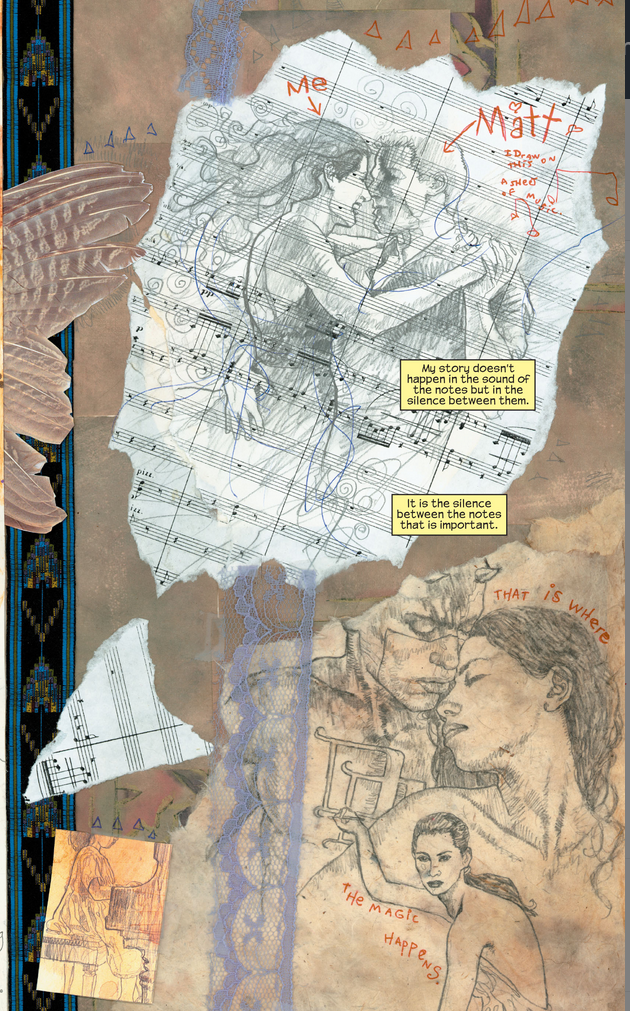
It’s difficult for me to look at the card the same way, knowing that Mack’s words are being presented here as though they were pulled from the aether, as though there isn’t a real human context from which this derives. The card is attempting to convince me that human labor and production don’t matter, that this card is tapping into something so transcendentally mythical that it just appeared in front of me and I should buy it because I should. But there was a real person who wrote these words, and he wrote them in a much, much different context than this. Compared to the page where it came from—and in light of the mercenary practice that transposed Mack’s words onto this card–Echo, Perceptive Prodigy looks like a cheap photograph of a photograph of a photograph.
Is this the best that Magic can do? Even supposing that this sort of intellectual-property sliminess could have been avoided—and, for what it’s worth, I suspect that intellectual-property sliminess is an inevitable outgrowth of Universes Beyond collaborations—even supposing that everyone had gotten the credit they deserved, is this the kind of aesthetic philosophy that should guide Magic?
Getting mad makes me get romantic, but I think a Magic card can be something else besides a generic receptacle for the broken-up leavings of other media forms. A Magic card, when rightly approached, demands you spend time asking how a different franchise might—and might not— translate to the particular affordances of the text box, the 3.5-by-2.5 illustration, and the flavor text line. Ultimately, we should expect more from a Magic card than just the serving-up of what we already expect (with the added spice of even less corporate ethics than usual). We should want to find a gateway into another world, another version of reality. Otherwise, why play at all?
Ryan Carroll (he/him) is a writer and Ph.D. candidate in English and Comparative Literature. On Substack as Dominarian Plowshare, he writes about Magic’s art, story, and experience. Outside of Magic, he writes on topics including 19th-century literature, information theory, television politics, and cliche.