


Strixhaven: School of Mages and its as-we-speak previewing sequel, Secrets of Strixhaven, have a bold aim: to make schoolwork look exciting.
As someone who spends most of his time on what might loosely be called schoolwork, I can affirm this is no easy task. There’s a lot of sitting, double-chinning over laptop screens, scribbling manically in journals, flipping through books—all potentially maybe-sorta-kinda interesting to look at, but a world away from the bombastic fantasy realism of Magic: The Gathering.
What makes Strixhaven’s worldbuilding enchanting, then, is the way that Wizards of the Coast’s worldbuilding and art teams meet the challenge of making academics feel as energizing as throwing lightning bolts and stepping through reality. It’s an experiment in making schoolwork and high fantasy come together.
Wizards’ response to this problem defines both Strixhaven’s stylistic wins and its most unresolved issues.

So You Want to Found a School for Mages
In a way, it’s a little surprising to hear that Strixhaven is a deeply experimental Magic world. After all, the Multi-College Wizarding School™ is a very legible setting, thanks in large part to a certain mega-franchise whose name for some reason escapes me, which ingrained the nested-sub-college structure of traditional English private schools into the pop cultural imagination.
But Magic operates according to different visual rules than that mega-franchise, whose name would surely be great to remember but gosh I just can’t manage it. That mega-franchise’s bread and butter are books, which don’t have particular visual demands, and movies, which allow you to represent moving images and which can skip through the actual substance of school—schoolwork. They can exude the vibe of school without dwelling in the unsexy imagery of actual book-learning.
Magic, on the other hand, relies predominately on huge collages of frozen images for its visual storytelling. It can’t skip through the schoolwork entirely (otherwise it wouldn’t really be engaging with the setting of the school), so it has to make academics look interesting.
The first solution to this aesthetic problem are the colleges.

Studious First-Year by Mariah Tekulve
The aforementioned unmemorable mega-franchise innovated an extremely important practice in the creation of the Fantasy Setting for Adolescents: dividing its sub-colleges on the basis of personality. You will find your cohort on the basis of one of the following traits: intelligence, sweetness, being the good guy, or being the bad guy. Young Adult fiction the world over drew extensive inspiration from that simple choice.
Strixhaven, though, takes a different approach. Although, like its predecessors, it clumps its students into neat sub-cohorts, these sub-cohorts are organized not around personality (at least not entirely) but around academic disciplines. The writing students are Silverquill, the history students are Lorehold, the math students are Quandrix, the biology students are Witherbloom, and the art students are Prismari.
Besides evoking a more American-style university structure than an English one, this method allows Strixhaven to distinguish itself from its pop culture antecedents by placing aesthetic focus on schoolwork itself (rather than, you know, making moral judgments about children’s personalities).
But here’s the wrinkle: most of the Strixhaven colleges still aren’t sure how to represent schoolwork.
Take the Silverquill. As Blake Rasmussen wrote in an early article for the original Strixhaven: “Silverquills wield the magic of words, from inspiring battle poetry to biting arcane insults. Stylish, intimidating, and tirelessly competitive, these mages are born leaders with a razor-sharp wit and natural charisma that can be used for good or for ill. Their motto is ‘Sharp style. Sharper wit.’”
The first sentence of this blurb sets up the same information I mentioned above—Silverquill are the writing students of Strixhaven. But almost as soon as academic focus is established, it’s made complicated. As the subsequent sentences reveal, the essence of Silverquill is, evidently, not just a field of study but a personality type: namely the stylish and competitive cool kid.
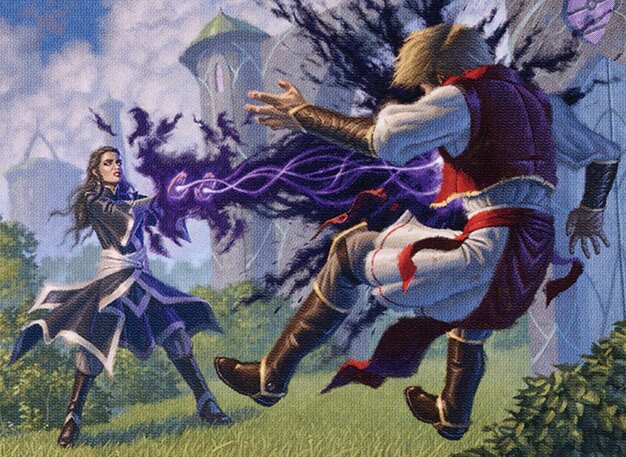
Closing Statement by Craig J Spearing
In turn, in the original Strixhaven at any rate, personality defines Silverquill visuals far more than academics. Cards like Arrogant Poet, Author of Shadows, and Closing Statement might refer to the academic discipline of writing, but notably, they don’t actually represent people penning poetry, writing books, or making speeches. They emphasize, instead, the Silverquill personality: slick, authoritative, aggressive.
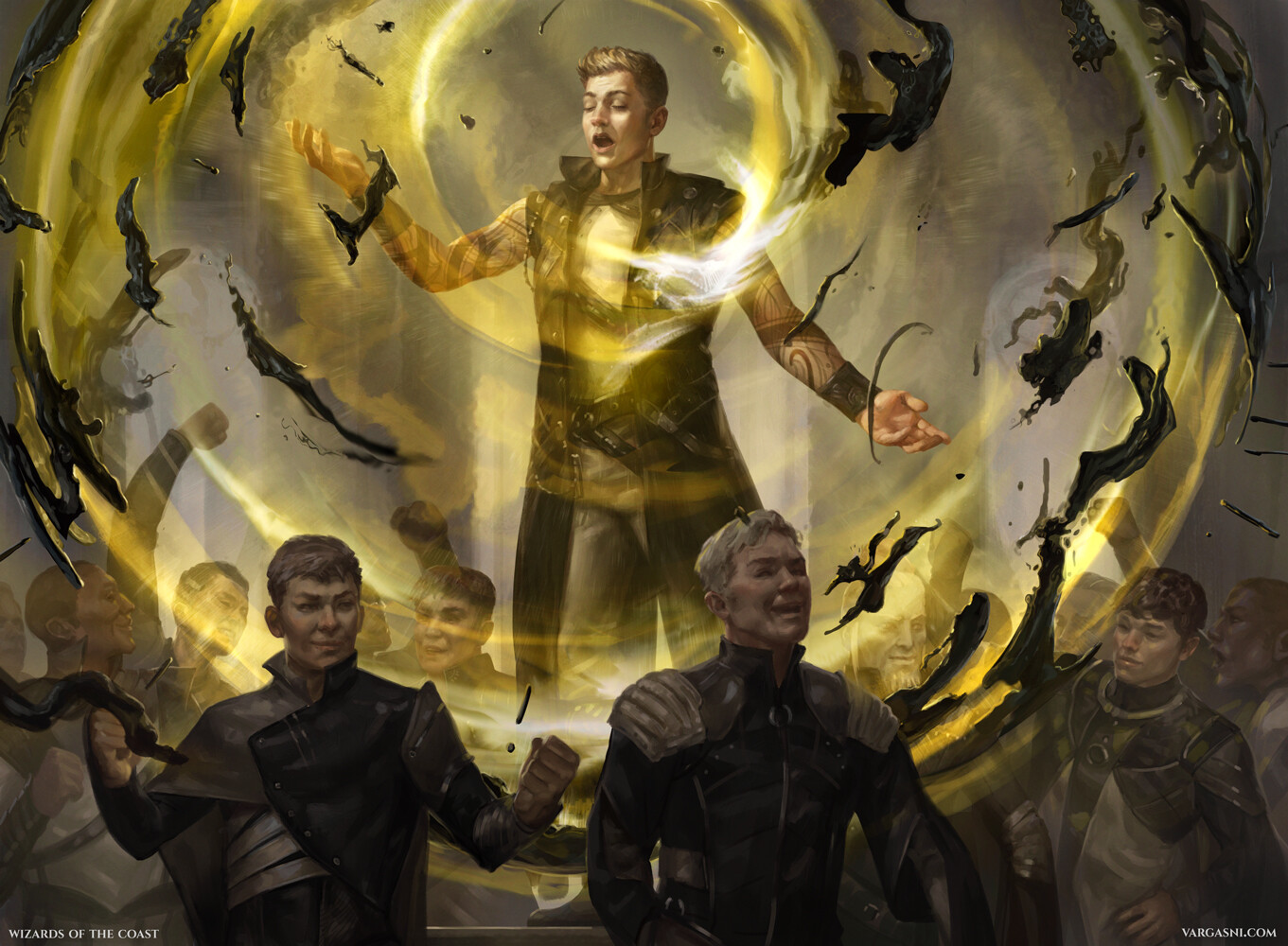
Exhilarating Elocution by Randy Vargas
One of the few cards that does represent writing is Exhilarating Elocution—whose illustration is visually compelling but is also the exception that proves the rule: it’s hard to make public speaking look compelling in itself (though I should say, in fairness, that there are a lot more works in Secrets of Strixhaven that depict Silverquills writing and reading—there just weren’t enough cards previewed at the time of writing for that to be the article’s focus!).
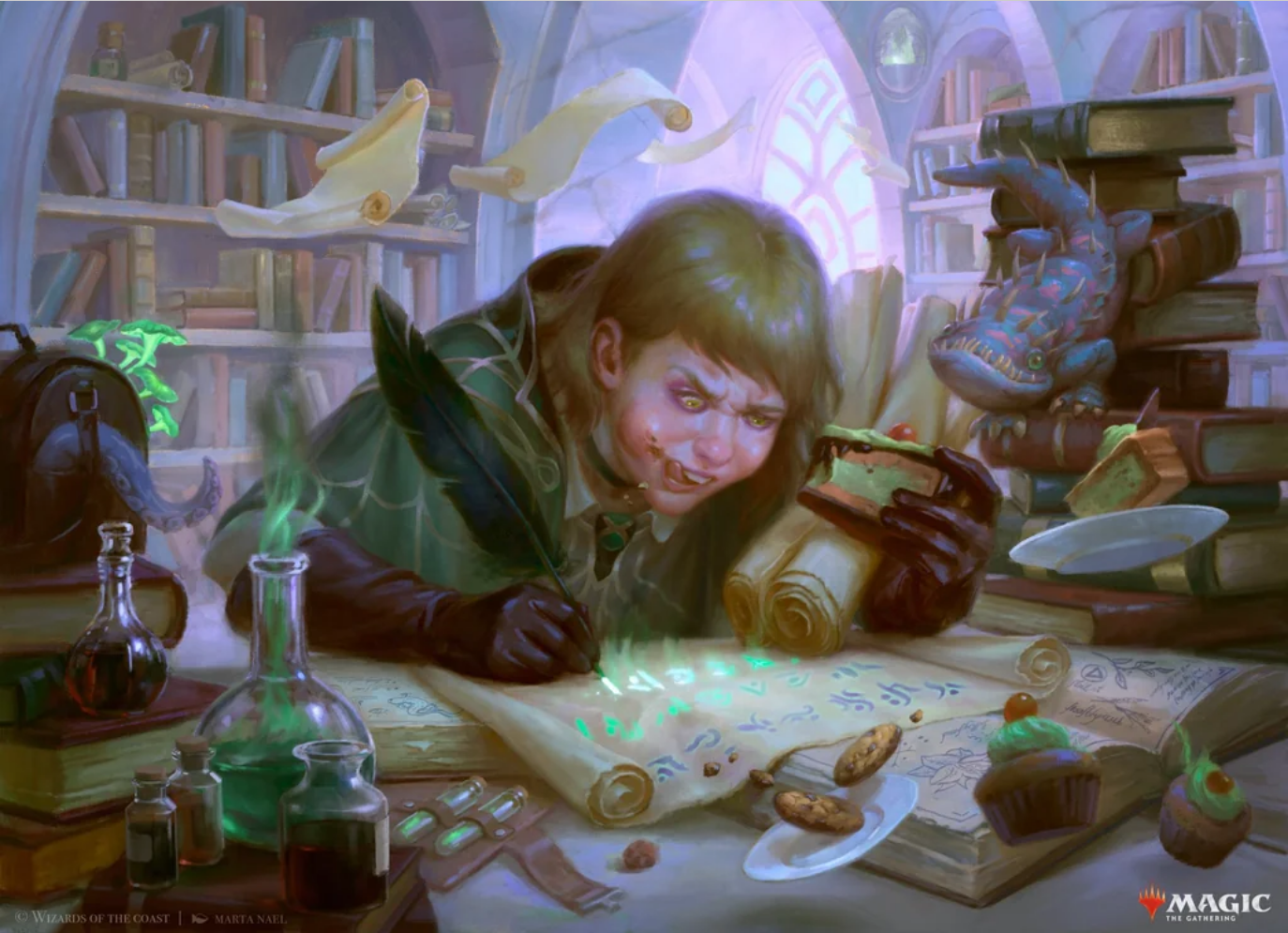
Cram Session by Marta Nael’s
In this, we can locate the artistic tension underpinning Strixhaven writ large: it’s not all that easy to make school look interesting while still making it school. You can only have so many cards that depict people studying or lecturing or taking tests, like Cram Session and Professor of Symbology and Borrowed Knowledge. So what’s an art team to do?
One response might be to emphasize personality over academic study, like Silverquill art does. But doing so, it seems to me, defeats the purpose of dividing the colleges based on academic discipline. If it’s all about personality, how is Strixhaven any different from that one wizarding school franchise whose name I’m still blanking on?
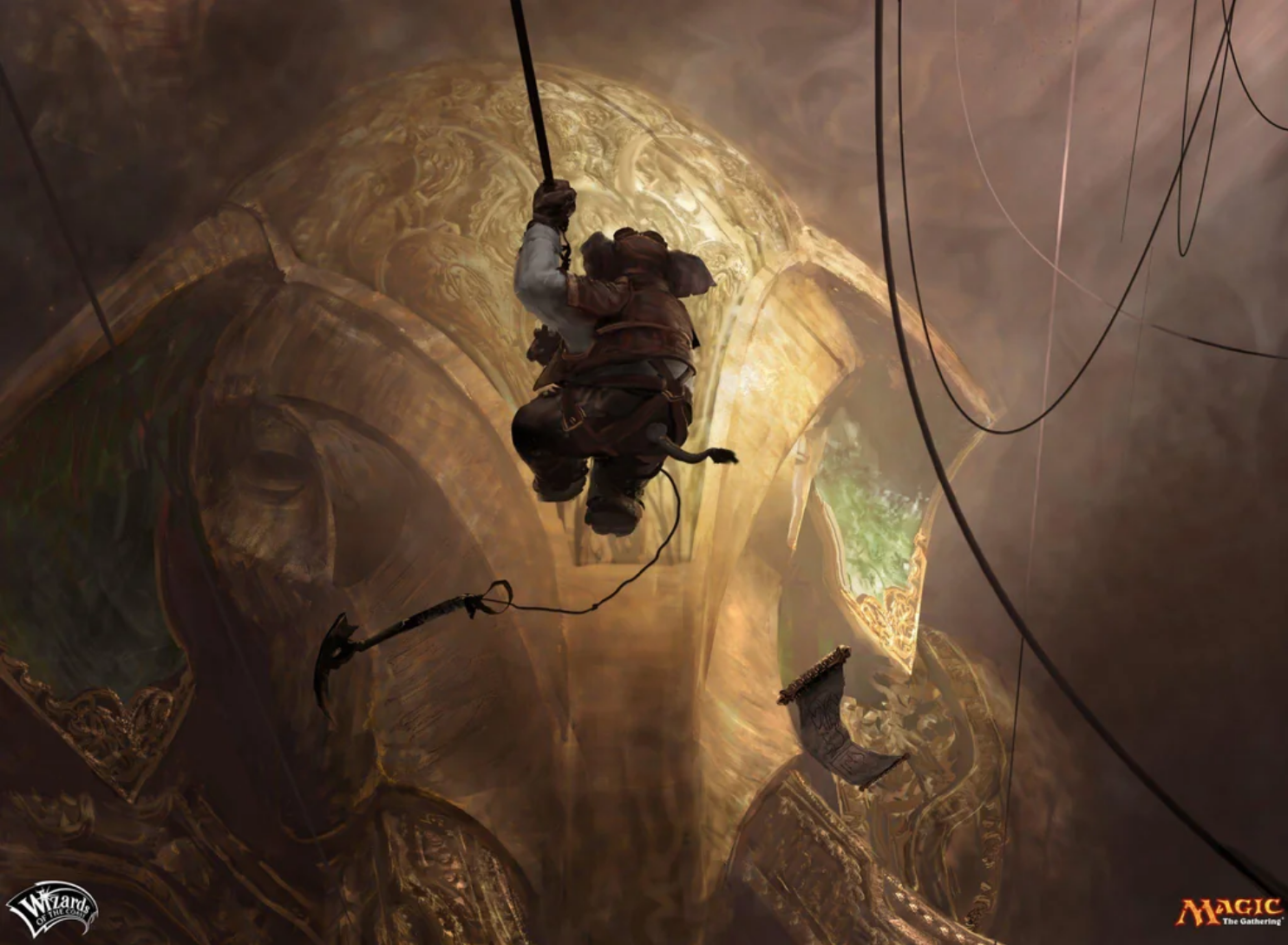
Thrilling Discovery by Campbell White
Another approach might be to represent applied schoolwork, rather than classwork. This is what we see in the colleges of Lorehold and Witherbloom, whose art respectively emphasizes archaeological expeditions and wildlife research/chemistry. This can often be effective, as in Primary Research, Thrilling Discovery in Lorehold, and Revival Experiment and Hunt for Specimens in Witherbloom.
But in other cases, this method can splutter, because it emphasizes the objects of study more than study itself. The art of Lorehold and Witherbloom abounds with living statues and oozing pests, sometimes eclipsing colleges’ distinctive characters (I must confess, as I was researching for this article I learned there are quite a few Lorehold and Witherbloom cards that I had never processed as being from Strixhaven at all).
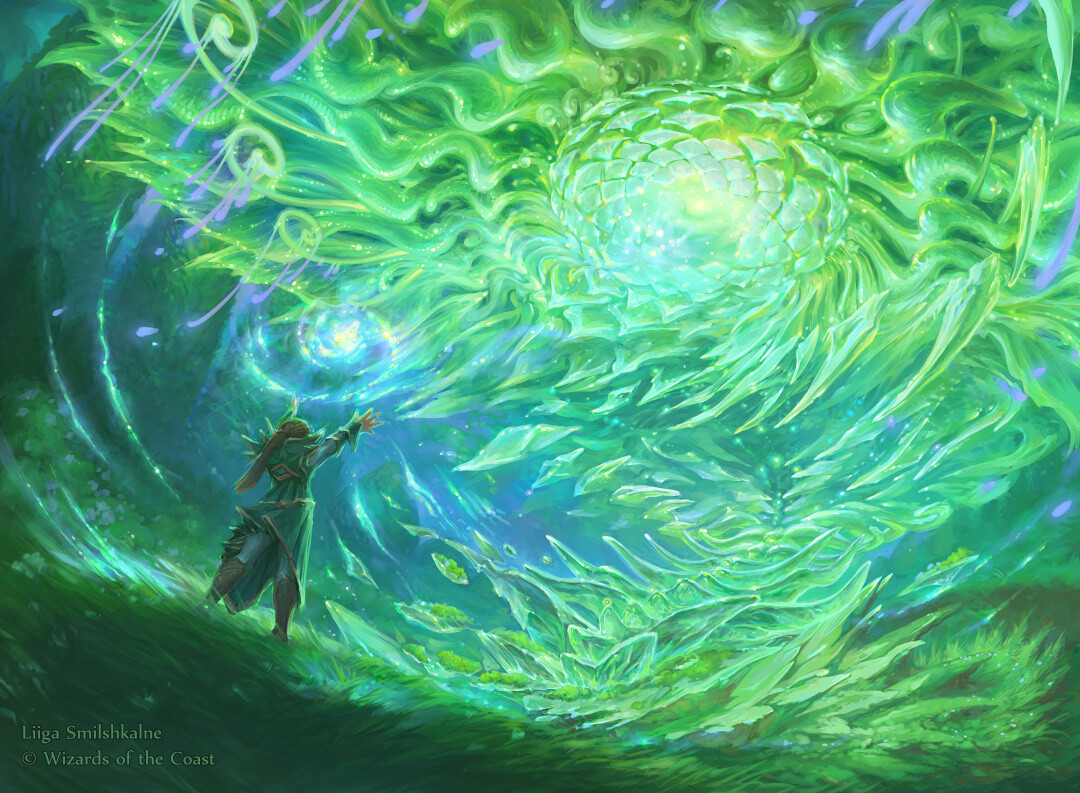
Leyline Invocation by Liiga Smilshkalne
Yet another might be to make magic basically symbolic of academic work, which is extremely common in the art of Quandrix. Students of that school (so speaketh Rasmussen, again) “study patterns, fractals, and symmetries to command power over the fundamental forces of nature.” Quandrix art predominates with mages creating hard-light geometry and living fractals out of the natural world, as in Imbraham, Dean of Theory Mind Into Matter and Leyline Invocation.
Although these images don’t show anyone doing math work per se, they channel the abstract feeling of dealing with the mathematical enormity of the universe–the power that seems to course through ideas itself. That’s great!
Still, as cool as this principle is, Quandrix art also frequently downplays the school component of a magic school. It’s cool math magic, but it’s not necessarily essential to math as a field of study; some images may well be from the Escheresque plane of Xerex.
And this brings me to the secret thesis of this article: the best art in Strixhaven is from the Prismari college. And not coincidentally, it’s because Prismari art is able to draw out a distinctive magic style while still retaining the school’s essential academic focus.
Expressive Elements
If, as we’ve seen, the Strixhaven colleges are experiments in making schoolwork magical, the challenge is in balancing magic with visuality. Here’s what’s great about the Prismari: you don’t need to pick one or the other. The performance is the academic discipline and the magical ability.
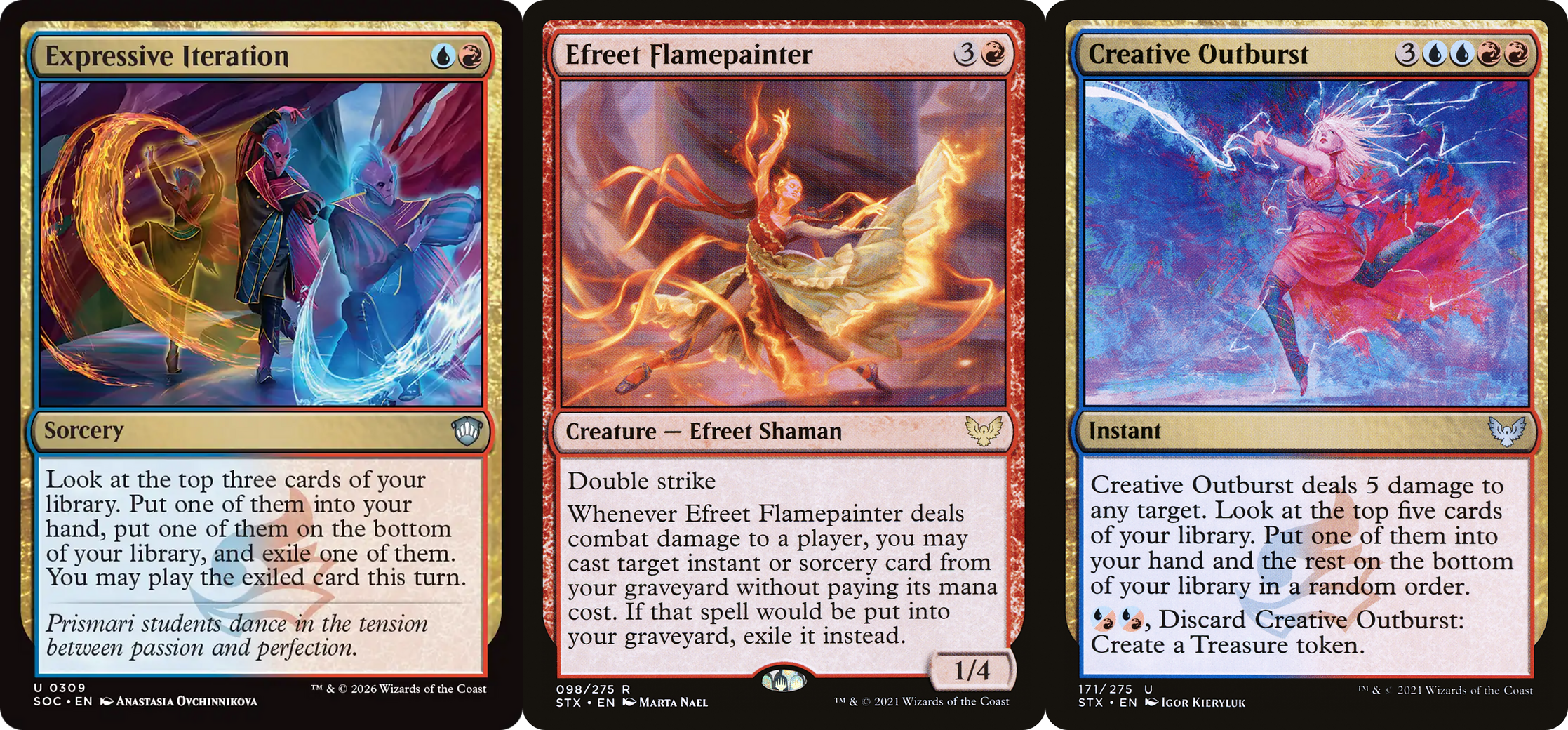
Creative Outburst, Efreet Flamepainter, and Expressive Iteration
This is evident in some of the best-looking Prismari images. The original Strixhaven depicted the Prismari as dancers whose movements commanded the elements, as in Lie Setiawan’s Waterfall Aerialist, Marta Nael’s Efreet Flamepainter and Elemental Masterpiece, Anastasia Ovchinnikova’s Expressive Iteration, and my favorite original Prismari painting, Igor Kieryluk’s Creative Outburst.
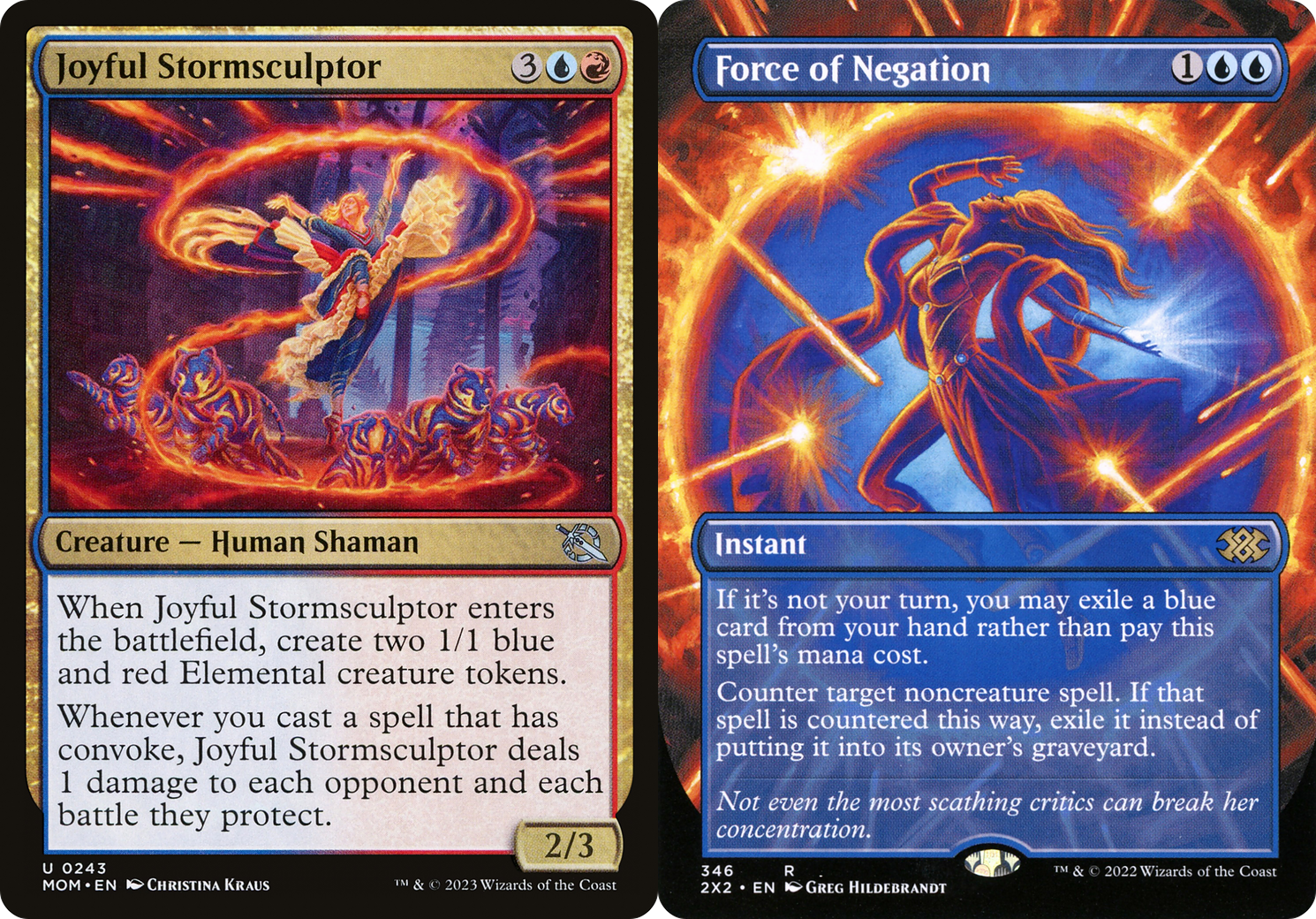
Joyful Stormsculptor by Christina Kraus and Force of Negation by Greg Hildebrandt
In the next several years, this illustrious group would be joined by such dazzlers as Greg Hildebrandt’s Force of Negaton, and Christina Kraus’ Joyful Stormsculptor.
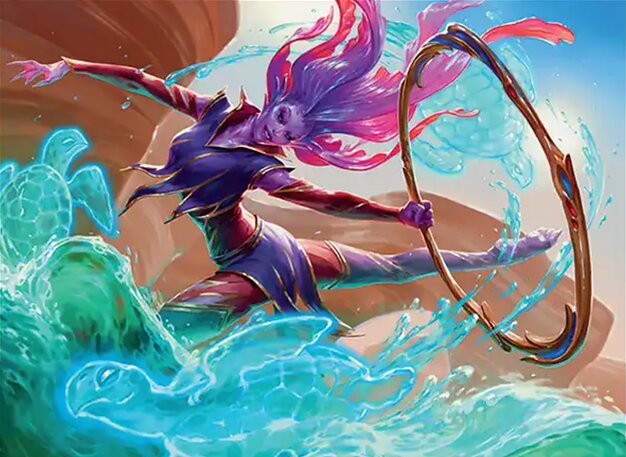
Orysa, Tide Choreographer by Anna Pavleeva
In Secrets of Strixhaven, some standouts include Justine Cruz’s Deluge Virtuoso, Nael’s Improvisation Capstone, Anna Pavleeva’s Orysa, Tide Choreographer, and more.
Take some time to drink in these images. They have a lot going for them. For one thing, Red-Blue probably has the best color palette among the enemy-color pairs, with its mixture of warm and cool primary colors. But more than that, these images do so well at capturing the Prismari because they evoke a mood (exuberant bombast), illustrate exciting magic (you can’t go wrong with surges of elemental power), and (here’s the important thing), anchor the mood and the magic a visually engaging academic discipline.
The art of Prismari makes for great worldbuilding, in other words, not just because fire magic is cool but because its coolness is evoked in the college’s academic focus. Their studies lend themselves well to dynamic images, and so there’s a synthesis of the fantastical with the academic.
I’ve been equally impressed with the way that Secrets of Strixhaven has expanded Prismari’s visual ambit beyond dance and into painting and music.

Leitmotif Composer by Himawan
In Leitmotif Composer, for example, Nathaniel Himawan smartly uses the lines of the central figure’s violin as (fittingly for the card) a visual motif. The straight, sharp lines of the bow and neck contrast nicely with the arcane curvature of the bout (betcha didn’t think I knew that much violin terminology, huh?). This contrast echoes satisfyingly with the mixture of sharp and muddled lines in the composer’s water-construct copies.
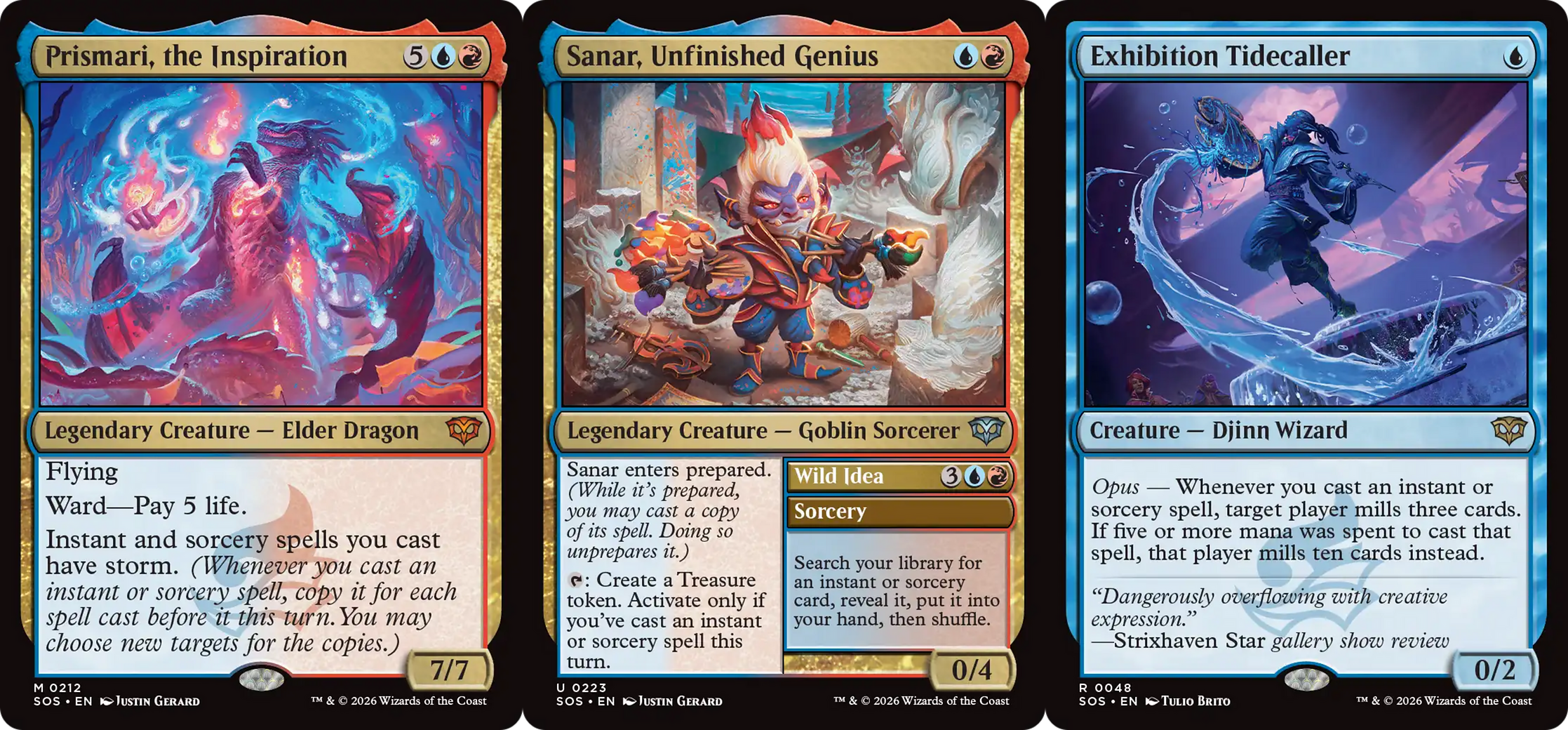
Prismari, the Inspiration; Sanar, Unfinished Genius; Exhibition Tidecaller
Tulio Brito’s Exhibition Tidecaller Justin Gerard’s Sanar, Unfinished Genius, and Gerard’s Prismari, the Inspiration do similarly stellar work with painting.
Brito and Gerard both make smart use of the palette—not just their own color palettes, but palettes as physical objects—as focal points. Gerard’s popping colors allow him to represent seemingly motionless scenes (Sanar and Prismari painting things) as coursing with raw magical energy; in turn, Sanar’s and Prismari’s own palettes seem to be both objects of magical power and tools for their academic pursuits. In the same way, in Brito we see the moment of artistic education interfuse with magic itself: the painter remains a painter while also being infused with magic.
In short, these images (along with so many others that have been debuted so far) do exceptional worldbuilding work because they make school magical while still being school.
Close Your Test Booklets
Aligning the high-concept pitch for a group with its aesthetic identity is what defines some of Magic’s greatest factions—from the guilds of Ravnica to the clans of Tarkir to, more recently, the duelling religions of the Edge.
As Strixhaven bears out, though, even the ideas that seem the most legible, that have the clearest pop-culture antecedents, still take time to work out. At the time of writing, previews haven’t concluded for Secrets of Strixhaven, but I remain fascinated by the way that the set’s art team has attempted to pay off Strixhaven’s basic premise.
I can only imagine the world will get better looking as time goes on. Until then, I’ll be doing the visually unappealing work of peering at books and typing on my computer.
Ryan Carroll (he/him) is a writer and Ph.D. candidate in English and Comparative Literature. On Substack as Dominarian Plowshare, he writes about Magic’s art, story, and experience. Outside of Magic, he writes on topics including 19th-century literature, information theory, television politics, and cliche.