


Reintroducing the Hipsters of the Coast Logo Tee!
Slowly, yet surely, I’m trying to perfect the process of making a nice-but-accessible t-shirt. Other stuff too, but making a nice playmat is many ways solved and figuring out more bespoke merch is an off-shore sourcing nightmare so for now I’m sticking with ole’ reliable. I’ll almost certainly never be making my ideal tee – but like in many related pursuits (writing, brewing Magic decks, cooking), I can try. So – I figured I’d walk you through my process of trying again and again to get tees made that I want to wear… with the perfect example, the recently released Hipsters of the Coast Logo Tee! That’s right, you can buy a cool shirt that supports this even cooler website. How about that?
THE WHY
Why have I started transitioning to causing clothes to be manufactured and selling them? I mean, really it is simple – number one, I’m continually frustrated with a lot of the quality of merch items available both to fans and people who want to have merch. It’s a complicated beast to make and source stuff yourself just from a monetary angle, much less the creative one. Number two, I enjoy making real stuff. I print out my articles. I almost exclusively brew decks by grabbing cards out of my boxes. Helping make stuff into something that I can touch and feel is a big motivator. So into making shirts (and other stuff but mainly shirts) I have gone. I lied – there’s a third reason. Towards the beginning of college, I fell into a group of people that were all starting some Instagram Streetwear Brands and was incredibly inspired by following their journeys as a friend. Some have gone on to be pretty successful! Starting out now to make this kind of stuff myself is a continuation of that shared dream, to me.
THE ART
For me, the art assets are the worst part. Why? I’m a writer, I’m not a drawer or painter or designer or anything of the sort. But, this is great – it gives me a chance to work with others, either by collaboration or via helping someone else make something they made into a real object, or by commissioning someone. For something like the Hipsters of the Coast logo tee, it’s a pretty simple solution. There’s an existing logo and we want to put it on a shirt.
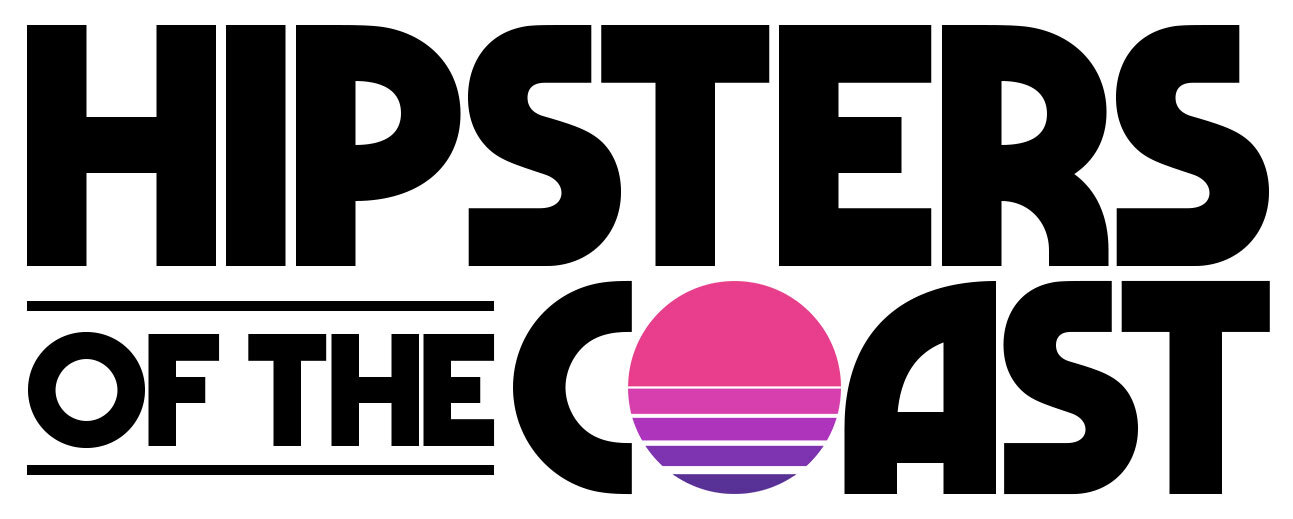
Now! This specific logo could have potentially caused a small problem later down the road, but we’ll cross that bridge when we get there. This is the easiest form of making a shirt or something else real – it already exists and you need to shepherd it to the finish line. Doing something more based on coming up with a wholly original concept and then shuffling it slowly to an agonized end (because nothing can be perfect) aligns more with my average experience of getting a shirt made. It’s like writing an article or painting a painting. Eventually you have to know when to call it quits. It’ll get easier with time (cope).
THE TEE
Short of making your very own custom blank for all your stuff to be made with (the dream), the next best thing is finding your very favorite readily available, semi-mass product blank and sticking with it. There are plenty of producers out there these days, most of them secretly owned by Gildan, but there’s huge ranges of quality, colors, cuts, and consistency available along every possible price point. Additionally, there’s also the opportunity to signal something to your buyers through the blank you choose, if they happen to be familiar with it.
The blank’s price point has continually been a sticking point in my adventure so far. I want to be making something nice but also accessible. If I wanted to drop one of the two, I would use $2 blanks with Direct-Film-Transfer graphics printed by someone far away from me. Or, I would use $35-a-pop blanks that I or someone else hand-screen printed one by one, demolishing any with minute imperfections.
I’ve tried my best to settle in the middle, using two of my personal favorite blanks that don’t break the bank, the Gildan Hammer and the Comfort Colors 1717 (also secretly a Gildan-owned product). They both have their pros and cons. I love the boxier fit and also the colors brought by garment dying. This is the process of dying the entire finished shirt instead of the cloth it’s made out of, before making it into a shirt. These features on the Comfort Colors are nice, but sometimes their necks immediately blow out. What the heck is up with that? Comfort Colors also has the advantage of being a relatively long tenure “quality” brand that people associate with a band tee they love. Even post-Gildan acquisition, Comfort Colors tees have continued to be nice – less nice than they once were – but still are 100% ring-spun cotton and the sizing is consistent.
The Gildan Hammer is a bit more fitted, a bit heavier and also more true-to-color (due to NOT being garment dyed) while also being about 20% cheaper and ALSO doesn’t have necks that blow out. It does have other problems – perceived less quality, less consistent sizing, a fit that people often tend to like less even if I like it, that kind of stuff.
I’m rambling about two blanks – imagine having to pick between the many multitudes that are out there, even in the $5-12 a shirt price point (which I try to maintain so I can keep my resulting t-shirts below $40 & still have me and whoever I’m working with still make a buck. Don’t forget screenprinting adds cost too!).
For the Hipsters Logo Tee we ended up choosing the black Comfort Colors – simple, easy, classic. Donny knew he liked the way it fit from ordering another Comfort Colors shirt that I had made. Isn’t that nice? No issues. No problems.
THE SCREENPRINTING
Screenprinting is a pretty cool process. A series of mesh screens have their holes blocked in a specific pattern, effectively creating a range of stencils that, when having different colors (one at a time) pushed through them, often by hand with a squeegee, creates a composite image. Once all colors are applied, the ink itself is cured and dried, creating a permanent printed image on the shirt.
It does, however, come with a lot of restrictions many art/asset creators aren’t used to being constrained by. For example, every color you add to the art will increase the cost of the screenprinting – because it will require another screenprinting step, usually with another custom shot screen. Additionally, most screenprinters have a cap they can work with, depending on their machines or personal capability – with my preferred printer, that color number is nine. There are also specific elements, such as gradients, that are way harder to do without in-house knowledge about how to blend colors across screens. Luckily for the Hipsters of the Coast logo, which gestures a hot-pink to deep-purple fade, my preferred printers (Tonic Studios right here in Columbus, Ohio) were prepared to handle this no problem, resulting in it “only” being a four color print. Oh ho ho, you say, there are only three colors! Black, pink and purple! This is true, but one must also include a secret additional color, white, which is printed beneath the entire design and then covered to help a design pop on a dark t-shirt. So there. Once the art, the tee and the screenprinting are all arranged, we get to pick them up and see the sick results.
THE FINISHED PRODUCT

Tada! It’s a comfy shirt I’m proud of and has a sick screenprinted version of the Hipsters of the Coast logo on it! It’s funny to tell the high-level process of the decisions caught up in the most basic version of getting a shirt made – because this is about as easy as it gets. Supplier already decided, blank pre-approved, existing art, screenprinter relationship acquired, shipping logistics (another article in itself) solved by other sales.
Making Stuff Rules
I’m fully convinced that for the rest of my adult life, I’ll be chasing the dragon of making stuff. I used to think that Writing® was the outlet for me, and to many extent it still is – otherwise I wouldn’t be doing it. And yet, there is always more Making to be done. I’ve found Making Energy all around me but the things that have somehow always scratched the itch are things like writing, obviously, making podcasts (largely concluded at this point) and, weirdly enough, getting physical objects made for me to sell. Magic As a Hobby continually helps occupy this space in my brain as I seek to delve into the possibility of using it as a vessel to direct all of the above pursuits.
Alright, that’s enough capitalizing non-proper nouns and verbs. Back to the physical objects part. Do I wish I could make these things myself? Yes, obviously! I am definitely not an artist in any traditional sense and from time to time have tried to improve to little effect. It’s something I would love to figure out but haven’t quite yet, and nor does adult life with its many twists and turns allow me to, especially when trying to improve at the multiple creative pursuits I already take up. Maybe dabbling in screenprinting myself and continually trying to search up the perfect t-shirt blank. Or maybe just finally perfecting the perfect Ball Lightning-based Commander deck. I’ll keep at it though because man, does making shit rule.
I’ll admit a little secret, if you can keep it between the two of us. This article is, secretly, a trojan horse advertisement for the Hipsters of the Coast logo tee. But it is also a little bit more than that, a quick reflection on how making stuff can and should propel us every day. Even if the making is made up of mashing together the work of many others and regurgitating it for your own prof- hey, wait a second…
Callahan Jones (he/him) is not a content creator. He’s a Gamecube collector, DanDan fanatic and occasionally, very occasionally, has a thought to share about Magic: The Gathering. Follow his pursuits on Bluesky or on his personal Substack.