


Lorwyn was released on October 12th, 2007, during a challenging time for Magic. Dreamblade, Wizards’ attempt to enter the miniatures market, had failed due in part to Iraq War-catalyzed fluctuations in the price of crude oil and an expensive price point (boosters retailed for $14.99 in 2007 dollars, meaning a Dreamblade draft at your local game store cost the modern equivalent of $74.65). The creative and financial success of Ravnica Block had transitioned to the self-reflective Time Spiral Block and Magic’s cultural identity was a bit unclear. The nerd culture boom of the 2010s hadn’t yet started, and online culture was still a subculture instead of our atmosphere. “Content creator” and “influencer” weren’t yet professions, but Facebook was booming and new modes of interaction were incubating. The economic canaries that would signal the Great Recession had not yet started to drop dead, but they were anxiously singing. The monoculture was dying and lashing out on its deathbed as the fragmentary digital cultures squabbled over its possessions.
2007 was also a challenging time for me. I had just turned twenty-one and the last year had been tough—a play I was miscast in shut down during rehearsals due to my inexperience, a week spent in the hospital in London with e. Coli had left me with some lingering health issues, and failing interpersonal relationships were sapping my mental health. There was something wrong with me that I didn’t have the vocabulary to express. I had started sensing things that weren’t there, waking up with my heart pounding and a certainty that I was about to die. I was skipping classes, unable to deal with being enclosed in a room with other people and their voices and odors. Ironically, when I was able to leave my dorm room, one of the things that made me feel sane and stable was drafting Lorwyn at my local games store—definitely a loud and malodorous enclosed space, but there was something comforting and predictable about it. Nothing outside that room made sense, but Mulldrifter made all the sense in the world.
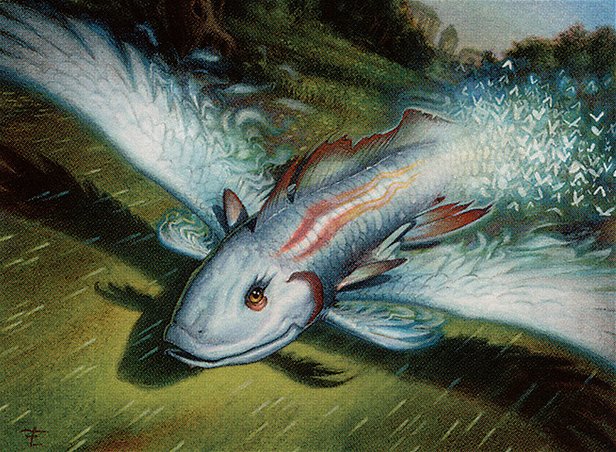
Mulldrifter by Eric Fortune
A World Without Supervillains
Lorwyn was meant to be a reset, something of a corrective. Most Magic sets to that point hinged upon a cataclysm—the Phyrexian Invasion, the Akroma-Phage war, the Kami-human war, the dissolution of the Guildpact, the Dominarian post-apocalypse and Mending—and Lorwyn was initially pitched as a pastoral world free of civilizational conflict. Of course, Shadowmoor was waiting in the wings to alter the landscape and ethos of Lorwyn, but for a few months, we had a sunlit and cozy world. The removal spells were more whimsical (Needle Drop, Crush Underfoot) and the names more absurd, from Stinkdrinker Daredevil to Stingmoggie.
Lorwyn is an inspired setting and one of Magic’s more welcoming worlds. There’s still danger from malevolent Treefolk or mischievous Faeries, and you could easily get stepped on by a careless Giant or Tarfired by an enthusiastic Boggart, but the bucolic villages of the Kithkin or the shady groves of the G/W Treefolk are pleasant places to settle. Even the Swamps are closer to the swamps with which I’m familiar—riots of flowers, reflections of the blue sky overhead and the wisteria vines and Spanish moss that trail toward the surface of still waters.

There’s a glaring issue with Lorwyn, though: per Mark Rosewater, “Lorwyn is the worst-selling large set (in contrast to its time) in the history of the game.” In past analysis, Rosewater has noted that players didn’t like the exclusion of humans, the sunlit setting, and the difficult draft format. The storybook-style art design, with vibrant and whimsical art from artists like Omar Rayyan, Rebecca Guay, and Nils Hamm and the ugly/cute distorted design of the Kithkin and the Changelings (Amoeboid Changeling, was polarizing; over the weekend, Mark Rosewater noted “Lorwyn’s artistic style was controversial at the time. Many thought it was pushing Magic outside ‘what Magic was.’” I was there, and can corroborate: Magic players, sensitive over a pre-MCU cultural zeitgeist’s attitude towards what was still viewed as a childish pursuit, pushed back against anything whimsical in the game. Personally, I loved it. The hyperhedonistic Boggarts are some of my favorite Magic creature designs—flabby and warty and maximalist, as in Ralph Horsley’s Boggart Birth Rite, or doing extreme body modification, as in Matt Cavotta’s perfect Sensation Gorger or Jim Pavelac’s appalling Pulling Teeth. I like horror in Magic, but I also like whimsy in Magic more than most.
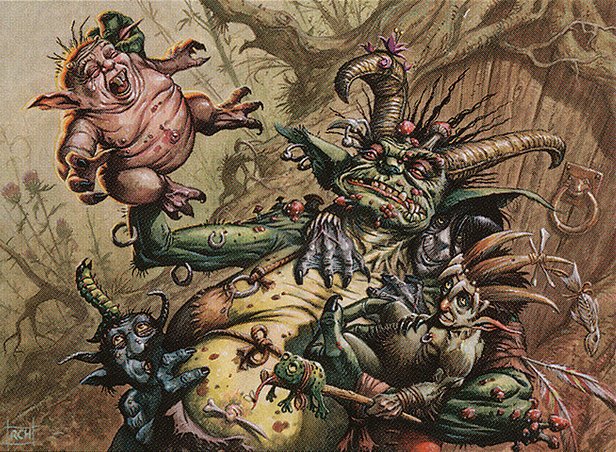
Boggart Birth Rite by Ralph Horsley
Other players may have been turned off by Lorwyn’s aesthetics, but there was another glaring issue with the block–Lorwyn draft was notoriously complex. When you draft a new environment, there are the usual heuristics you can rely upon, and those transferred over to Lorwyn—even if you haven’t drafted in years, basic Magic competence could lead you to first-pick Incremental Growth or Profane Command and crush the draft. Level two thinking comes quickly, though, and you’d end up asking “Should I pick Mistbind Clique and force Faeries?” Lorwyn’s five colors each dipped into multiple creature types—White had Giants and Kithkin; Blue had Faeries, Merfolk, and Elementals; Black had Goblins, Treefolk, and Elves; Red had Giants, Elementals, and Goblins; and Green had Elves, Treefolk, and Kithkin. Every color had access to Changelings as the mortar for each archetype, and every color had Elementals with Evoke, from Shriekmaw to Mulldrifter to Spitebellows.
A Brushwagg, Homarid, and Orgg Walk Into a Bar
The Changeling keyword was an evolution of Mistform Ultimus, a one-off design from Legions that became very popular (and had recently reappeared in Time Spiral’s Timeshifted bonus sheet), and they were incredibly important to Lorwyn Limited. It was possible to draft every (otherwise unplayable) Elvish Handmaiden that came your way and every decent Changeling in order to grow your army of Handmaidens. Handmaiden even triggered off your opponents’ Giants or Changeling creatures–and they were all but guaranteed to be playing Changelings.
All of this is complex enough, but then you get to card-specific interactions, which becomes overwhelming. The first time they used Boggart Harbinger to tutor up a Fodder Launch or Nameless Inversion was a learning experience. Silvergill Douser was one of the top Limited cards for Blue, because it let you split the difference between Merfolk and Faeries and win combat. Adding to this, half of the Faeries had Flash, meaning it was impossible for your opponent to guarantee how much Douser could shrink their creature at any given moment. The only safe attack was one where they were tapped out. There was a subcycle of cards that temporarily gave creatures every creature type (Wings of Velis Vel) or took every creature type away (Ego Erasure), which also complicated matters. For a more details-oriented drafter, it was a great format, but Lorwyn was a hideous onramp for newer players–made even worse by Morningtide, which suddenly shifted from the Lorwyn creature types to caring about “class,” the secondary creature type that had been underdeveloped. How many Changelings do you need before Cloak and Dagger becomes playable? Is Bramblewood Paragon enough of a pay-off to begin snapping up Goblin Warriors over Goblin Rogues? Asking players to care about their creature types is one thing–asking them to monitor the typeline of every creature their opponent plays, particularly when that can change at a moment’s notice, is another. Pivoting mid-draft (the smaller set was drafted second at the time) from prioritizing, say, Elves to prioritizing specifically Elf Warriors added another layer of complexity and a slowdown in the drafting process, but it did reward knowledge of the format and flexibility.
The irony of the player pushback to Lorwyn’s aesthetic is that the most serious-minded tournament players adopted Lorwyn–or were forced to adopt Lorwyn cards to compete. From a design perspective, Lorwyn is one of the most consequential sets in Magic’s history. This would be a justifiable argument even if the set were just Thoughtseize and 300 unplayable cards, but Lorwyn also introduced two new card types in Planeswalkers (held over from Future Sight) and Tribal (now Kindred), thus turning Tarmogoyf from a neat build-around to one of the most-feared creatures in Magic for the subsequent decade. The list of top cards from the Lorwyn side of the Lorwyn–Shadowmoor block includes some of the most important cards in Modern’s history, from Thoughtseize to Scapeshift to Tarfire to Fulminator Mage to Kitchen Finks to Pestermite. Even just the Lorwyn side of the plane gave us Cryptic Command, Mutavault, Idyllic Tutor, Oblivion Ring, Merrow Reejerey, Silvergill Adept, Mirror Entity, Spellstutter Sprite, Bitterblossom, Ponder, Reveillark, Heritage Druid, Gaddock Teeg, and Vendilion Clique, all cards that formed the core of early to mid-Modern archetypes.
Commander was also nascent but present during this era; by 2008, you could show up to most local games stores in college towns or larger designated marketing areas and find a pod. Players were hungry for new Commanders, and Lorwyn gave popular creature types new options—one of the earliest Commander moments that drew me into the format was watching a friend demolish a table with the combo of Nath of the Gilt-Leaf and Sadistic Hypnotist. Doran, the Siege Tower, Wort, Boggart Auntie, Oona, Queen of the Fae, Rhys the Redeemed—all were common Commanders at a crucial point in the format’s adoption.
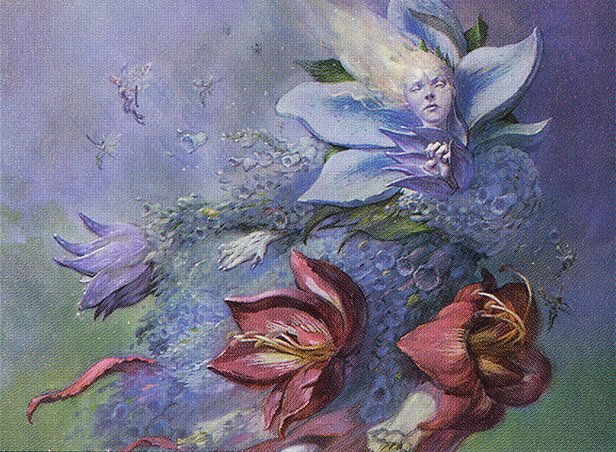
Oona, Queen of the Fae by Adam Rex
Learning To Use Your Tools
The mechanics of Lorwyn were more of a mixed bag. Evoke was fantastic as a pseudo-Kicker that gave you death triggers and bodies in the yard. The Makeshift Mannequin deck, which used the reanimation spell to buy back Shriekmaw and Mulldrifter, was one of the most fun Standard decks I’ve ever played, and cards like Aethersnipe, Briarhorn, and Spitebellows were excellent in Limited. I’m glad it returns in Lorwyn Eclipsed—it feels both quintessentially Lorwyn and also like a bridge between the sunny world of Lorwyn and the grimness of Shadowmoor.
In contrast, Clash was a failure—it was somewhat logical in a set with Evoke and the cycle of top-of-library Harbingers, but adding a layer of unpredictability to utility cards is not going to make them exciting. I’m glad we eventually got Marvo, Deep Operative out of it, but no one was reaching for Broken Ambitions or Recross the Paths at the time, and there was no real payoff for Clashing. Lash Out saw some play before it was rendered obsolete by Searing Blaze and Spring Cleaning tilted some people off a lucky Clash, but in general, it’s a forgotten mechanic for good reason.
Champion proved to be mediocre, but conceptually interesting. In exchange for temporarily exiling a creature of the right type, you got an above-the-curve creature like Wren’s Run Packmaster or Thoughtweft Trio. Champion appears on a dozen creatures, most of which never saw play outside of Limited, where they tended to be top-tier bombs. There was one very prominent exception in Mistbind Clique, of course, and I have an abiding fondness for Boggart Mob, but the creatures weren’t quite powerful enough to counteract the drawback of Champion (note that, if you cast a Champion with only one qualifying creature on the board, if your opponent removes that creature in response, you’ll sacrifice your Champion creature–a hell of a two-for-one). In the modern world, where so many creatures have enters-the-battlefield abilities, Champion goes up in value, but I wouldn’t expect to see it again in Lorwyn Eclipsed. I do really like the design of Champion in the context of Lorwyn–tucking a Harbinger of the appropriate type under a 5/5 for four mana felt fantastic, as dealing with your powerful creature meant you could tutor up another–but we’re not in the context of Lorwyn and I don’t think I’ve seen one even in Commander in over a decade.
Hideaway, introduced in Lorwyn in a cycle of five lands and reintroduced with minor tweaks in Streets of New Capenna, was barely a mechanic, but is worth mentioning in passing. Windbrisk Heights actually saw a huge amount of Standard play once Spectral Procession was printed and the Orzhov Tokens deck took off, but the other four were left out.
In Response, I Flash In…
Aside from the mild mechanic failures of Clash and the disappointment of Champion, the real knock against Lorwyn is the Standard it birthed. Faeries ended up being incredibly overpowered and the Vivid lands and filter lands (Fire-Lit Thicket), in conjunction with Shadowmoor’s Reflecting Pool reprint, eventually made control decks into undifferentiated slop-piles that could run Cloudthresher into Cruel Ultimatum. Meanwhile, the aforementioned Makeshift Mannequin and Morningtide’s Reveillark made Reanimation strategies weirdly prevalent in a Standard without much in the way of graveyard hate, and Shadowmoor’s Persist mechanic yielded grindy decks that would eventually morph into combo decks that defined Modern archetypes for years.
With the release of Morningtide, Faeries became an absolute menace in Standard. Faeries could operate entirely at Instant speed and had a four-mana, Flying 4/4 Time Warp in Mistbind Clique, whose Champion was either entirely nugatory (exiling a Faerie Rogue token from Bitterblossom) or even positive (exiling a Bitterblossom that was growing dangerous). Bitterblossom itself was an absurd card for the time that could land on turn two and start building up a board presence without further investment, and backed up by Thoughtseize and Spellstutter Sprite, the Faeries play could outtempo and outcounter anything their opponent could throw at them. It was an incredibly frustrating deck to play against, and it ran rampant in the format without any bans or truly effective hate–any format where you’re forced to run Volcanic Fallout or Cloudthresher to counteract the top deck is a format with problems.
And now it’s almost twenty years later and we’re finally returning to Lorwyn and Shadowmoor. Thoughtseize remains one of the most important discard effects in Magic’s history. Bitterblossom shows up every time Wizards needs a quick pop of nostalgia and value, and Changeling has returned several times to mainline Magic sets. It’s strange to realize that Lorwyn is now before Magic’s historical midpoint—it was released fourteen years after Alpha and eighteen years have passed since Mulldrifter was first printed—and thus, Planeswalkers have now existed for more than half of Magic’s history. I’m very heartened to see that Lorwyn as we knew it back in 2007 still exists–Rayyan’s Figure of Fable leans into the off-putting design of the Kithkin almost as a provocation and Bitterbloom Bearer tacks Flash onto a fragile Bitterblossom as though to throw the few remaining 2007-era Standard players into a flashback. There are Evoke Elementals and Shapeshifters with Changeling and, no doubt, surprises remaining in the cards to be revealed this week, but, like Neon Dynasty before it, Lorwyn Eclipsed is more about how the game and we as players have evolved, rather than simple nostalgia. Lorwyn had its issues, but it defined the game as it’s played now, and revisiting it has the potential to redefine it.
Rob Bockman (he/him) is a native of South Carolina who has been playing Magic: the Gathering since Tempest block. A writer of fiction and stage plays, he loves the emergent comedy of Magic and the drama of high-level play. He’s been a Golgari player since before that had an official name and is never happier than when he’s able to say “Overgrown Tomb into Thoughtseize,” no matter the format.