


[Please note that Hipsters of the Coast receives a referral bonus for purchases made after clicking on certain links in this article]
While normally I write about the latest Dungeons & Dragons news or product reviews, I do in fact play the game as well. I run games for my older daughter and her friends as well as the occasional one-shot at a local game night here in Queens. As I find myself with more time these days to return to hobbies like TTRPGs and my children are now old enough to share those hobbies I’ve been getting back into homebrew campaigns and want to share some of these things with all of you.
So today I want to talk about a relatively new concept for D&D 5.5 which is Evolving Magic Items, which was introduced in the recent Arcana Unleashed source book. For anyone who’s played a video game you’ll be familiar with the concept of items that gain new abilities as they level up. While these are really intriguing and open up a lot of opportunities for advancement you’ll want to be thoughtful about incorporating them into your campaigns.
I’ve made the decision to include them in a homebrew campaign I’m working on (more on that in a future article) and want to share my thought process with everyone and hopefully it will help you in your own games to find innovative and engaging ways to reward your players with one of these unique items.
Why Am I Giving Out Evolving Magic Items?
A Dungeons & Dragons character isn’t just a bunch of numbers on a character sheet in similar ways to how a Commander in Magic the Gathering isn’t just artwork and (usually) text on a piece of cardboard. They are extensions of the player’s identity and personality and many of us see parts of ourselves in the avatars we choose to inhabit. As explained in Arcana Unleashed, beloved magic items from low levels become obsolete as players level up, putting them in a frustrating position between advancing in power with a new magic item and holding themselves back due to love for an underpowered one.
Giving your players the ability to evolve their magic items lets them keep their favored equipment throughout their adventuring career. Imagine a low-level ranger who has been bequeathed his grandmother’s magic hunting bow. He’s now advanced through trials and tribulations and incredible adventures, with that trusty family heirloom on his back, and hits level five and finds a much more powerful magical weapon while adventuring. Allowing him to evolve the legacy bow means continuing to play at the correct power level but still embracing the things that make his character unique.
How Many Evolving Magic Items Should I Give Out?
Now that I’d made the decision to incorporate this new rule into my own games, the next question becomes obvious. How much is too much? How little is too little? How does a DM strike the right balance between letting players keep their low-level signature items and replacing some of the obsolete junk when shiny new toys are available.
Broadly speaking, there’s three options here. The simplest is that they each get one item, while the most complicated is that any item can be evolved. The third option is somewhere in-between. Honestly, I think every option here has merits so let’s break them down.
One Item per Player: The main advantage to this is it gives every character a signature item. For most players this will likely be their primary weapon through the campaign. It could be a ranger’s bow (as mentioned above), or a fighter’s sword, or a paladin’s shield, or a sorcerer’s cloak, and so on. Picking a single item also means you can make it the most powerful item in their repertoire. The main drawback is that if they outgrow the item, or want to change things up, they’ve put a lot of resources into this item. If a sword-and-shield paladin, for example, wants to trade armor for power and switch to a two-handed great weapon, they may face a difficult decision.
Some Items Evolve: This option feels a bit more natural as there’s no reason why each player should be limited. After all, they can have more than one beloved item. This gives the player and the DM some flexibility in advancement and rewards and storytelling. One way in which this could become very flavorful is the concept of “set items” where multiple magic items have an affinity for each other and evolve together. For example, a magical jewelry set consisting of a ring, a diadem, and a necklace, all of which grant a bonus when worn together, and then evolve together to gain new abilities both independently and in concert with each other.
You can also give your players multiple items that evolve independently. This helps solve the problem of player frustration but it does introduce a new one which we’ll discuss in a follow-up question which is making your players choose between item evolution as a mini-game and the actual game they’re trying to play.
Everything Evolves: I call this option the “sandbox” choice. If you want to give your players complete freedom to choose how to spend their resources, either on item evolution or new items altogether, why not just give all magic items the option to evolve. This can also feel a bit like a video game mechanic, where players, as they progress to even higher levels, can evolve more lower level items that they find, in order to unlock powerful effects.
This option does, in several ways, fundamentally break parts of the game, mostly around how rewards are distributed. If every single item has the potential to become a legendary item as your players level up, then you need to be very careful about how many items you give out, and the mechanics by which the items evolve. This really brings us to our next question:
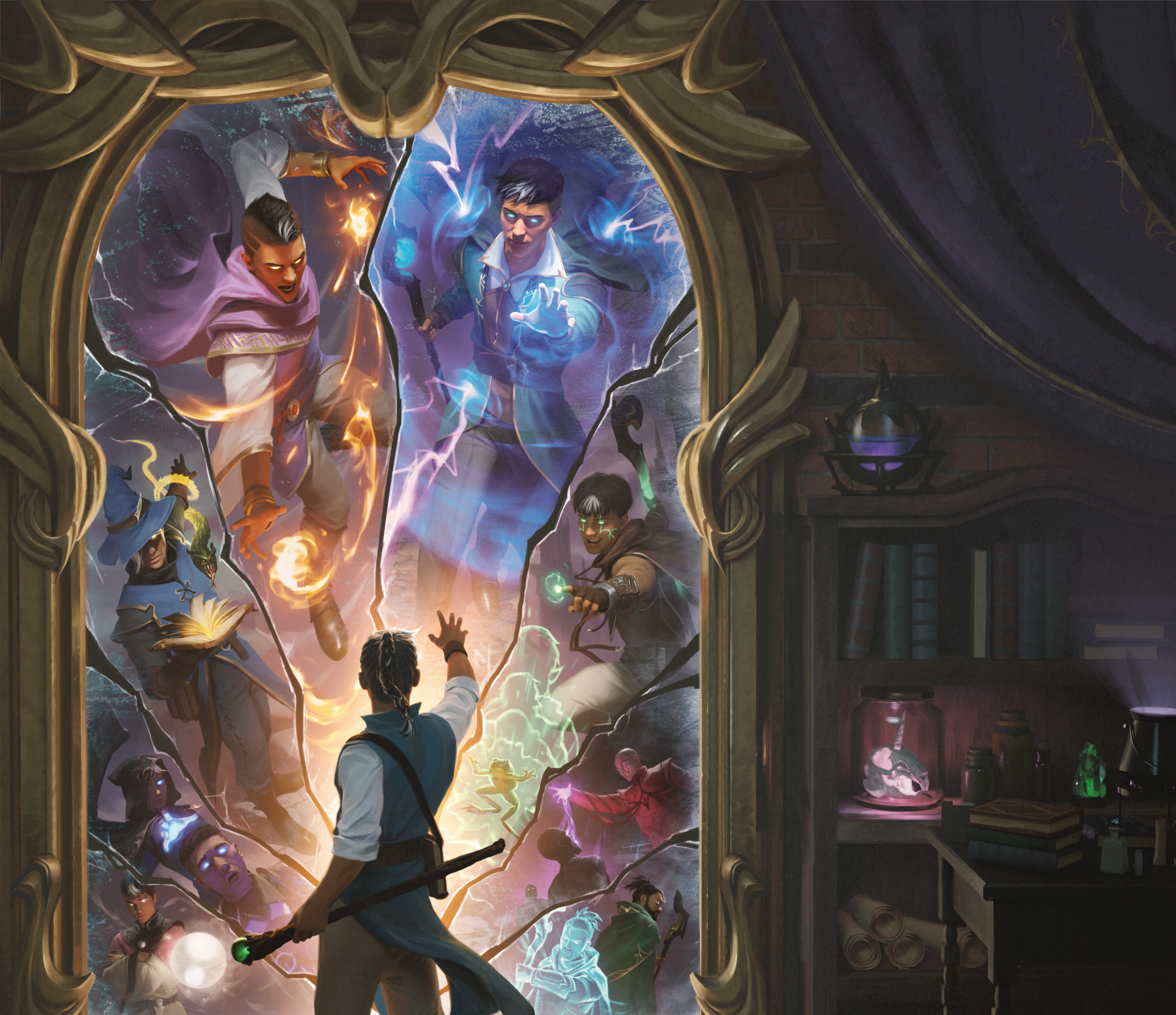
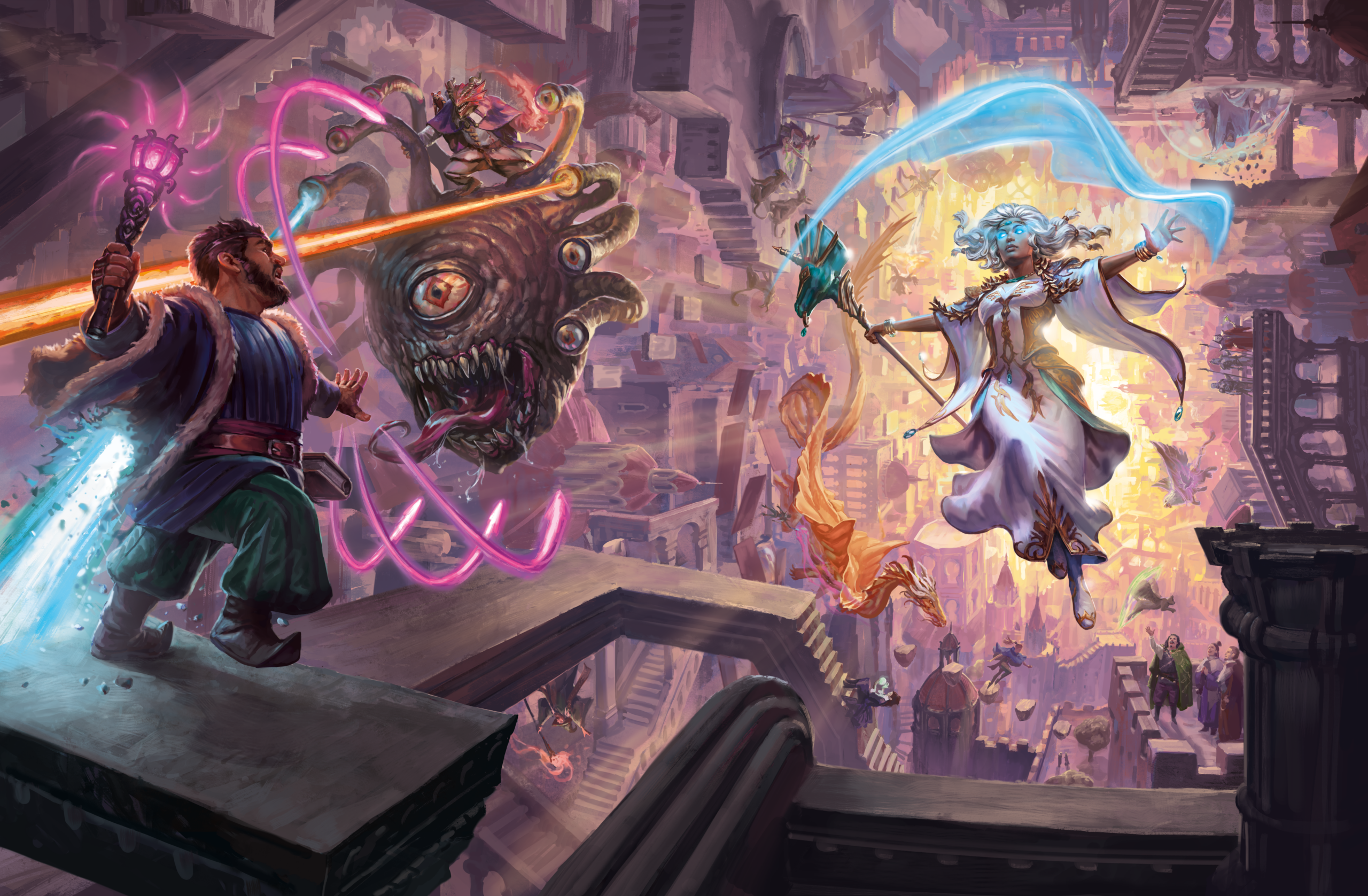
Illustrated by Billy Christian
How Will Players Evolve Items?
The rules in Arcana Unleashed outline two basic ways to evolve magic items. The first is that they just evolve upon player advancement. This obviously works best if your players only have one evolving item, or one set of evolving items. When they reach level five, their uncommon signature item evolves with them into a rare item and gains a new magical property. Alternatively, you can allow (or require) your players to earn that evolution through crafting instructions laid out in the Dungeon Master’s Guide and Arcana Unleashed.
But, being the obsessed lover of all things spreadsheet-related that I am, I figured I’d consider a few other options …
Quest-Based Evolution: This option involves designing quests built around item evolution. This could involve having to secure a rare catalyst from a lost treasure trove. It could require the party to seek favor from a powerful magical being like a dragon or arch-fey. The whole party could seek the same goal to evolve all their items together, or as they progress through the tier all the quests for each player could be revealed. This option may be tedious for some players so make sure you gauge their interest before embarking upon it. But, this also allows you to tie in player back-stories as an incentive.
Dungeon-in-an-Item: This is similar to questing, but more in the style of video games like Disgaea where you enter a completely unique dungeon that exists in a pocket dimension contained within the evolution item(s). This lets you craft a dungeon-crawl experience that’s directly inspired by the magical item instead of by the world or story setting. Maybe your campaign is in the deep jungles of your world but you want to take a break for a fortress siege to unlock the evolution of a magical sword? This is good for parties that enjoy classic dungeon crawls that have little-to-nothing to do with an over-arching plot.
A Whole Crafting System: Next week we’ll learn more about the new World of Warcraft sourcebook but we already know it has rules around professions and crafting. Instead of questing for evolution catalysts you can simply build them into your normal adventures. Reward your players with crafting materials and let them decide what to do with it. This also lets them choose a profession that has resonance with their signature items. If they’re evolving a sword they may be a blacksmith. If they’re evolving a magical cloak they may be a weaver.
Renown/Bastion-Based Evolution: If your campaign is using faction renown and/or bastions as a core part of the adventuring then that may be an intriguing avenue for evolving magic items. Renown with a magical entity or organization is an easy enough way to unlock access to evolving items. Setting up ranks at which rare, very rare, and legendary evolutions unlock creates a progression parallel to the “automatic” evolution suggested in Arcana Unleashed but with the added benefit of adding in your campaign’s living storytelling components.
Bastions are another avenue players may want to explore as part of a campaign and setting up a progression where the players can use their facilities, maybe unlock a special one for this purpose, and combine a few orders to achieve magic item evolutions. A combination of research orders to discover the evolution formulas, harvest or trade orders to gather materials, and craft orders to finally unlock the new powers allows players to put their bastion to use while they continue adventuring. You can also use it to separate a player from their magic toy for a little while for a bit of a curveball.
You can also combine these two and use faction renown to unlock a special facility for the bastions that adds a new Craft: Evolve Magic Item (Tier) order.
What Did I Settle On? How Do I Decide?
I’m actually still on the fence! I love most of the ideas I’ve laid out here but the reality is I need to discover what my players are going to enjoy too! My homebrew campaigns have yet to kick off, but what I’ve settled on right now is this. Everyone will get at least one magic item, early on, likely around level three, with the potential to be their “signature” item. Once they get to level five, when rare items become available, I’ll lay out some options. By then I’ll know how interested they are in systems like crafting, bastions, faction renown, dungeon crawls, powerful benefactors, and so on.
That should hopefully open up the first “Evolving Magic Items” quest/process/task for the party. We’ll see how that goes and then build off from there. The one caveat that I still need to settle on is sets of items versus single items but I’m leaning towards single items because sets feels a bit like making too much work for myself. And being a DM is enough hard work (like writing this article) to add more to the pile.
I’ll be sure to write back here as this process evolves (see what I did there) and let you all know the progress.
Rich Stein (He/Him) loves to tell stories and the shared storytelling experience of tabletop gaming. He’s a big fan of Dungeons and Dragons, Hackmaster, Fabula Ultima, Vampire: the Masquerade, and the upcoming Shift system. He’s never run a virtual game but he’s interested in trying it out. Running games for kids has taught him a lot about how to run games for grown ups.