


In theory, I should be suspicious of a product like Mystery Booster: Commander Edition.
MBC is, for now, available only to a select few—the fodder of conventions and Festival-in-a-Box Secret Lair orders (though that won’t stop me from proxying it). MBC is full of references to incredibly niche, old-school Magic cards, which should, in theory, give me pause—does bringing Chandler into a slick present-day card negate its inherent, beautiful oddness? MBC is, from a design standpoint, pure Commander, complete with sneaky pushes toward rule-exceptionalism that define and, for many, ruin the format.
And yet I love it.
I love MBC precisely, I think, because it both welcomes and overclocks my powers of intellectualization. As I turned this set over in my head—as preview photos with the image quality of Bigfoot evidence turned into crisp Scryfall-friendly .pngs—I was consistently drawn to a feeling of abundance, of excess, of exuberant extravagance and stupid superfluity that permeated each card.

In this article, I’d like to give you a taste of what that felt like.
Out of the Past
When Mystery Booster: Commander Edition was previewed at MagicCon Amsterdam, it defined itself in part—we’ll get to the other part in a moment—through its brazenly bizarre flavor. One of the first two cards previewed for the set was Joven and Chandler, a sendup of two extraordinarily odd cards from 1995’s Homelands: the pithily named, but unpithily designed, Chandler and Joven.
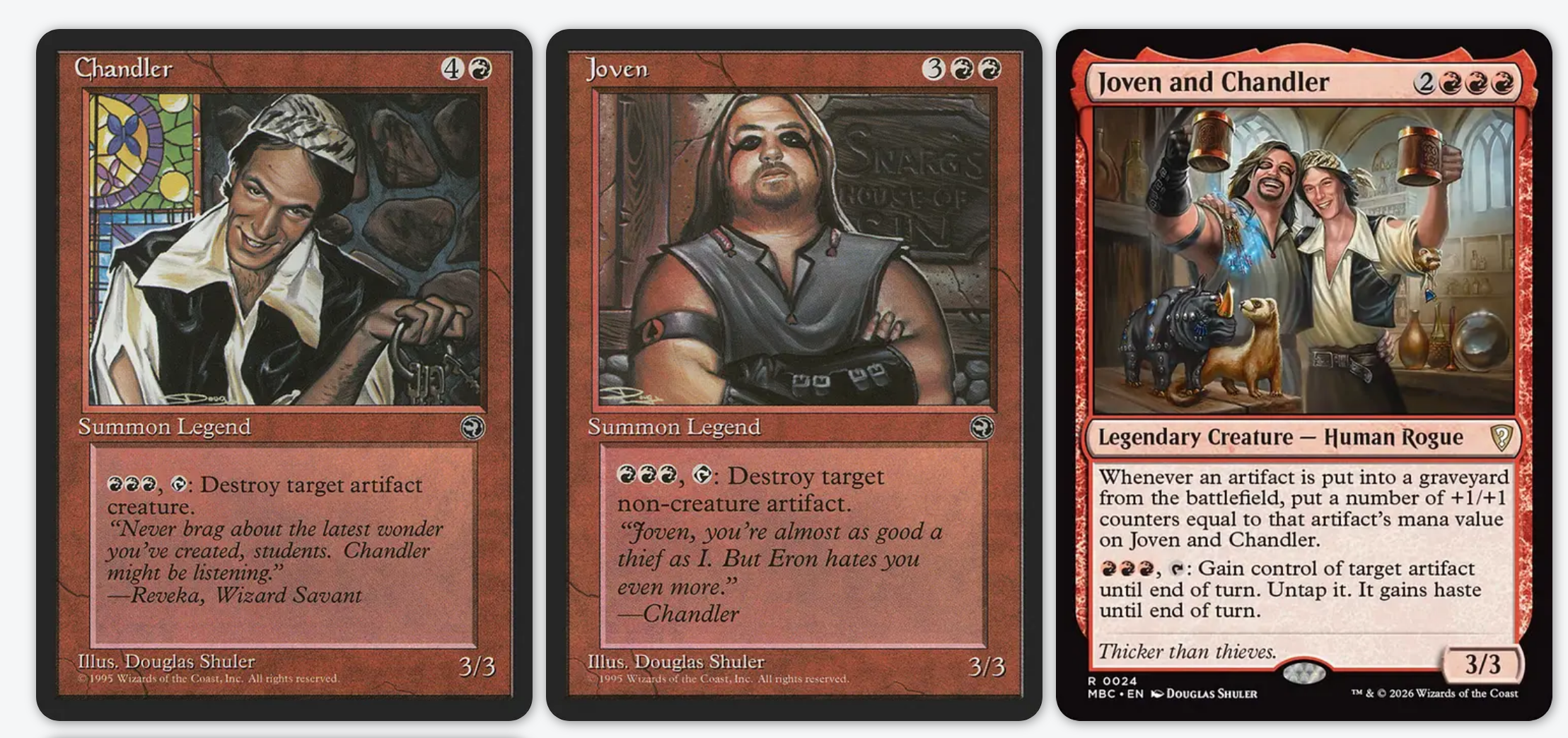
I have loved these cards for many years, because they’re equal parts stupid and useless and hilarious. The eye catches first on Douglas Shuler’s odd oily paintings, which messily mingle banality with ostentation: each depicts a man dressed in high fantasy haute-couture, good start, but they’re static portraits rather than dynamic action-poses. Why, you ask yourself, are these guys looking at me like that? Echoing the nondescript simplicity of their names, the paintings are just, like, guys. (And, to state the obvious, Chandler looks like Anthony Bourdain got trapped in the Han Solo factory and Joven looks like Zach Galifianakis just came back exhausted from a Gathering of the Juggalos).
And don’t worry, the cards’ mechanical strength makes up for it: for the mere cost of, uh, 5 mana, you can summon an, uh, 3/3, whew, pretty good, that can, uh, spend 3 red mana to destroy a single artifact creature or non-artifact creature.
Needless to say, they aren’t chase cards for tournament grinders.
Like I said, as a lover of Magic’s strange hidden corners and reliquary oddities, I’ve long adored Chandler and Joven—so I was cautiously optimistic when the combined Joven and Chandler was previewed. On one hand, the card sticks its fingers deep in the cookie jar of the Magic archives and attempts to resurrect a strange jagged piece, even bringing back Douglas Shuler to create an illustration that sends up Magic’s early history. On the other hand, its new illustration has the slick brightness of 2020s Magic house style rather than the weird muddiness of 1995, and the card’s new ability was suspiciously decent. Does this, I wonder, denature the inherent stupidity of the original cards?
As it turns out, the rest of the MBC card file paid off on all the best of Joven and Chandler’s promise and avoided the worst pitfalls. The mini-set goes so extraordinarily deep for its subject matter that it swallows you up and demands you revel with it in oddness.
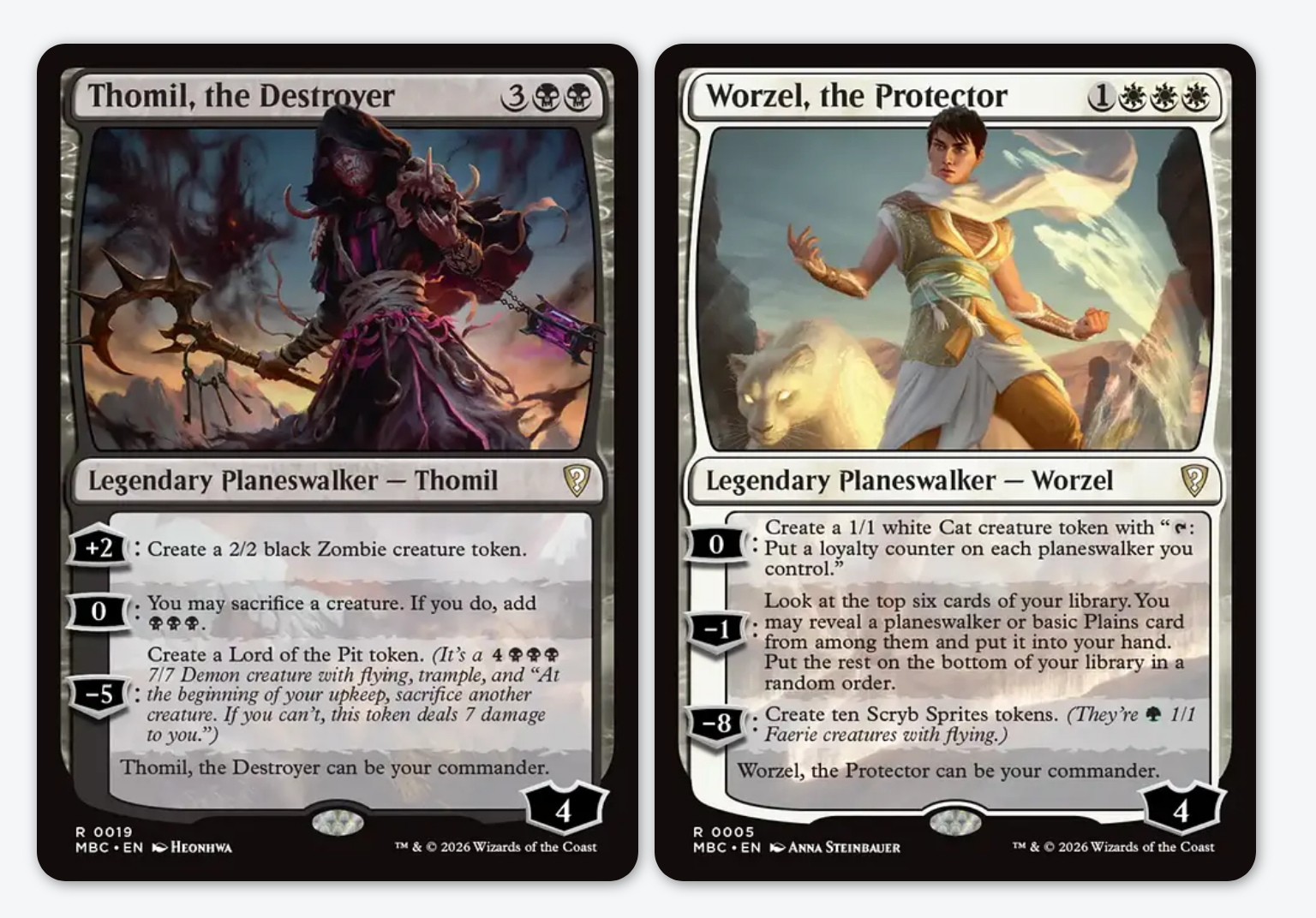
As Jay Anelli and Loreley Weisel-Librizzi have thoroughly illustrated, MBC is bursting at the seams with deep-cut characters, many of whom have appeared in Magic story but never on cards. There are Worzel, the Protector and Thomil, the Destroyer, Magic’s very first planeswalkers, who had heretofore appeared only in a supplemental rulebook in The Duelist #0.
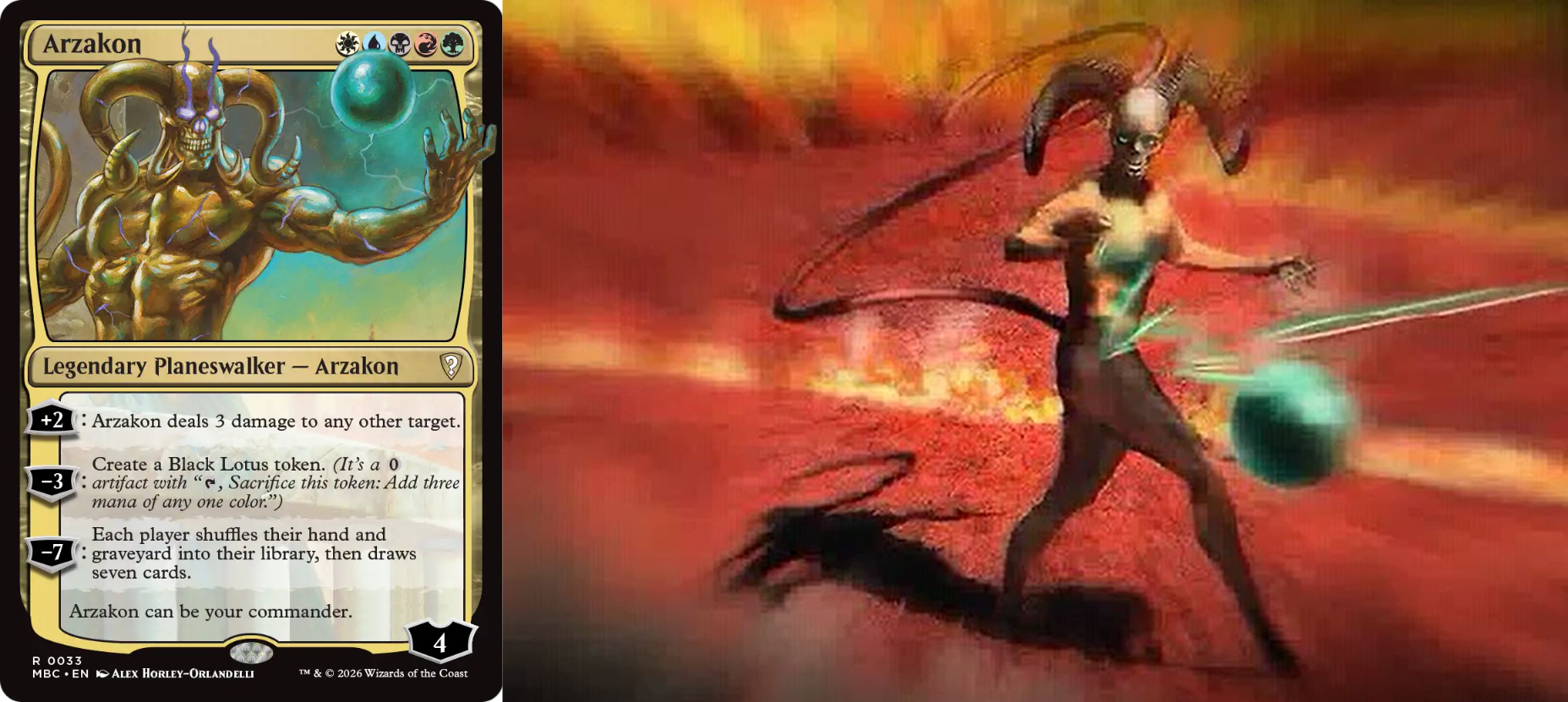
There’s Arzakon the epic final antagonist of the 1997 MicroProse Magic computer game (that’s him on the right, tossing a ball at you because he’d like to be your friend).
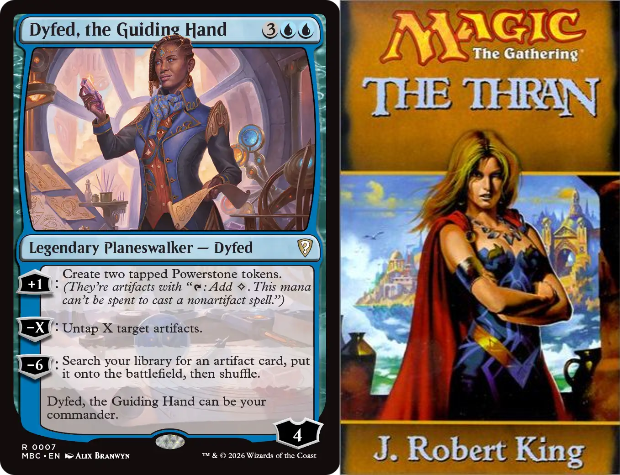
There’s Dyfed (Dyfed, the Guiding Hand), who served a fateful role in J. Robert King’s 1999 novel The Thran: first introducing Yawgmoth to Phyrexia (oops).
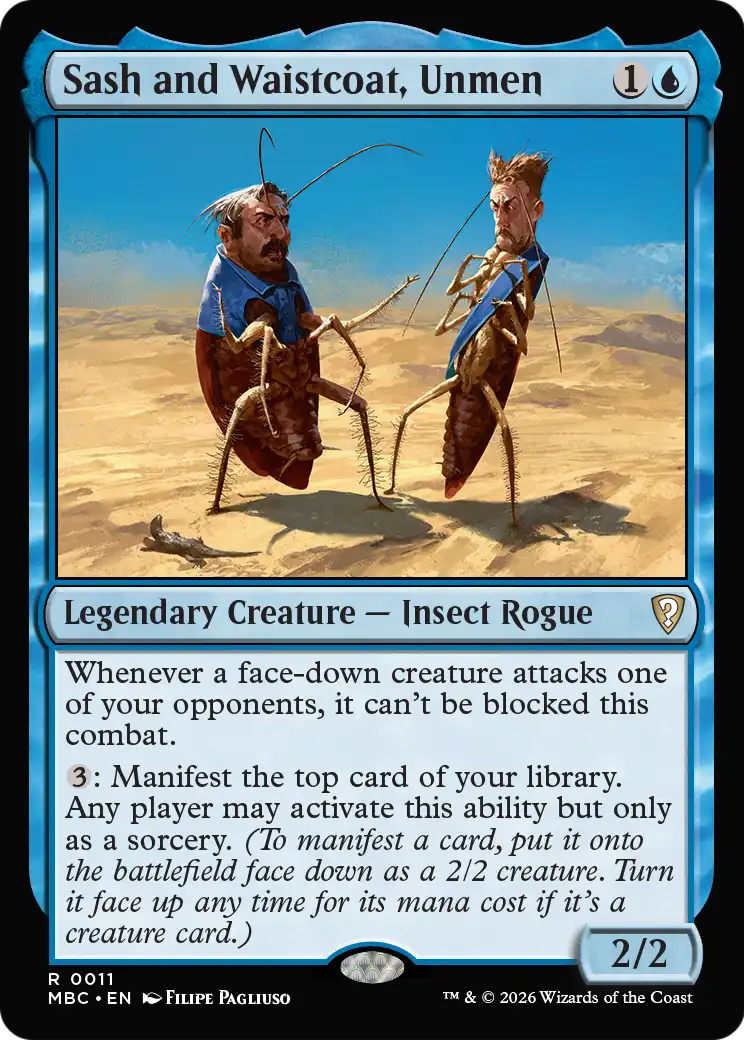
Most messed up of all, there’s Sash and Waistcoat, Unmen two goons who served the villainous Ixidor in the storyline of the Onslaught block. I hate them and wish I could unsee them, but I’m glad they were included.
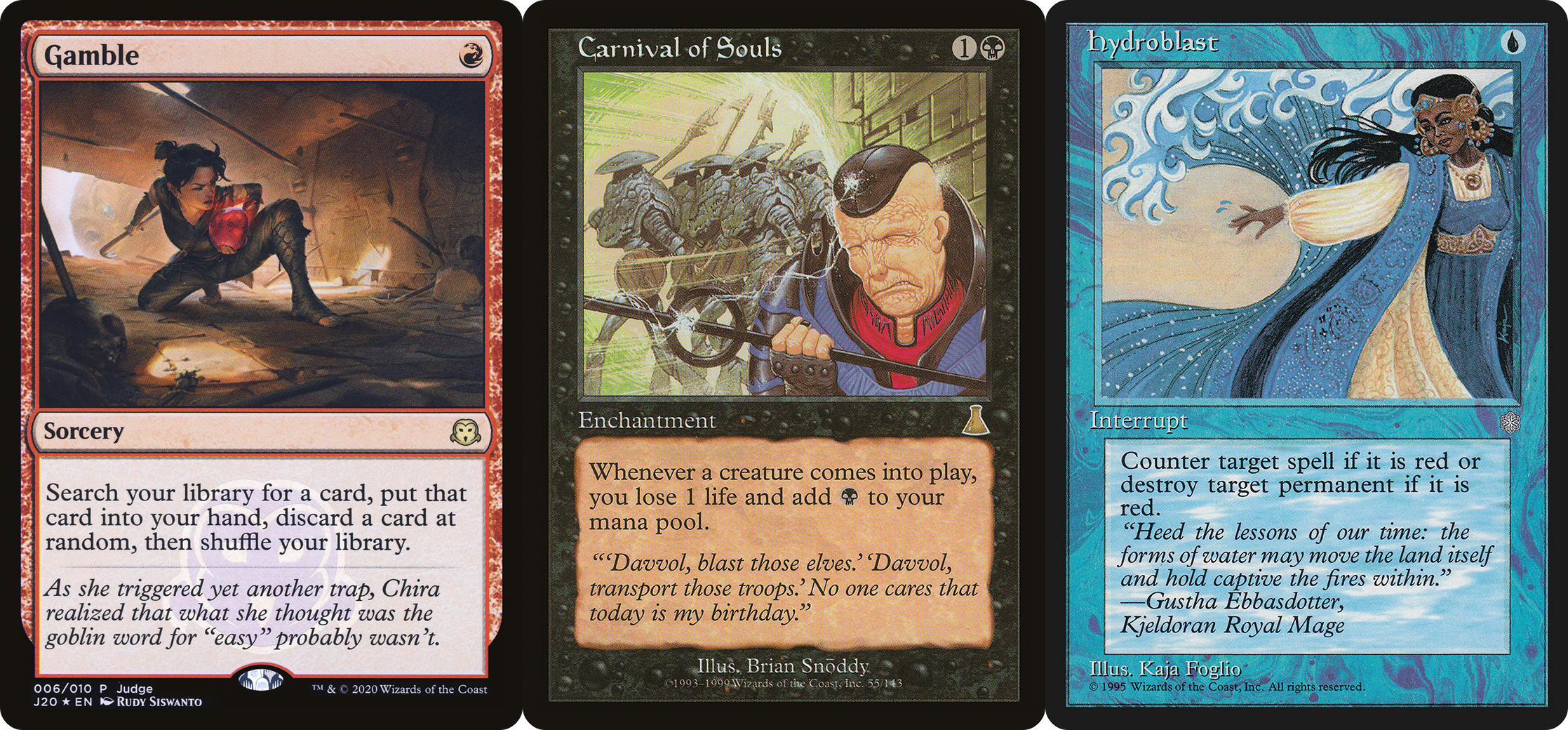
In other cases, MBC wraps names and lore around characters that had heretofore escaped notice. Chira, All In dedicates a whole creature card to a character who had previously appeared on two random editions of Gamble, one from Eternal Masters and one from a six-year-old Judge Gift Program entry. Davvol, Evincar of Rath had previously appeared on a few Y2K-era cards, most memorably the hilarious Carnival of Souls but was never afforded a creature himself. And Gustha Ebbasdotter, whose pulsing Karl Kopinski illustration is one of my favorites from MBC, has the bravery to ask: who was that character from the 1995 printing of Hydroblast?
The very volume of words I’ve dedicated to naming these cards (imagine me breathlessly explaining them to an entirely confused but genuinely encouraging parent, and you’ll get something like the experience of that from the preceding paragraphs) bespeaks the habit of body and mind that MBC instills in me. This was what I felt as I repeatedly interrupted my pod’s Sunday EDH game to pass them new previews from the set: there was an excitement at that superfluity that registered in my nerves and hands as well as my mind, a desire to be immersed by the gratuitous joy of these strange cards.
It might sound, at first, like the microdosing of pleasant recognition of contemporary media’s precious in-jokes: I know that reference! But it’s something different: MBC feels so defiantly invested in the odd and obscure that it’s difficult to accuse the set of mercenary nostalgia-baiting. It’s hardly a guaranteed moneymaker to bring Sifa Grent out of the woodwork.
And, in fairness, this has partially to do with the set’s timing. When I chatted with Vorthos extraordinaire and Homelands sage Cary, they noted that MBC benefits from its temporal distance from Magic’s recent uber-referential in-universe sets. “Personally, I’d burnt out on the mining of Magic’s cultural references around the stretch of Modern Horizons 3 into Mystery Booster 2’s playtest cards. This was also close to the time when Duskmourn and Aetherdrift were being eagerly picked apart for allusions to external media. Both styles of references took a backseat (or possibly trunk space) in the time since, which has more likely contributed to MBC feeling more welcomed.”
And, as Cary highlighted, MBC does not occasion the same sort of reference-getting experience as, say, the average Universes Beyond set. “MBC ‘points at the thing’ in a similar way to how half the year is now allocated. Are they the same, though? I wouldn’t say so,” they remarked. “MBC is a reasonable number of flowers being given—many for the first time—to Magic’s own stories, characters, and the authors and artists who first created them.”
Indeed, if anything, MBC’s over-the-top obscurity creates a space to ask what it means for Magic to engage with its history at all.
When I asked Weisel-Librizzi about MBC’s apparent love of deep cuts, she rightly noted that what makes something a “deep cut” is itself unclear.
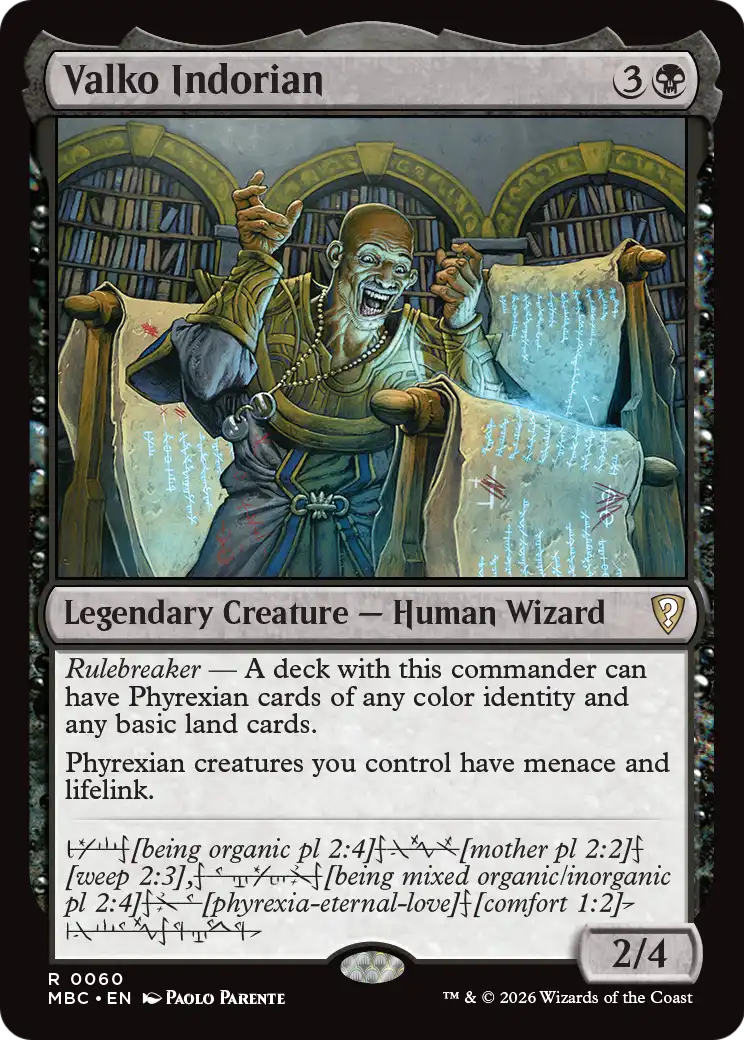
“Joven and Chandler already got cards, lots of older players know who they are, and they’ve been kind of memey online over the years. So are they even that deep of a cut?” she said. “Compare that to a character like Valko Indorian, created in 2023 for the Phyrexian language insert booklet included in Beedle & Grimm’s Phyrexia: All Will Be One product. To me, that’s a much deeper cut! Who’s even heard of that guy besides the dedicated Vorthoses?” Not me, I’ll confess.
There’s a sense, in other words, that MBC channels the sheer gratuity that, as I’ve written elsewhere, underpins Magic’s best worlds. It does so not because it makes something entirely original, but because it so excessively lampoons the very act of historical reference that the old feels new. The cards are far more obscure, far more ridiculous, far more everything than they need to be, and in that they seem to momentarily transcend the market logic that underpins them. MBC steers so hard into the fan-service skid that it drifts, free and joyous.
Of course, this excess wouldn’t be possible without MBC’s design.
Smart Stupid
Joven and Chandler was only one half of the MBC cards previewed at MagicCon Amsterdam. The other was Tolabow, Loch Rascal, a card whose flashy first ability—Rulebreaker, which allows players to situationally add another color to their commander deck—drew plenty of attention in the week that followed.
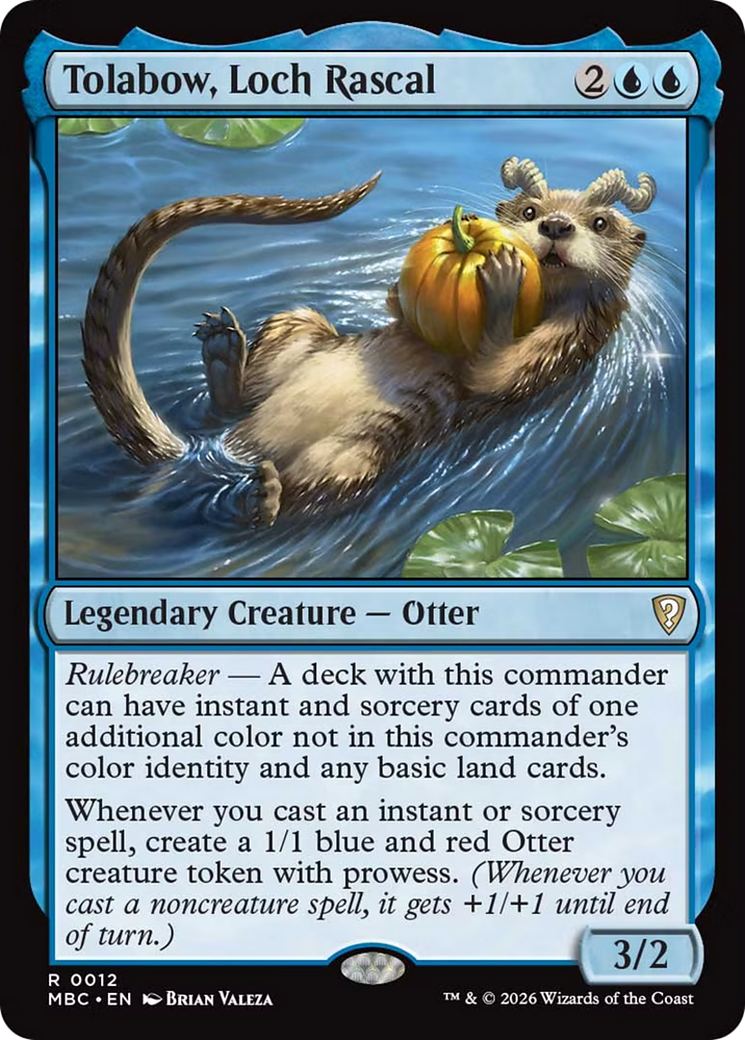
But intriguingly enough, Tolabow was like Joven and Chandler in that it, in isolation, gives an overly impression of MBC’s sensibility.
Not that either Tolabow or Joven and Chandler are bad. Rather, despite their indulgent bombast compared to the average Magic card, they represent some of the tamest entries in a set defined by its ridiculousness; in showing off MBC’s mechanical kookiness, Wizards actually undersold it. For the set’s design aren’t, to my palate, anyhow, just spoonfuls of high-power slop for EDH whales. Instead, they’re the pleasantly extreme richness of ice cream on a homemade brownie. You know it’s a lot, you know you won’t have it all that often, but something about it feels deeply, unspeakably good.
We can see this sensibility in MBC’s aforementioned revival cards. One of the most pernicious challenges in resurrecting an old Magic card is finding a way to retain that card’s essential alienness. The past, as they say, is a foreign country, and to bring something to the present risks making it normal, unchallenging, domesticated.
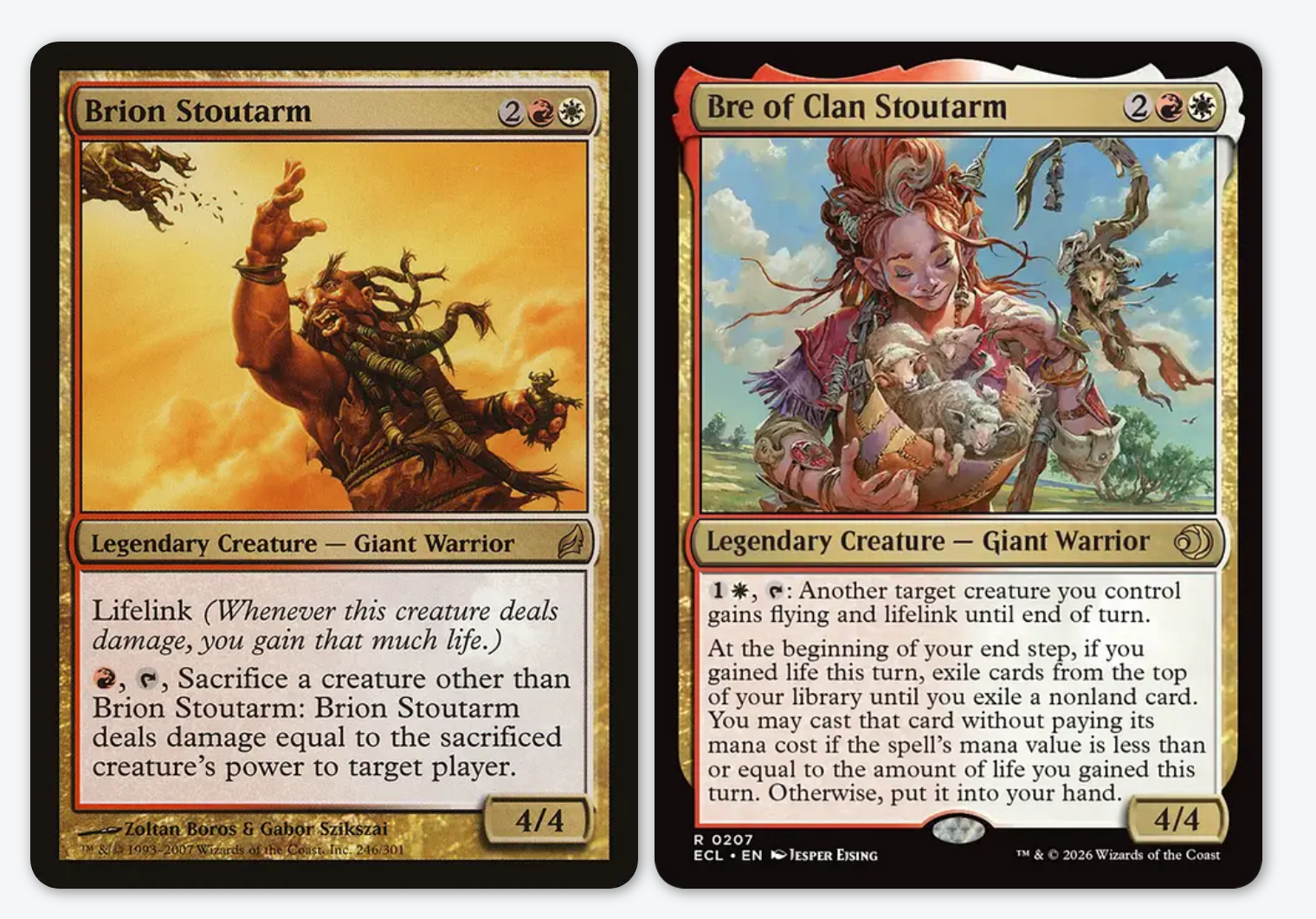
For example, Lorwyn Eclipsed’s Bre of Clan Stoutarm is a fun flavor sendup of Lorwyn’s Brion Stoutarm, but to my mind something is lost by adapting Brion’s elegantly simple ability text into a 9-line wall of ink (however cool those nine lines might be).
MBC offers an elegant, if contingent, solution: steer into the skid. In this, the set reminds me of a comparison I once made of Magic’s various strains of humor to various versions of Da Vinci’s Mona Lisa: the serious original, the insipidly faux-irreverent image of Mona Lisa blowing bubblegum, and Fernando Botero’s Monalisa.
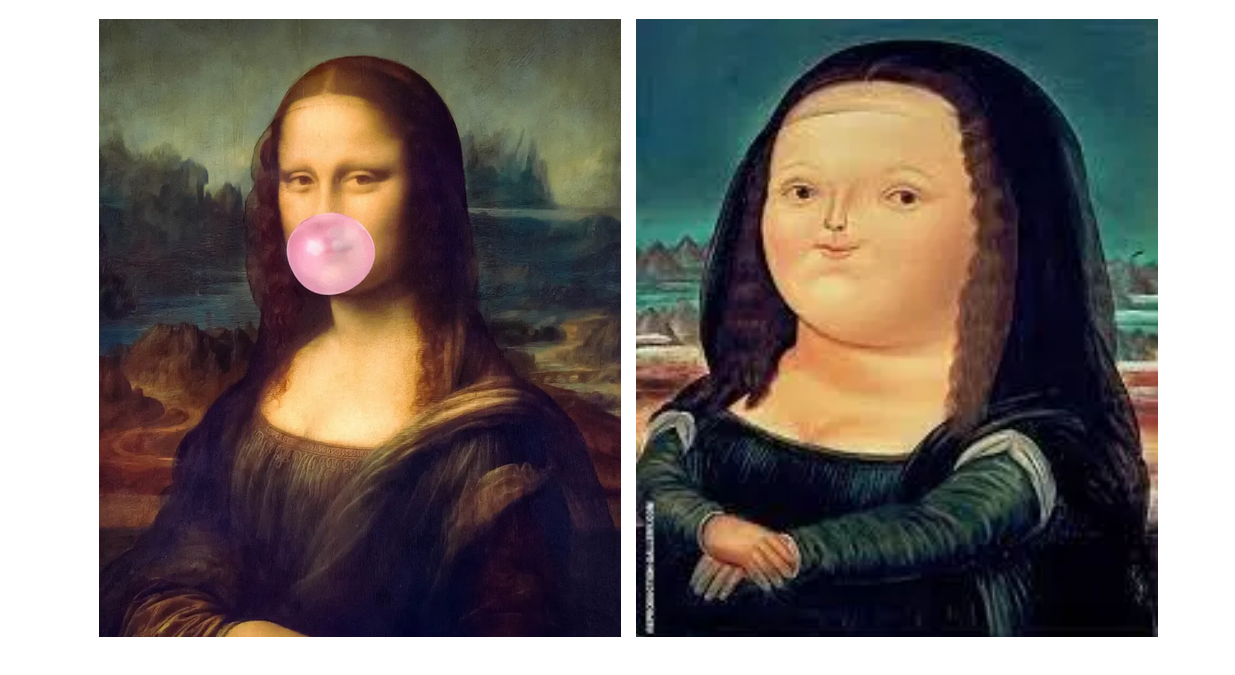
MBC is the latter: shrugging off either quiet elegance or self-serving sarcasm, it inflates itself up to exuberant, larger-than-life goofiness.
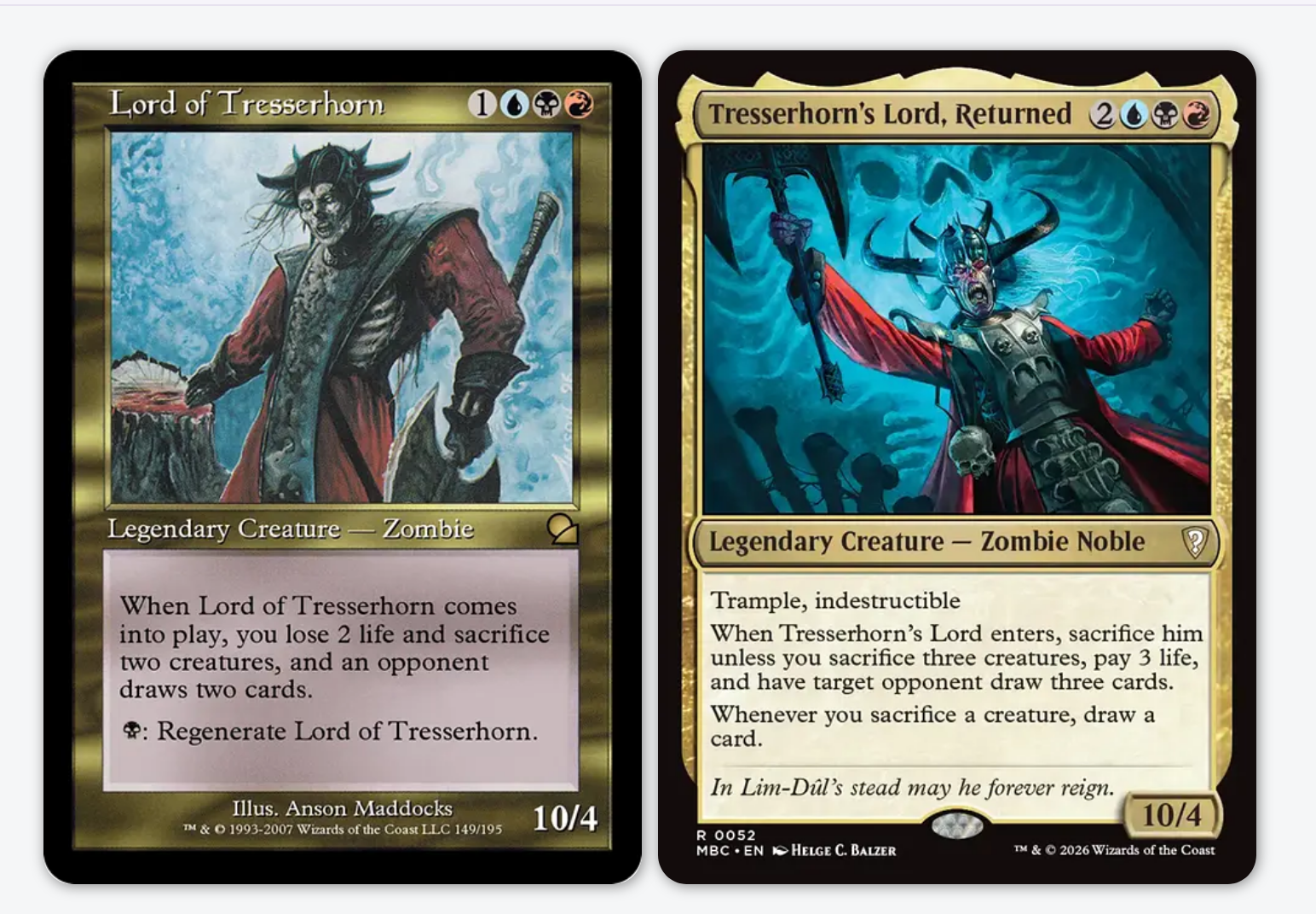
Like Baroque architecture and Botero’s Monalisa, everything is bigger in MBC, more bombastic, more spectacular. In some cases, this increase is purely numerical. Tresserhorn’s Lord, Returned tweaks Lord of Tresserhorn by sliding up almost every feature by one—one more mana to play it, one more creature to sacrifice, one more life you pay, one more card in your opponent’s hand. Wizards further juiced his Crusty Lordship by giving him trample, indestructible, and an ability that pays off his crazy ETB demands. Like the jumbo-sized axe he swings around, liked the pronged helmet-horns that seem to have grown twelve sizes since 1996, the new Lord of Tresserhorn is entirely impractical and delightfully loud.
So too for some of the set’s hilariously strange mechanics. Some, like the aforementioned Sash and Waistcoat—
—sorry, had to stop and hurl from thinking about them again–
—and Lyna, Veil of Vengeance provide support for archetypes that are barely playable to begin with, in this case cloaked cards and cards with Shadow. Others get even odder: I love cards like Grandmother Goby, which encourage you to shift the basic vocabulary through which you interpret Magic—how do you turn counterspelling yourself to an advantage? There is, in fact, an answer, but I leave it to you.
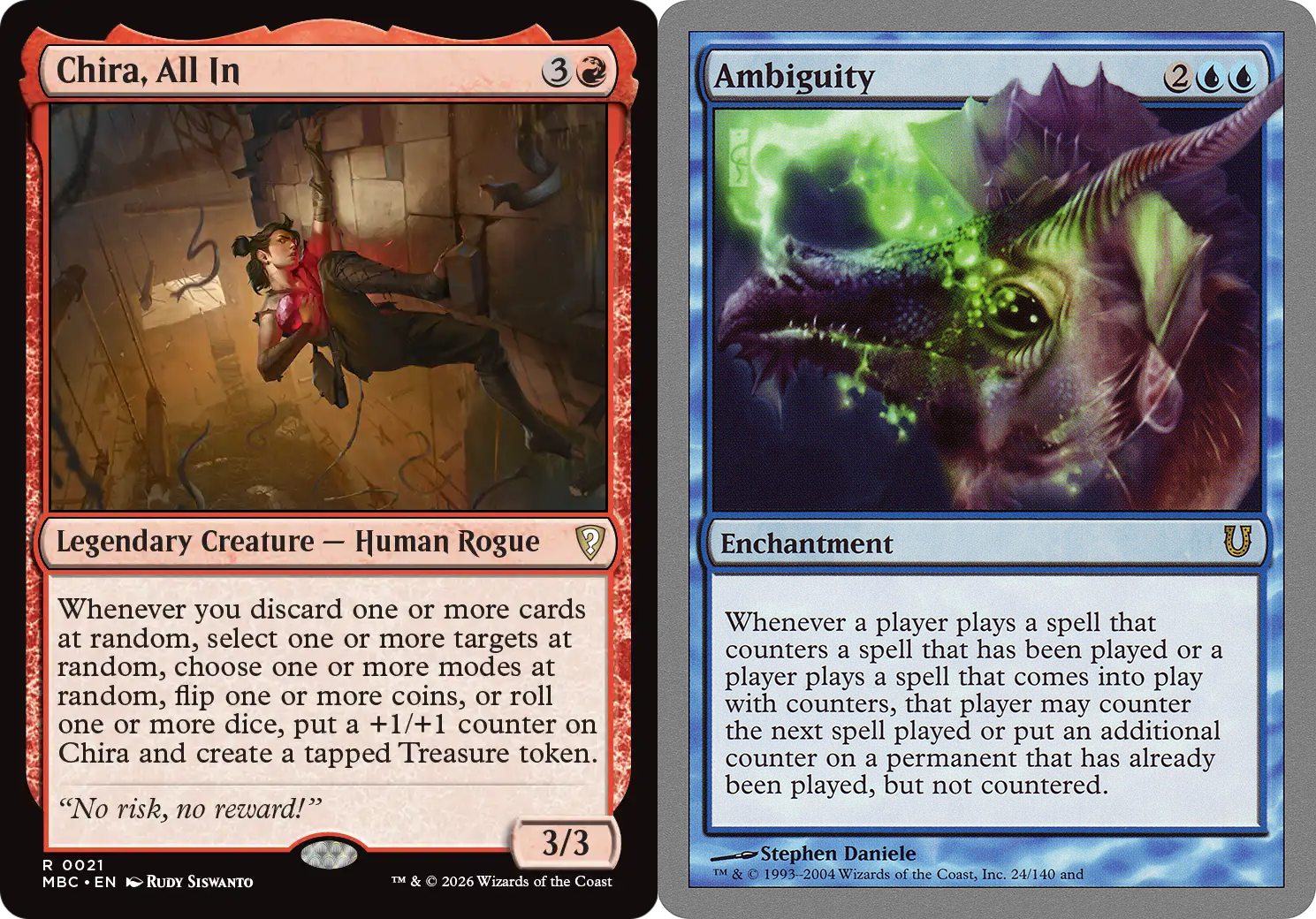
Others revel in labyrinthine layers of language—some, in fact, less complex than they appear. Chira, All In asks whether excessive wording might be an aesthetic feature. Chira stacks words upon words upon words, “random” upon “random” upon “random” , all this in spite of having a fairly intuitive design (whenever you do (almost) anything at random, Chira gets a counter and makes a treasure). This may be the closest a modern Magic card gets to an Un-set card like Ambiguity, and I love it for that reason—against the fluid speed of play so common in Commander, it asks you to slow down and laugh at a hat being balanced on top of a hat being balanced on top of a hat.
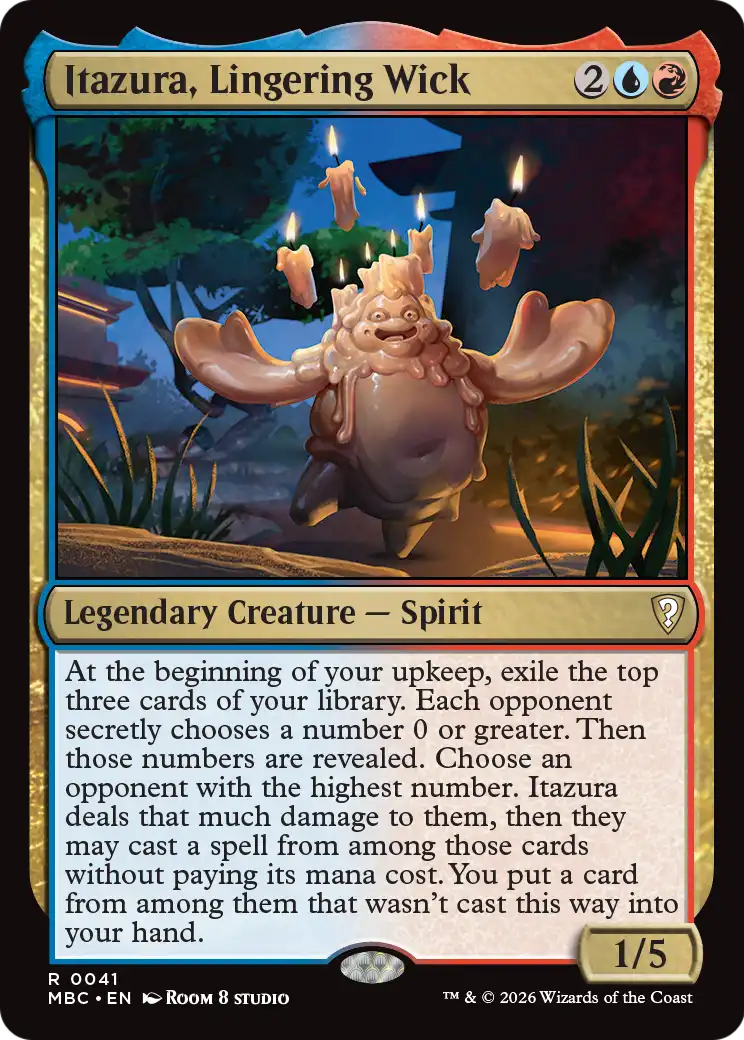
Ditto for Itazura, Lingering Wick, whose squishy lovable body is matched by a soupy mass of words that I haven’t yet cracked a code for strategizing. But that’s the fun of it, after all: this is a card designed like a cartoon hammer, and if you’re ready to get flattened like a pancake, you might enjoy it.
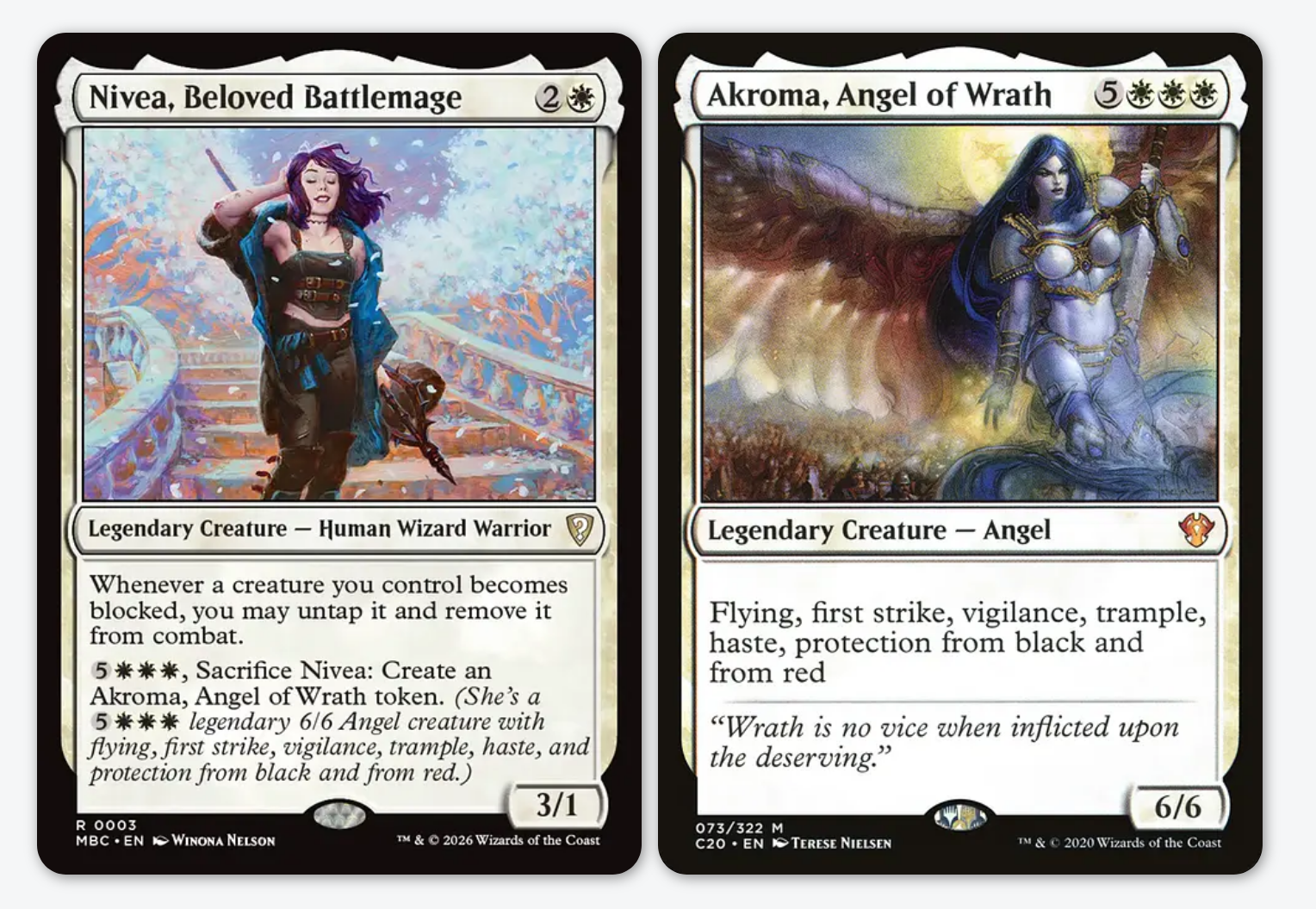 Perhaps the best encapsulation of the more-is-more mentality guiding MBC is the proliferation of highly specific or highly powerful tokens, like Thomil’s Lord of the Pit tokens, or Nivea, Beloved Battlemage’s Akroma, Angel of Wrath tokens, or, my goodness, the Black Lotus token generator stapled to Arzakon (to say nothing of his other two Alpha-referencing abilities). All these cards announce and revel in their own excess—and in so doing, they announce their own unseriousness. These are not format nightmares like Elesh Norn, destined for consistent infinite combo powerhouse decks. They’re Timmy-Bait, loud challenges to do something absurd–more Looney Tunes than Tchaikovsky.
I could go on and on and on about MBC—I haven’t even touched on the hilariously stupid-fun design of Ashaya’s Enduring Bond–but I think you get the idea.
I’m transfixed by this tiny file of cards because, viewed from a 1000-foot distance, it would seem to embody much of what’s problematic about contemporary Magic. And yet MBC fills me with delight, bloats me up like a lady in a Botero painting. Perhaps, to return to that distance analogy from two sentences ago, it’s because MBC isn’t meant to be viewed from 1000 feet away. Like a rock concert or maximalist art exhibit it wants to be viewed up close, just so you can see how huge and hear how loud it actually is.
Ryan Carroll (he/him) is a writer and Ph.D. candidate in English and Comparative Literature. On Substack as Dominarian Plowshare, he writes about Magic’s art, story, and experience. Outside of Magic, he writes on topics including 19th-century literature, information theory, television politics, and cliche.