


I would love to pretend that my introduction to The Hobbit was through the charming version illustrated by Tove Jansson–about to be reprinted in America for the first time–or the elegantly bound 1988 Douglas A. Anderson reissue, but that wouldn’t be the truth. The first copy of The Hobbit I ever read was the one my sister brought home from middle school in 1994. It was a dogeared copy of the 1982 Ballantine Books edition, on the cover of which Michael Herring chose to depict Bilbo Baggins as Bobby Baccalieri in a wig and Gollum as some sort of malevolent turnip.
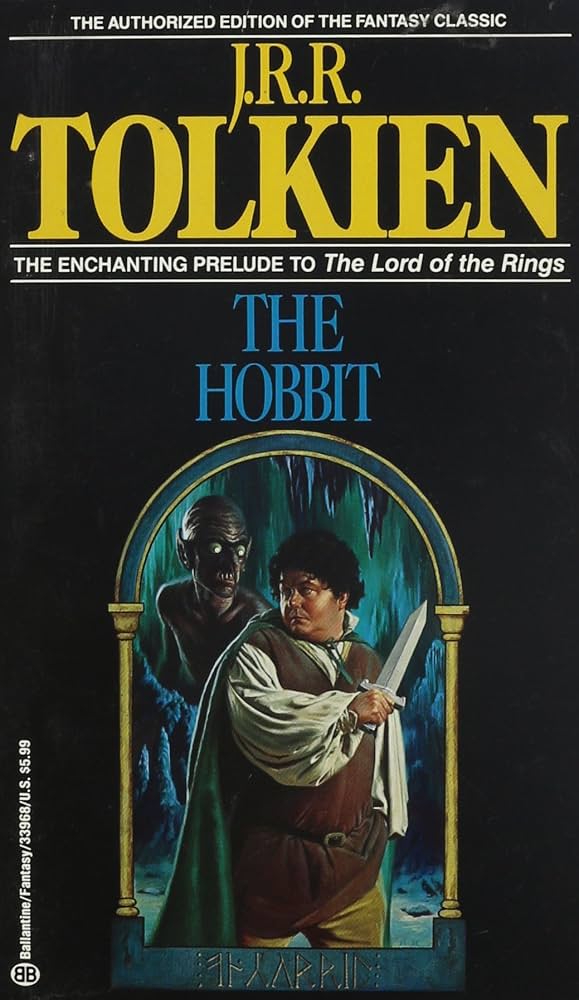
Not the most inspiring cover art, but I was a fantasy fiend at eight, having devoured the Prydain books with my father and moved on to C.S. Lewis. Tolkien was a natural next step, particularly when my sister dismissed the book as being “full of trolls and goblins.” Those, I believed then and still believe now, are the best kinds of books. What The Hobbit is also full of, even more memorably, is Gollum.
The aforementioned Anderson, a scholar of Tolkien, theorizes that “Gollum” comes from the Old Norse word “goll,” meaning “treasure, something precious,” which is the sort of antediluvian wordplay Tolkien loved. It’s somewhat of a cognate with “Golem,” too, but we don’t have the space to go into Tolkien’s complex attitudes toward Judaism today. Textually, it comes from the guttural swallowing noise Gollum is constantly making in his throat, which must have been profoundly disruptive if it became his cognomen. Tolkien describes in The Hobbit as “slimy,” “as dark as darkness” with “two lamp-like eyes.” Otherwise, Gollum is not elaborately described in early, unrevised versions of the novel, leaving it up to the reader–or, as Tolkien was adopted by the culture and adapted in the 1970’s, to the director.

In the 1977 TV movie of The Hobbit, directed by Arthur Rankin, Jr. and Jules Bass and animated by Topcraft Limited Company before it evolved into Studio Ghibli, Gollum is a flabby froglike creature voiced by surrealist performance artist Brother Theodore. I’m a huge fan of this Gollum design. He doesn’t look like a feral Hobbit, but like a rotting amphibian with gray skin and hanging flesh. Brother Theodore’s performance is alternately lugubrious and ferocious, all guttural muttering and uncontrolled shouts. It’s an unrestrained and rough performance, like a lot of that flawed adaptation, but there’s a pathos and pain to Brother Theodore’s Gollum.
That makes sense once you know the story of the performer. Brother Theodore was a midcentury polymath with one of those backstories that sounds like the flight of a fabulist but is well-documented. An Austrian Jew, Brother Theodore was sent to Dachau, where he was released after signing over his family’s fortune to the Nazis. He bounced around Europe before emigrating to America under the recognizance of his friend (and, per some accounts, his mother’s boyfriend), Albert Einstein. In the 1950’s and ‘60’s, he became a Greenwich Village cult figure, performing macabre monologues to hepsters and beatniks, and making money by hustling at chess.
A favorite of David Letterman’s, he appeared on his show sixteen times. Like many great depressives, he lived a very long life, eventually dying of pneumonia at 94. He is buried in New York under a headstone with the epitaph:
Known as Brother Theodore
Solo Performer, Comedian, Metaphysician
“As Long As There is Death, There is Hope”
There’s a temptation to see Brother Theodore as an icon of pre-financialization, pre-Giuliani New York, the era summarily decapitated by 9/11. There’s something haunting about him, a lingering existential chill of the horrors of the 20th century and their echoes in the 21st and how they can be ameliorated through living. This is a man who lived three lives throughout nine decades, from decadence to Dachau to the depredations of the New York City arts scene. To make him an icon would be a disservice to his memory, though—perhaps it’s best to remember him as David Letterman did, as “philosopher, metaphysician, and podiatrist,” or as I first came to know him, as Gollum. I showed my three-year-old daughter the Rankin-Bass Hobbit a few months ago, and as rushed and shoddy of an adaptation as it is, Theodore’s Gollum remains a highlight to me and a new joy to her.
Our next depiction of Gollum was in Ralph Bakshi’s 1978 adaptation of Lord of the Rings, where he’s an emaciated green goblin with pus-yellow eyes. As Bakshi was working with rotoscope technology, he couldn’t stray as far from humanoid forms as he could have in other forms of animation, so his Gollum is disconcertingly human in proportions and movement. He’s voiced by Peter Woodthorpe, a British stage and character actor, who broke onto the stage in his twenties as Estragon in an early production of Waiting for Godot. Frankly, the Bakshi movie is a mess. It ends midway through The Two Towers, elides Tom Bombadil and The Old Woods, and has generally weak and cliché character designs. It remains mostly notable for inspiring Peter Jackson’s adaptation and for giving early hands-on training to Tim Burton and Bakshi collaborator (and Magic artist) Mike Ploog. Gollum isn’t among these highlights. I’m sure Woodthorpe was a great stage performer, but his Gollum performance is neither interesting nor committed; that said, it’s clear that Peter Jackson was inspired to an extent by the Bakshi version of Gollum.
This brings us to Andy Serkis’ Gollum. Serkis gives us an indelible performance that has, like Ian McKellen’s Gandalf, rewritten any preexisting depiction of the character. Serkis won a Saturn Award for Best Supporting Actor and the character was nominated by numerous other bodies for his performance and for Wētā Workshop’s digital effects work. The Lord of the Rings trilogy itself won 17 Academy Awards, including multiple for best make-up and visual effects, with Gollum doing some heavy lifting in those categories. Previous computer-generated characters were hyperexaggerated or deliberately inorganic—c.f. Young Sherlock Holmes’ stained-glass knight, prefab protagonists of Toy Story, or the elastomorphic Jar-Jar Binks—whereas Gollum, to work as a character, had to be present in the scene and read as emotive and expressive. He may have been a CGI representation of a decrepit Hobbit, but he crucially had to be human enough to land as a digital actor.
Serkis’ Gollum is all about tension. There’s a humanity in his features that contrasts with his simian and scrabbling physicality. He’s not cute per se, but his features—exaggeratedly large eyes, a small nose, tapered face—are signifiers of “cute” in cartoon and character design. The character work done by Wētā and by Serkis highlights Gollum’s divided nature and the archetypal British Catholicism that runs through Tolkien’s conception of Gollum, culminating in the glowering Gollum contrasted with the childish Sméagol in The Two Towers’ “dialogue” scene.
After twenty-five years, there are some technological seams, mostly in how Gollum is lit compared to the scene around him, but they’re minor and entirely covered up by the commitment of Serkis’ performance. His Gollum is pathetic in every connotation of the word, his physicality alternately subservient and petulant, his vocal tics irritating, his sallowness and scrawniness uncanny and pitiable. It’s notable that The Hobbit trilogy doesn’t update the character beyond minor visual tweaks to better composite the model into the scene, and that, I would argue, Gollum doesn’t look much more “realistic” than he did in the original trilogy. That’s less a slight on The Hobbit than praise for Serkis and Jackson’s work back at the turn of the millennium; Gollum truly is a uniquely inspired creation. Personally, I found The Hobbit trilogy all but unwatchable, with the “Riddles in the Dark” segment in the first coming closest to recapturing the magic, thanks to the incredible work Serkis did in reconnecting to Gollum.
As you might expect, Magic’s Gollum is very much aligned with the Peter Jackson depiction. As approved by Middle-earth Enterprises, a notoriously litigious and continuity-conscious corporation, he’s a grayish-blue emaciated guy that’s recognizable as a degenerated Hobbit and of the lineage of the Bakshi-Jackson Gollum. There is a continuity of style that transcends artist. Nino Is’s Gollum (The Torment of Gollum) is identifiable as Dimitry Burmak’s Gollum, Scheming Guide, who resembles Irvin Rodriguez’s Gollum, Riddle Master. There was clearly a style guide produced by Wizards and Middle-earth Enterprises to keep everything aligned with the post-Tolkien vision of the brand, and even slightly off-model versions like Campbell White’s Sméagol, Helpful Guide are well within artistic parameters. Gollum, Riddle Master could be slush art from the old Decipher TCG (although, having reviewed some of the Decipher cards, Irvin Rodriguez’s art is better executed than every screengrab and illustration from that defunct game). Again, this all makes sense, as the Andy Serkis Gollum has a cultural cache that you have to either grapple with or capitulate to, and Wizards of the Coast only has so much space to innovate the imagery of some of the most popular and well-regarded movies of all time*.
*I am aware of the Peter Jackson trilogy haters, I get your concerns and even share some, but the movies made $5.6 billion total (adjusted for inflation as of 2025) off a $525 million (adj. for ‘25) total budget. They are what Lord of the Rings is to the vast majority of people.
Wizards of the Coast sees their job as delivering or embodying the familiar. This is not an insult or a kvetch, as “familiar” can be anything from a Gollum that aligns with the Jacksonian depiction to a reference to Uncle Istvan that gets a pop from the old guard. It does mean that Wizards was not going to give us a feathered and corpulent Gollum or a looming Gollum like Tove Jansson did in her early illustrations, because you need to rely upon shorthand when your canvas is 2” x 1.5” and mostly seen upside down and across a table. Gollum has become canonized as a slinking, starving thing, a halfling made a quarterling through centuries of meanness and isolation, and so Magic’s Gollum has to abide by that cultural impression. But, like Gollum’s Halfling nature lingering through the centuries and leaving him open to redemption, older and stranger versions of Gollum peek through the style guide. The book cover variant of Gollum, Riddle Master in The Hobbit, with its rich purples and dark-hued Gollum, even has a kinship with the Michael Herring cover. Tolkien was a proto-Jungian, a writer obsessed with linguistics and semiotics and the way they shape cultural memory, and he would be astounded at how his work has shaped the trajectory of European fantasy. The tropes he established in Middle-earth became the bones of Dungeons & Dragons and the early years of Magic, with its brutish orcs and sinister wraiths and dwarven gold. There’s something wonderful about how the gleaming highlights of myth become old tropes and how innovative imagery becomes hoary archetypes with repeated exposure. We make ourselves out of what we collect or pilfer, which is something Bilbo, the accidental burglar, and Gollum, the tortured thrall to seductive evil, would both agree is precious.
Rob Bockman (he/him) is a native of South Carolina who has been playing Magic: the Gathering since Tempest block. A writer of fiction and stage plays, he loves the emergent comedy of Magic and the drama of high-level play. He’s been a Golgari player since before that had an official name and is never happier than when he’s able to say “Overgrown Tomb into Thoughtseize,” no matter the format.