


The multiverse is in stasis.
Ever since the culmination of the New Phyrexia arc in 2023 with March of the Machine, there’s been something of a lull. The well oiled joints of narrative machinery have begun to creak to a halt, and we’ve settled into what might be dubbed as a “filler season” of our favorite story. More than just the “beach episodes” of Murders at Karlov Manor, Outlaws of Thunder Junction, Duskmourn, and Aetherdrift – and crikey, that’s more episodes with funny hats than even I recalled when I began that sentence – we’ve had to sit through the relatively unimportant Wilds of Eldraine, Bloomburrow, and Lost Caverns of Ixalan, sets that felt decidedly low-stakes. Playing through the sets since March of the Machine has felt like watching Supernatural post Season 5, before it found its footing again.
You might sit there and tell me I’m wrong, and that the Omenpath arc has actually been good. I’m not here to dispute the quality of storytelling; indeed, a lot of the fiction crafted in the past few years by various writers has been good, if not exceptional. My point is more that without having multiple sets in a block structure, we lose the narrative momentum needed to signify the passage of time, the build up and outcomes of conflict, and the new equilibriums that result. Much the same as a photograph captures a flattened three dimensional image, when each story is condensed into a singular snapshot in time, it’s hard to really grasp the peaks and troughs of the journey we’re on.
There can’t be a rising conflict or a climax when you’re experiencing everything all at once.

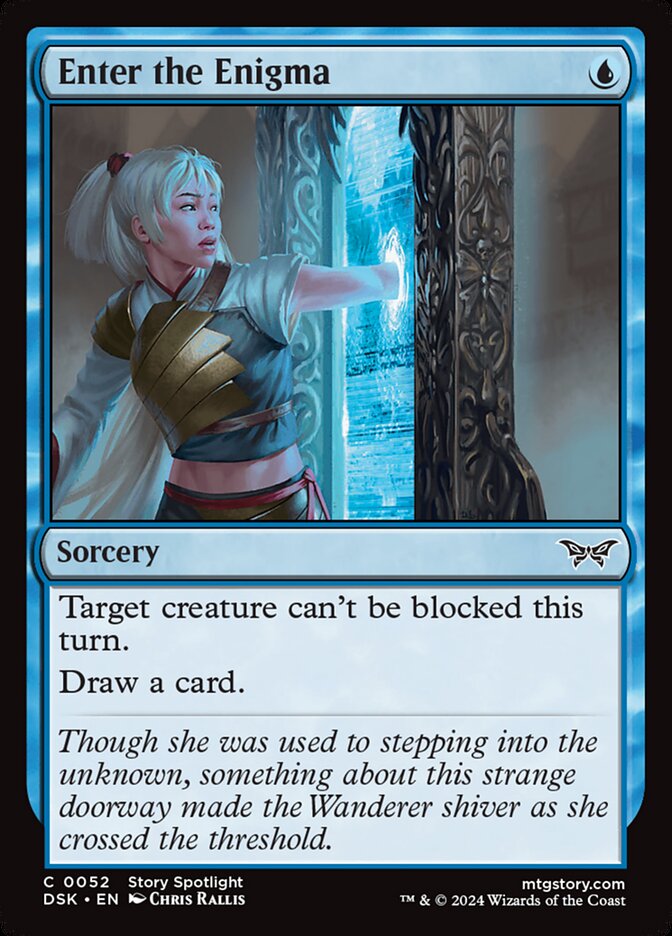
The wider Magic multiverse is massive, and the ripple effect of conflicts like the one in March of the Machine stretch through dozens of planes, affecting dozens upon dozens of characters, nations, factions and worlds we’ve visited in the past. We need time to see how things settle, but that’s time we’ve not been granted, as the next story arc has begun to set up momentum for a narrative peak in Reality Fracture later this year. Why haven’t we had time? Well, in part due to the aforementioned low-stakes visits to top-down planes like Bloomburrow and Eldraine, and because of the “beach episodes” – but also because of the sheer deluge of Universes Beyond that takes up so much of the modern release schedule.
After 2024’s year of hat sets and holidays, 2025 saw Aetherdrift, Tarkir: Dragonstorm and Edge of Eternities compete for space with FINAL FANTASY, Spider-Man and Avatar. In 2026, the balance tips further in favor of Universes Beyond, with only three in-universe sets to four Universes Beyond ones. While Standard in previous years has featured fewer sets than the increasingly unmanageable roster of recent times, it’s hard to ignore the impact that this schedule is having on Magic’s rich and deep lore.
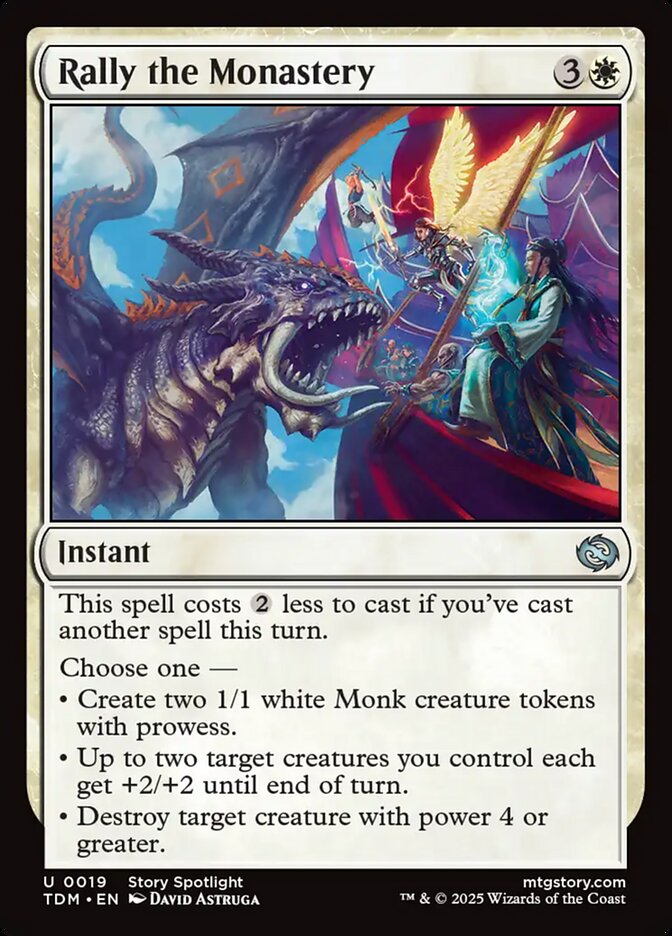
At the moment, Magic story is annually defrosted, much like Mariah Carey, and trotted out to drum up interest in a set. In 2025, it was Tarkir: Dragonstorm’s battle featuring Elspeth, Narset, Jace, Sarkhan and Ugin – classic Magic to be sure. In 2026, it’s going to be Reality Fracture, where we’ll learn more about Jace’s machinations. While it was nice to stop off on Lorwyn and Strixhaven, the former was a misstep lore wise, as we only got one set to somehow do justice to a plane that had four sets and dozens of mechanics over a two year period nearly twenty years ago. While Strixhaven gave us the phenomenal companion novel Omens of Chaos by Seanan McGuire, the set itself ultimately felt very similar to our first visit, and served only to tee-up Reality Fracture. We spent most of our time on the same campus, with only a brief excursion to the “DLC zone”.
The issue with the kind of storytelling we’re getting with Magic story right now is that by drip-feeding us such small morsels of ongoing narrative, the overall story turns into one of “potential” – and the problem with stories that have potential is that they inevitably fall far short of that promise because they just can’t stick the landing. This is especially the case in the kind of environment Magic finds itself in, with hardly any space to tell the story it wants to tell, and with only ever one set to establish and resolve the climax.
Even though block storytelling remains as an available tool, it seems to be forever shunned out of fear of disengagement due to boredom. It’s the problem of our time. Rather than trust the audience and be happy with better-than-modest profits, endless growth demands that keys are jangled to keep the TikTok generation engaged in a culture of consumption. Instead of allowing a story to be told over multiple sets (even just two) we’re being told to look at the rabbits and mice – no! – look at the horror plane, it references the thing. Isn’t that cool? If you don’t like it, just wait for the next hat set, you’re sure to like that one. The similarities with Universes Beyond are nauseating.
THE AFTERMATH OF AFTERMATH
This brings us neatly to one of the most maligned sets in recent times, March of the Machine: The Aftermath. Critically panned on release, Aftermath features only 50 cards, and is somehow a booster product. It doesn’t take a genius to figure out that a 50-card set randomized in 5-card boosters would go down like a lead balloon, but it got approved anyways. It features 35 rares or mythics for the rare slot, and only 15 uncommons, which makes the uncommons quite common, really.
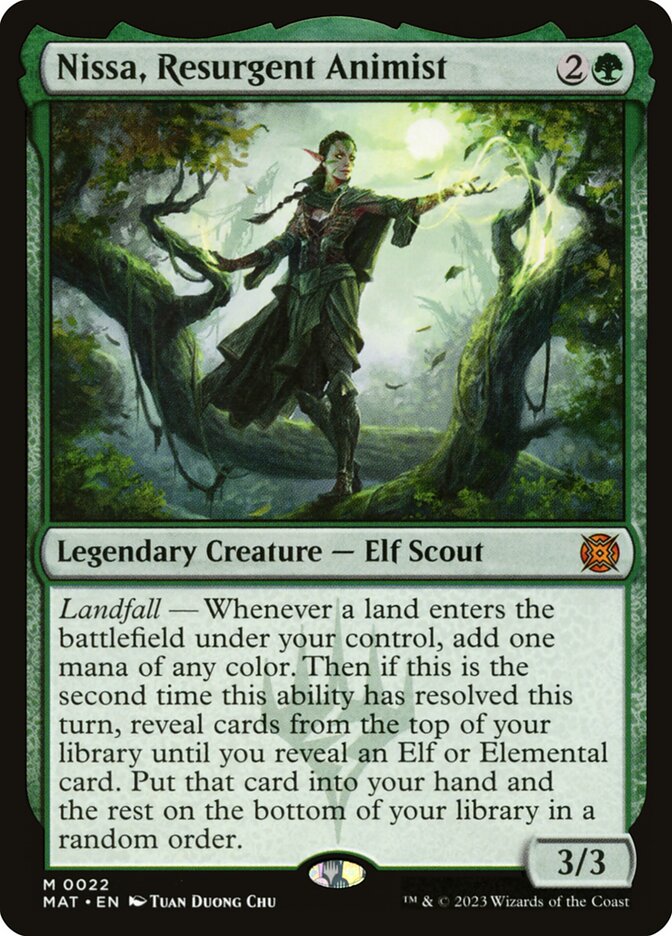
Even if Aftermath was a terrible product in its execution, the card designs are really quite good. While no single card blew up a format, we did get a nice shake-up of the Amulet Titan and 4C Omnath Modern decks with the addition of Nissa, Resurgent Animist.
Aftermath delivered some of the most interesting Commander designs in recent memory, with desparked creature versions of popular characters that have powerful – but not pushed – deckbuilding. Kiora, Sovereign of the Deep is such a fun sea creatures Commander. Nahiri, Forged in Fury keeps coming back for more, and pushes you toward Living Weapon equipment, which is very on-flavor for her character arc. Narset, Enlightened Exile is powerful, and cheaper to cast than the misery inducing six mana version that nobody wants to play against. These designs are home-runs, and are the design team firing on all cylinders to deliver cards that not only capture the essence of the characters, but crucially are cards people actually enjoy playing with.
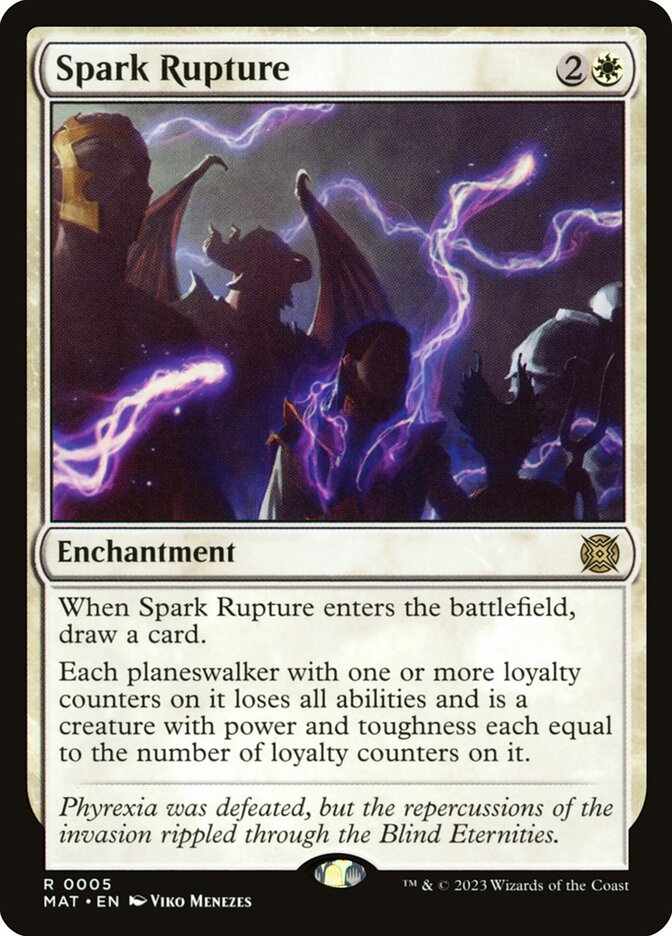
Elsewhere, we got cards that showed us the literal aftermath of the multiversal battle against Elesh Norn’s New Phyrexian invasion. The flavor text was concise, yet helped us piece together – along with the art and the card mechanics – just what was transpiring next. One of my favorites from the set is Gold-Forged Thopteryx, with flavor text “Worlds apart, Huatli built a device Saheeli would have been proud of.” Just in that one card, we got to learn about how different planes learned from each other, and also how heartbreaking it is for two close Planeswalkers to be suddenly ripped apart. It would have been trite to show us separated love interests multiple times in Aftermath (given the emphasis on Nissa and Chandra), so I can excuse the avoidance of actual representation when the set is only 50 cards; that said, this flavor text is peak storytelling.
Unfortunately, despite what the set did well, Wizards has axed this type of product, because Aftermath was so poorly received. You couldn’t even draft it. The Big Score bonus sheet from Outlaws of Thunder Junction was essentially comprised of cards from a planned mini-set, and feedback was folded into how they did Assassin’s Creed.
IT COULD BE GREAT
The thing is, I don’t think it’s impossible to make a good product here, and the ethos behind Aftermath is something that I wish Wizards hadn’t discarded so soon. We don’t get to catch up with the wider multiverse nearly as often anymore; partly due to the proliferation of Universes Beyond, but also for other reasons.
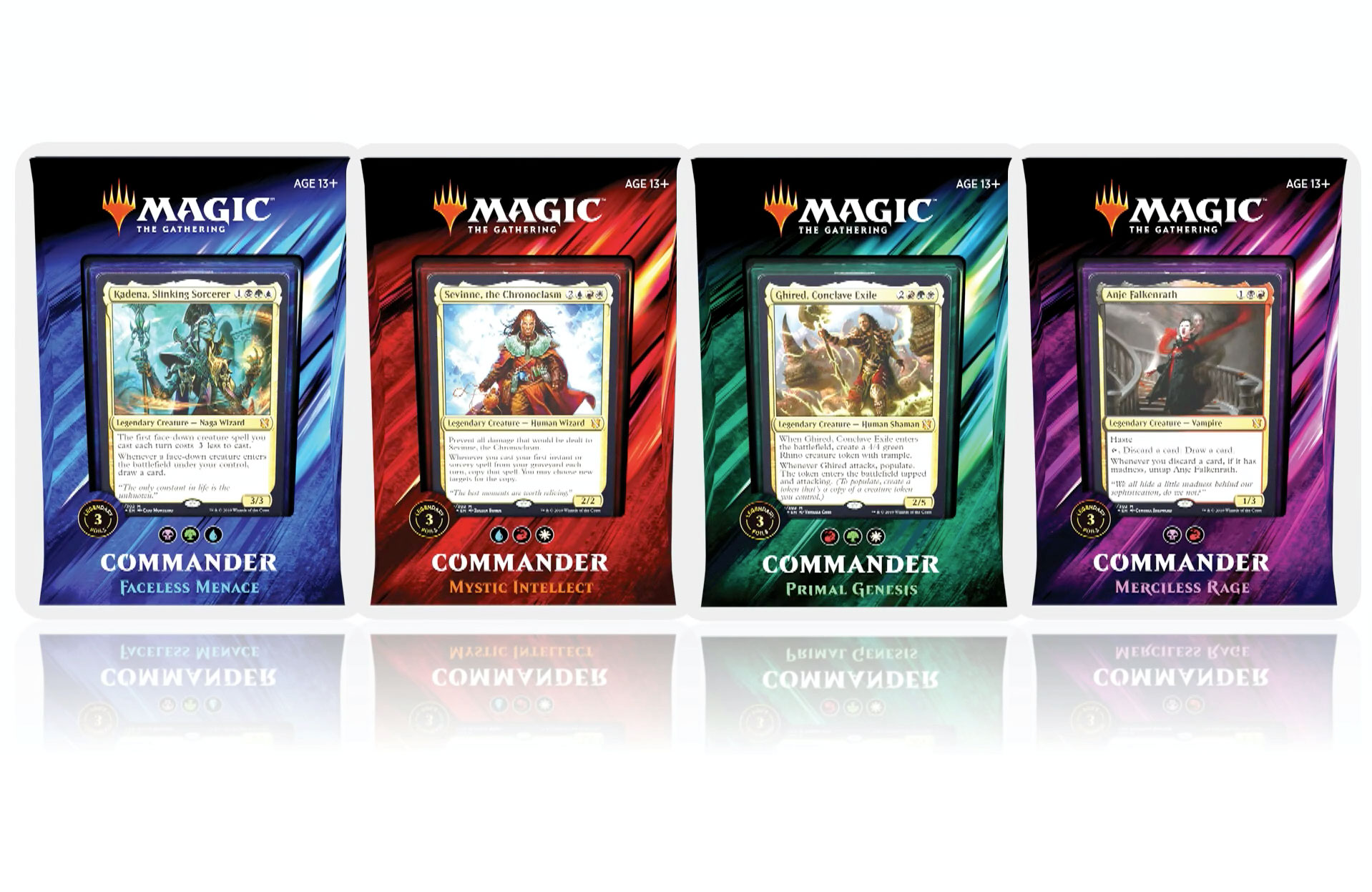
We used to have a yearly Commander product release where we visited different pockets of the multiverse to learn more about a specific character, and often we’d find out more lore about the past or the current events of whatever plane they resided on. It was also an excuse to give support to a lesser-supported archetype – in Commander 2019, we got a Sultai Morphs deck, while also learning more about Dominaria’s Chainer, Nightmare Adept and Innistrad’s Anje Falkenrath, among others. These decks were filled with easter eggs to find, too – I look back fondly on this treatment, and I think there’s a big hole left by moving on from it.
When we had yearly Commander decks and other experiments – from From the Vault to the Signature Spellbook series – we got a look into the lore of Magic more broadly. The current set up means we only really see one plane at a time, at one point in time, and we don’t even have Masters reprint sets to deliver us new art and storytelling, piecemeal.
Universes Beyond has had an inarguable impact on the game, but one aspect that we don’t talk about often enough is how it has drowned out the card pool, and how that affects in-universe design. When the ratio of new Magic Legends to UB Legends is 1:5, the available design space is eaten up by the fact there needs to be dozens of Spider-man cards. The very real impact here is that we don’t have time or opportunity to see in-Universe favorites grow, change, and adapt to the events in their lives.
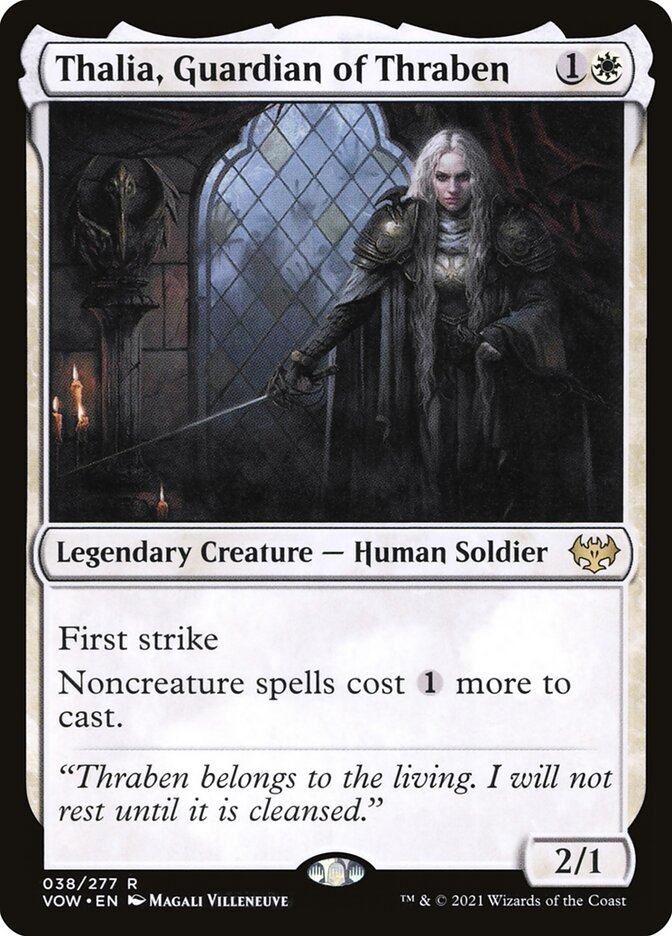
I can’t believe, at this point, that we only have two different Thalia cards – and one additional team-up with her riding The Gitrog Monster. Thalia is iconic, and she has had opportunity for growth. Reprinting Thalia, Guardian of Thraben into Standard provided some “wow” factor, but why couldn’t we have had that and an additional card to reflect her role in the story of Midnight Hunt and Crimson Vow? When you ask that question, threads begin to unravel, and you find yourself also asking why we didn’t get a new Odric card, pre-vamp, as well as his more bitey version.
The overarching reason that Aftermath was a bad product lies in the insistence on making it a randomized, undraftable booster product. There are myriad ways to solve this. Of course, you could make it draftable, but that would basically be in the guise of a Masters set, or a Core set. We’ve got Foundations filling the Core set slot for a five-year legality, so that doesn’t solve the issue. I doubt we’ll get Masters sets again anytime soon, unless they’re planning a UB reprint bonanza, whether in-universe versions or otherwise. Instead, you could make the boosters seeded, and offer them in one boxed product, with a guarantee of one of each card – a method used in Japan, where there are strict gambling laws. Another way would be to make display boxes – not unlike the current Scene Boxes used successfully in UB releases – and sell the cards that way. Hell, throw in some boosters of recent sets to make it more mass-openable. It works for Pokemon.
Whichever way you slice it, Aftermath failed as product, but not as an idea. The idea was fantastic, and it’s one that I think needs to live on. Magic story is massively underserved, and we so rarely get to see and interact with the timeless heroes and villains of the multiverse. It’s really hard to continue a story after ramping up the stakes time and time again – where do you go after killing God, right? – but therein lies the opportunity. We could be telling interesting side stories, entirely self-contained, and getting to see how our favorites grow. If they’re not going to give us multi-set blocks to experience how a narrative unfolds, and they’re trying to keep down the number of legendaries in in-Universe sets (to offset UB), then where do we go from there?
I feel the answer lies in the ashes of Aftermath. Just no more hat sets, please.
Kristen is a writer, streamer and member of the Commander Format Panel. Her work can be found across the magic-verse: at Card Kingdom, EDHRec and here at Hipsters. She’s way too into Boros and loves drafting as much as she loves EDH.