


There is probably a lot to say about Magic: The Gathering | Teenage Mutant Ninja Turtles, and I ardently refuse to say any of it, except for one thing, which in fact might end up being a lot of things: I cannot tell the legendary creatures apart.
This isn’t exactly an original insight. On countless Reddit threads previewing cards with one of the titular turtles, you’ll see at least one comment either curious or incredulous about how many Michaelangelos or Leonardos or Raphaels or Donatellos there are. And in fact, it is an especially high number: with each turtle appearing on one solo card in each rarity, and three dual-color team-ups in the main set, plus two additional solo cards and one additional monocolored team-up in Teenage Mutant Ninja Turtles Commander, each turtle appears on 10 cards (Leonardo, appearing as the face card of the Commander deck, appears on 11).
That’s to say nothing of the non-turtles: April O’Neil appears on 6 cards, Shredder on 6, Casey Jones on 5, Master Splinter on 5, Krang on 4, Bebop and Rocksteady on 3, Mona Lisa on 3, Rat King on 2, Rat Fillet on 2, Tokka and Rahzar on 2, Baxter Stockman on 2, and Leatherhead on 2.
To be honest, my knowledge of these characters flatlines after Bebop and Rocksteady, so maybe this is entirely reasonable, but it strikes me that the issue of repetition feels rather exhausting in TMNT—even more than Magic’s most legendary-stuffed set: Final Fantasy.

In part, this is a concentration issue. By my calculations, there are an average 1.75 legendary cards per character in Lord of the Rings and Lord of the Rings Commander—in other words, each unique character appears on an average 1.75 cards. 78 cards feature characters that appear more than once, which represents about 62% of the combined sets’ legendary creature cards and 20% of all new cards). In Final Fantasy and Final Fantasy Commander, the ratio is 1.16 (52 cards feature characters that appear more than once, representing 30% of the combined sets’ legendary creature cards and 18% of all new cards).
In TMT and TMC, that average is a whopping 3.12 legendary cards per character; 88 creature cards feature characters that appear more than once, representing 85% of the combined set’s legendary creatures and 33% of all new cards. That’s a big difference—as it bears out, Ninja Turtles’ density isn’t random.
But as much as numbers tell us, the sense of character overload also emerges in a more concrete place: on the card itself. When you need to jam fewer characters on more cards, their minute differences become all the more visible—and nowhere more clearly than in card names, in the sobriquets or epitaphs or titles or whatever you want to call them that demand we distinguish Raphael, Ninja Destroyer from Raphael, Tough Turtle.
And so this is not really a story about Ninja Turtles, not entirely. It’s a story about the vocabulary and syntax that have claimed an outsized place on Magic cards—and that have mutated with the game’s embrace of corporate intellectual property.
Etymology
Legendary titles are as old as legendary creatures themselves—though when they first emerged, dripping magma from the volcanic crags of the imagination, they were hiding in plain sight.
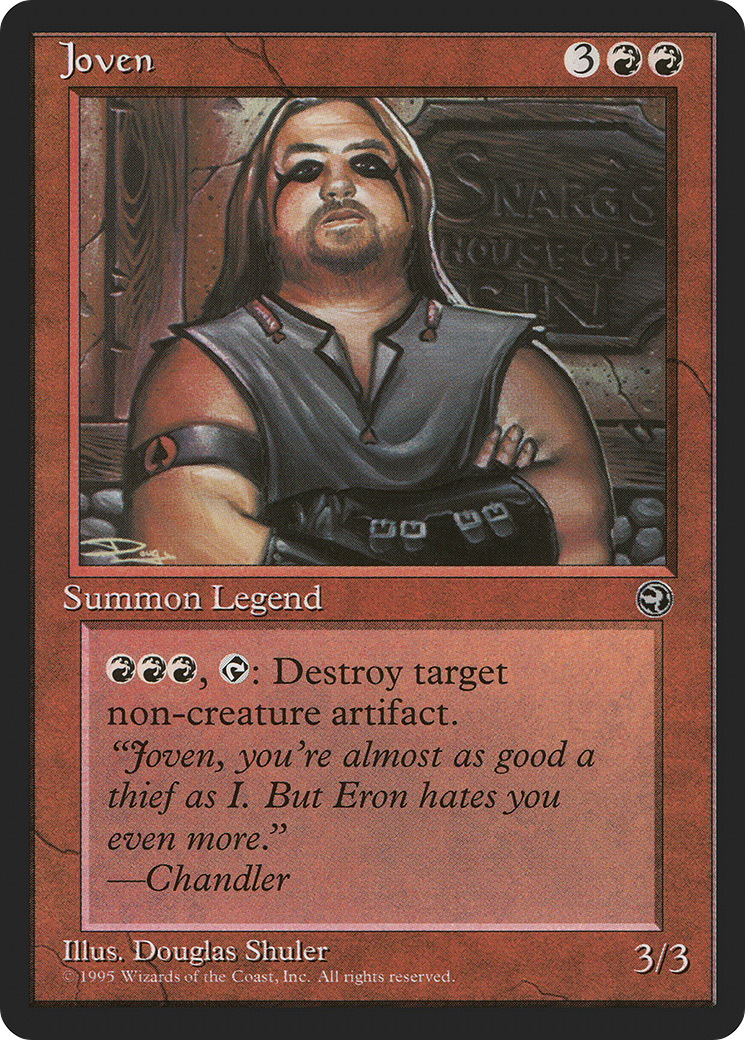
In Legends, which introduced the legendary creature supertype, most legendary creatures’ names are simply names: Torsten von Ursus, Jedit Ojanen, Gosta Dirk. Some of my favorites from this era are those with short, nigh-on-pedestrian names: Angus McKenzie, Ragnar, Johan, Jacques le Vert, Chandler, Joven. Oh, that guy? Yeah, that’s Joven.
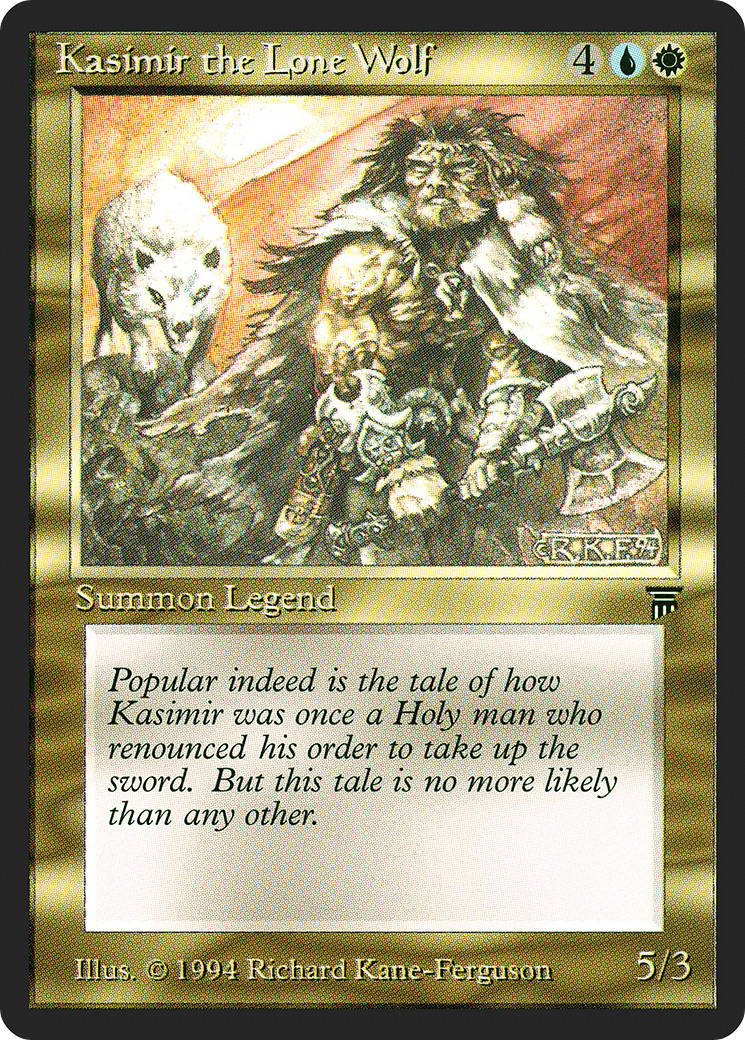
Others had titles of a sort, though they were more like medieval epithets (fitting for Legends’ sword-and-sorcery style): Gabriel Angelfire (he’s an angel, you see), Dakkon Blackblade (he’s got a black blade, you see), Kasimir the Lone Wolf (he works alone except for when he hangs out with one singular wolf, you see). These titles gave the scantest bit of evocative information about their subject, but most of the time it was nothing that the art didn’t already reveal (Sol’kanar the Swamp King is one of the few exceptions).
Things would continue in this fashion for the next year—until one punctuation mark snuck its way into an unmemorable blue legend in Homelands: Reveka, Wizard Savant.
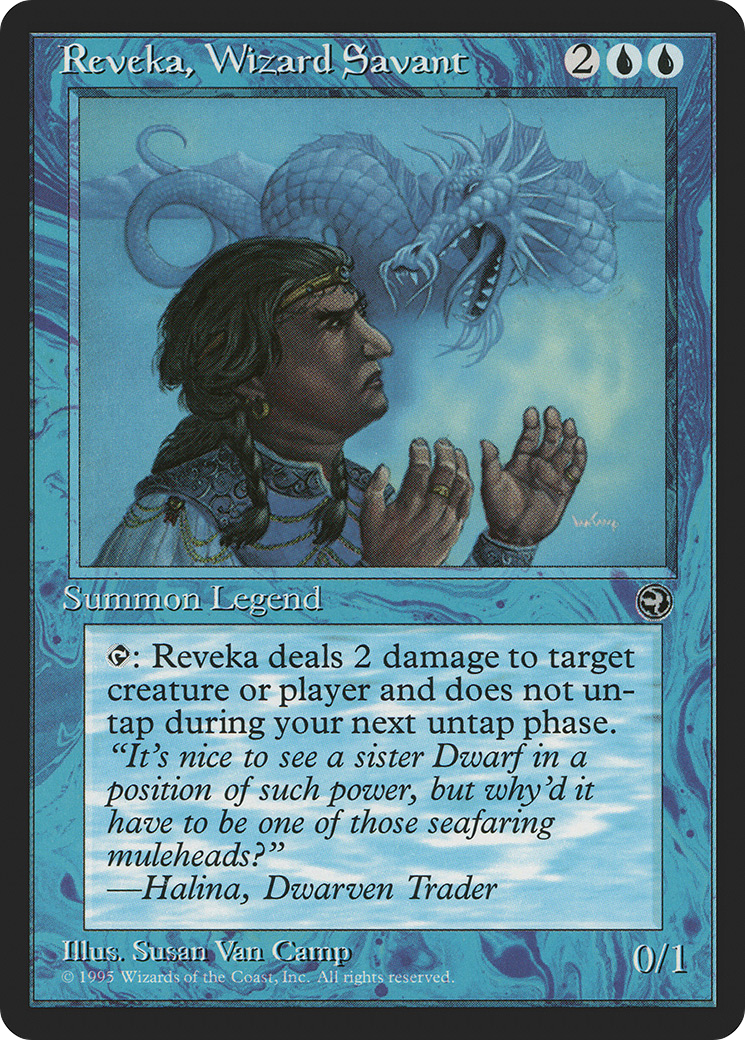
This card is the genesis of legendary card titles, that original blip from which legends have since descended. Elesh Norn, Grand Cenobite, Danitha Capashen, Paragon, Donnie and April, Adorkable Duo—all owe their names, however indirectly, to Reveka’s comma.
What this card innovates is a new grammatical mode for Magic card names. Up until this point, as we saw, legendary epithets worked only like literal titles: “Kasimir the Lone Wolf” is, grammatically speaking, the only lone wolf. But “Reveka, Wizard Savant” is something different: the comma turns the epitaph into a grammatical modifier, which means a card could be named after a character’s general noteworthy traits, rather than a totally unique title. Reveka is lots of things, but in the context of this card, she’s a wizard savant. The effect is to both give insight into Reveka but also to make her not-entirely-singular—to position her in a world of other characters.
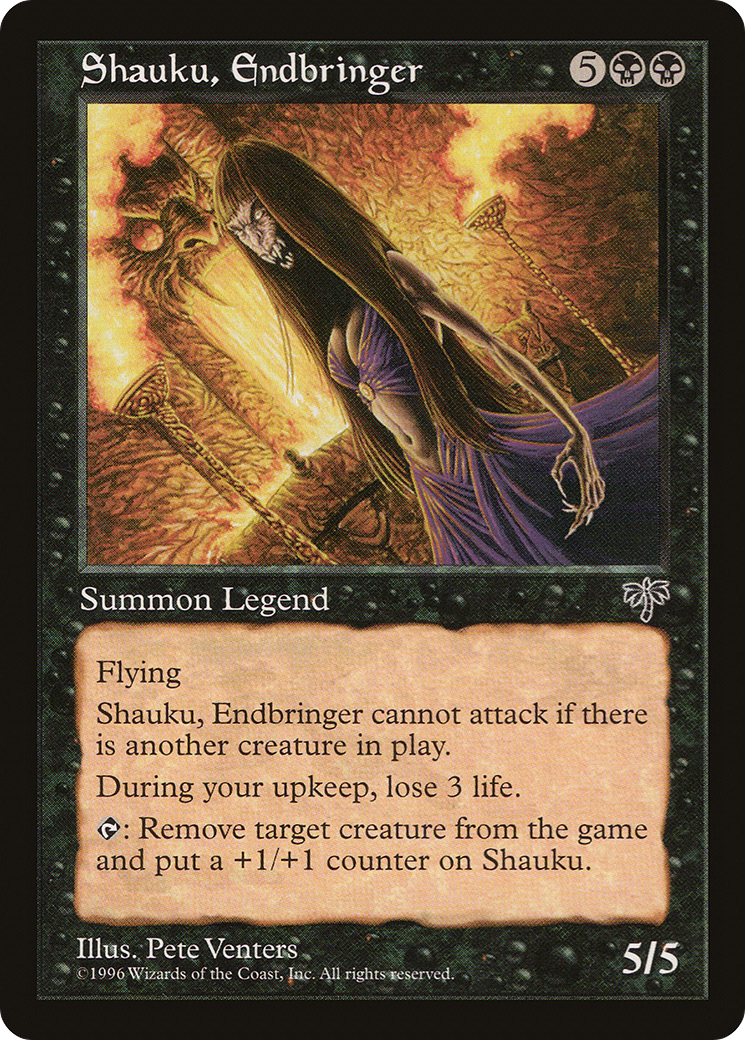
Reveka’s title was the only one of its kind in both Homelands and Alliances, but in 1996’s Mirage, Magic’s worldbuilders expanded the power of the comma: we see Zuberi, Golden Feather, Hakim, Lorweaver, Shauku, Endbringer, and Asmira, Holy Avenger. And that was just the beginning.
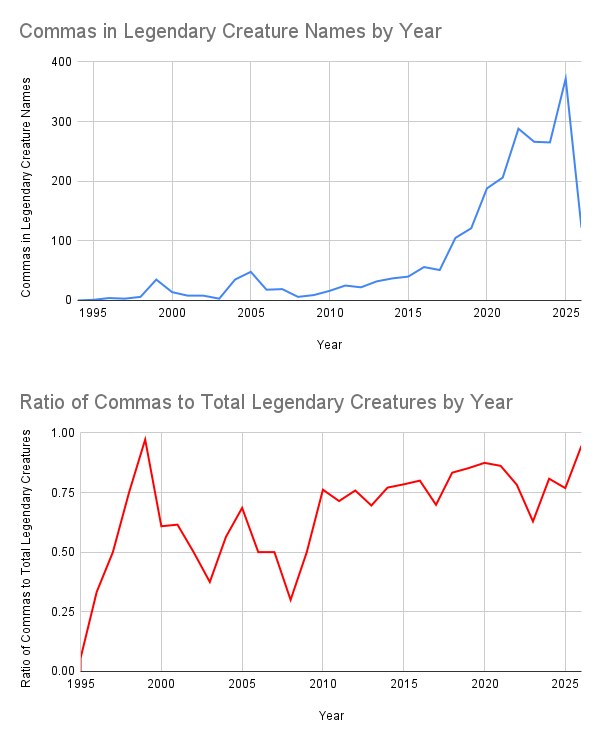
As these charts (which I, for some reason, spent an afternoon creating using data from Scryfall) illustrate, more and more legendary creature names began to include commas—and thus, presumably, modifier-based titles—over the course of the 1990s, apexing in 1999. That year, with the release of Portal: Three Kingdoms, every creature but one (Lady Sun) had a comma-adjoined modifier rather than an medieval-style epithet.
The raw number of commas surged and dipped over the next two decades, but the modifier-title clearly became convention along the way: since 1996, only two years have seen the commas-to-creatures ratio drop below 50%; in both of those years, modifier titles jockeyed for space with medievalistic epithets (and I’d wager that if they were printed today, many of the latter, like Balthor the Stout and Rhys the Redeemed might have used commas).
After the Commander Boom began in the late 2010s, the number of commas—like the number of legendary creatures writ large—skyrocketed. 2020 saw the highest ratio of commas to legendary creatures (188 to 215, or about 87%!) in a single full year, and in 2025, Wizards printed the most comma-modifier titles yet: 372. Things don’t show signs of stopping: although only two sets have been printed in 2026, 122 of the 129 new legendary creatures—that’s a stunning 94%—include commas.
Numbers like this, as I said above, can’t countenance the entire experience of playing Magic, but they can give an empirical basis to an intuitive feeling: there are a lot of titles to keep track of, even as Magic adds more and more characters (both old and new). The result is something that I’ve taken to calling…
Title Inflation
The function of the comma-modifier style of titling is to a) give a sense of a character while also b) alleviating the burden of singularity. Danitha Capashen doesn’t need everyone in the world to call her “Benalia’s Hope” for the card Danitha, Benalia’s Hope to exude her vibe. On the contrary, it’s better: the card represents the function she serves in the story itself. It’s a form of metalepsis, whereby a fictional work reaches out to its viewer rather than representing only the story-world.
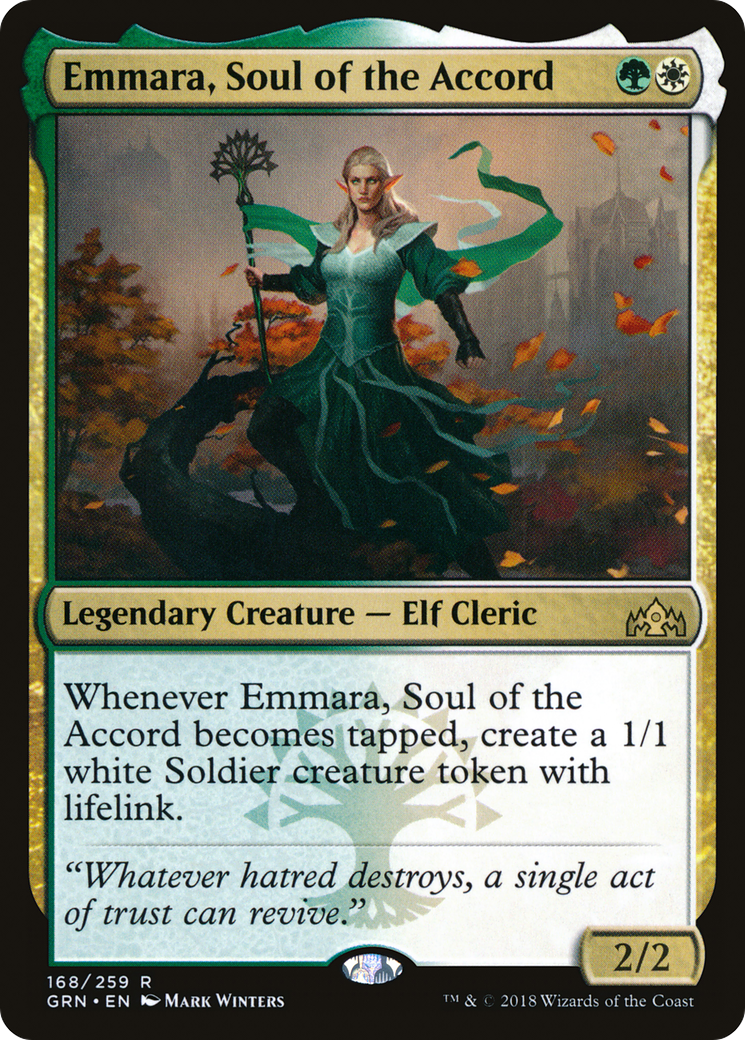
This metalepsis is, to my mind, one of Magic’s most powerful storytelling devices. When I was given my first Magic deck, a budget Emmara, Soul of the Accord EDH deck, it was Emmara’s title that captured me. What separated it from other character-rich games (at the time, I was thinking of League of Legends and Dota II, which is perhaps unfair, but they became slurry in my mind at the time) was the worldbuilding power of the name. I had no idea what this specific Accord was, but that didn’t matter: the title pointed me to a world beyond Emmara.
![A collection of several cards with cool titles, including Maha, Its Feathers Night; Teferi, Who Slows the Sunset; Kaheera, the Orphanguard; Chainer, Dementia Master; Silumgar, the Drifting Death; Obeka, Brute Chronologist]](https://www.hipstersofthecoast.com/wp-content/uploads/2026/03/07.png)
In other cases, titles can perform story work on their own, providing hyper-condensed character-building when other storytelling resources are sparse, as in Kaheera, the Orphanguard. Others can use poetry to make you feel the magnitude of a character’s power, as in Maha, Its Fearthers Night and Teferi, Who Slows the Sunset. Or they can add extra pizzazz, that little surprise that makes a character come to life, as in or Xolatoyac, the Smiling Flood or Belion the Parched.
In other cases, modifier-titles facilitate Magic’s increasingly cinematic storytelling. They might expose different angles on a character, as they do in Edge of Eternities’ Haliya, Ascendant Cadet and Haliya, Guided by the Light–one capturing the character’s material circumstances, the other evoking her motivations. Or, as in the case of planeswalkers, they might mark a character’s new position in an ongoing storyline, as in Jace, Unraveler of Secrets or Jace, the Living Guildpact.
But then, of course, there can be too much of a good thing. Too many titles, too many variations, too many reprints–the more titles you heap on a character, the less space remains for the next title to capture.
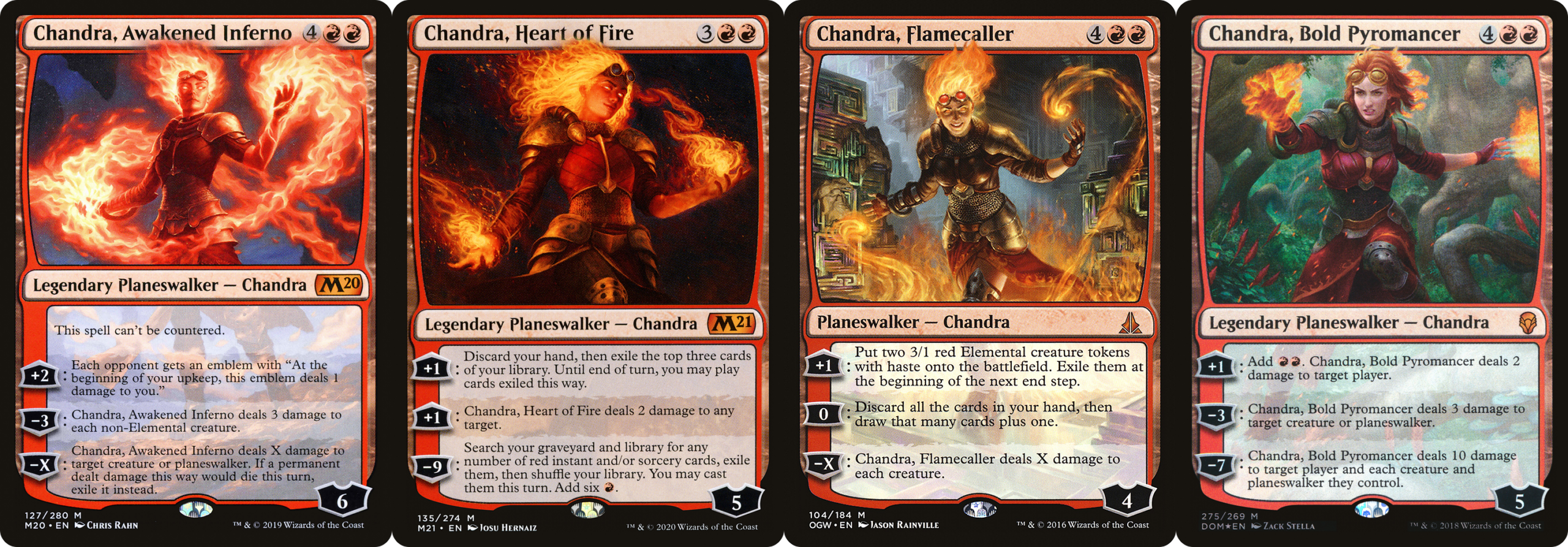
This is a problem for oft-printed characters. Is the vibe of Chandra, Bold Pyromancer all that different from Chandra, Pyromaster? Does Jace, Ingenious Mind-Mage stand that far apart from Jace, Arcane Strategist? Does Ajani, Inspiring Leader from Ajani, Wise Counselor? Wait, which Niv-Mizzet is that again?
And thus, inflation: a few titles are great, but the more titles you have, the less revealing they are.
To my mind, this problem has grown exponentially with recent Universes Beyond sets, which adapt franchises with a small and/or disproportionately iconic group of main characters. When you need to represent the same character seven or eight or eleven or times–and you need to do so in the same set—then the titles can lose their weight fast.
This difficulty points to another creative pickle—sometimes energizing and sometimes interesting, but also sometimes disheartening—in Magic’s ongoing romance with the word I hate to say but guess I will, IP. If the function of a title is to tell you about a character, but you already know the character—because why else print ten of each of the main characters—then what does the title accomplish?
For instance, from a design perspective, it certainly makes sense to have a Ninja Turtles card that highlights Leonardo’s relationship with his brothers, but what does the name Leonardo, Big Brother do, considering that I already know Leonardo is a big brother? What’s the point of having titles when they’re all basically expressing the same thing, as in the case of Donatello, Gadget Master, Donatello, Mutant Mechanic, Donatello, Rad Scientist, Donatello, the Brains, Donatello, Turtle Techie, and Donatello, Way with Machines? What’s the use of the team-up titles, like Mikey & Leo, Chaos & Order or Splinter & Leo, Father & Son?
In these cases, a card title is reduced to sheer, declarative, authoritarian information. “This is the card about how Donatello is a scientist.” “This is the card about how Leonardo has brothers.” “This is the card about how Leonardo is orderly and Michelangelo is not.” Rather than invite you into a world beyond yourself, a world full of mystery and possibility, these card titles assume that the most a work of art can do for you is remind you of what you already know.
Deflate Yourself
Ultimately, I don’t want to finish this article with a bad taste in my mouth or yours. So let me invite you to counteract title inflation.
Find that one title that really speaks to you, that special shining set of primordial words that seems to open up a world beyond itself—and savor it. Don’t let yourself be told what you already know or what you already know. Let yourself be taken by the mystery.
Ryan Carroll (he/him) is a writer and Ph.D. candidate in English and Comparative Literature. Writing on Substack as Dominarian Plowshare, he thinks about Magic’s art, story, and experience. Outside of Magic, he writes on topics including 19th-century literature, information theory, television politics, and cliche.