


2025 was a year of phenomenal tension. Headlines oscillated wildly from “norms or geopolitical order destroyed” to “destruction challenged in court”. Within hours, conflicting policy statements were issued at a steady clip, and human suffering felt like some new, infernal economy. The most depraved rhetoric imaginable became government policy, and the bravest and most marginalized of our citizens—which are often overlapping designations—fought back against those policies without anyone else in their corner.
For me, the most difficult part of the year was trying not to drown in the deluge of information. Balancing being informed and maintaining my fraying mental stability. I didn’t hit that moving target as often as I wanted, so it’s been a tough year. We all do what we can, and we’ll one day be held to account for what we did or didn’t do, whether in a court of law or something more metaphysical.
With that as the backdrop, it feels frivolous to try to map this atmosphere onto this game we all love, but Magic emerges from and reflects its cultural context, and the culture, right now, is officially weird. The same trends that are warping our society—American Fascism, technocratic feudalism, information degradation—affect Magic, and the same extractive consumer practices, from IP crossovers to loot box maximization, will continue to shape how the game is created and consumed. I’m not above any of this—I own the Adidas Krangs, I have a flannel in the Overlook Hotel carpet pattern, I periodically buy Secret Lairs, etc.—so don’t think I’m being purely judgmental. I love this game, and I love how it’s shaped my life and my career. But love without self-analysis is blind devotion, and I save that for the Orzhov.
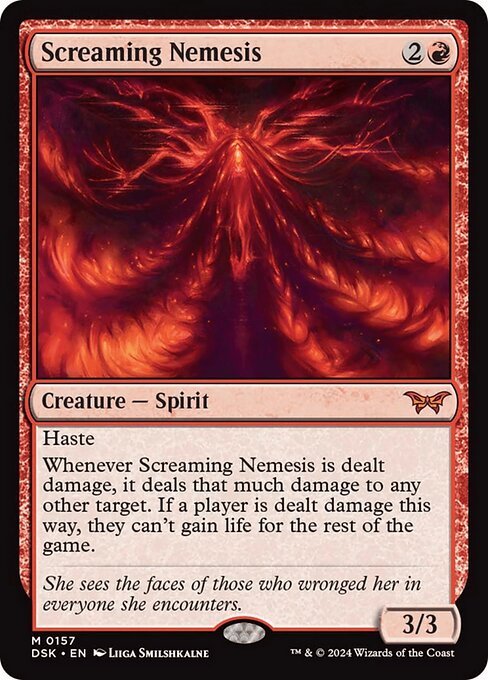

Big picture: Magic pivoted in 2025. This was the year where the Universes Beyond strategy reached its apex, as Universes Beyond sets became Standard-legal, Secret Lairs were released at an accelerated clip, and what we sowed in the pandemic started to bear fruit, some of which rotted on the vine. Ten cards were banned in Standard, across all commonalities and colors, from unassuming Mice to card draw engines to sales-driving Mythic rares. That’s not a successful year for Magic design or development, as it leads to unpredictable tournament environments, player fatigue, and grumbling on social platforms. Anyone who saved up for a $200 playset of Vivi Ornitiers or scrounged up a set of Screaming Nemesis at a Standard tournament is feeling the sting. Some quality issues are slipping through, from minor typos on cards to errors that require day-one errata, and the need to produce thousands of cards every year results in designs that must hit the overlap between “exciting” and “safe,” which often translates to “overly wordy.”
The highlights were high, though—Final Fantasy, aside from being a huge success from a sales perspective, was a great Limited format, and Edge of Eternities proved Wizards could adapt mainstream Magic to a different environment without wrecking player immersion. Tarkir: Dragonstorm’s worldbuilding was refreshing, and so was the return of big, beefy Dragons and characters from the original Khans Block. Avatar: The Last Airbender brought a new combo deck to Standard, a new chase Mythic, and a host of interesting cards and mechanics; I’m not a fan of it in Limited, but the set (particularly the well-designed Jumpstart set) is a good onboarding ramp for new players and meshes relatively well with Magic’s legacy of swords and sorcery. On the other side of the scale is Aetherdrift and Marvel’s Spider-Man, the ethos and aesthetics of which are antithetical to why I personally enjoy Magic, and the less said about those two misfires, the better. I don’t think 2025 will be remembered as a great year for Magic from a gestalt perspective, but individual cards, as ever, will be remembered for decades to come; as is tradition, I want to call out the most important cards of the year and spotlight why they embody this year in cardboard. These aren’t meant to be the best cards of 2025, or the most exciting, or the most regrettable (although some are all of these), but more of a time capsule: this was, for better or worse, 2025.
The best card list would be much more pedestrian (although also still important), and would include Stock Up, the completion of the Verges and return of the shocklands, Voice of Victory, Strategic Betrayal, Starting Town, Shared Roots, etc. These are all excellent cards, but they don’t reveal much about the general trends of Magic, other than that players like it when Wizards prints cards that help them advance their strategies or win games. The truly interesting cards, the time capsule cards, are those that can tell us what Magic was, rather than what Magic did. To that end, the list:
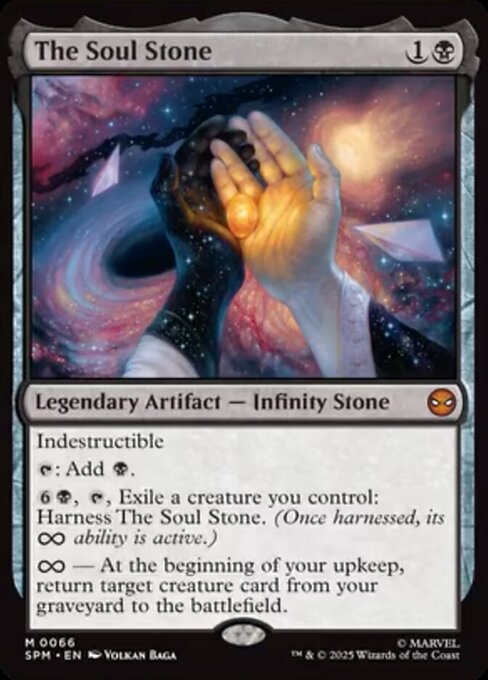
The Soul Stone–Mana rocks with extra utility are a tough target to hit. Arcane Signet has been an auto-include in most Commander decks for half a decade now, but even that just ramps and smoothes your mana. The best of the remainder of two-drop rocks–the Ravnican Signets, the Mirage Diamonds, Fellwar Stone—have minor restrictions and do nothing but add mana. Magic: the Gathering’s Marvel’s Spider-Man brought with it a new two-mana rock that’s also an eventual win condition, serving as part cheaper Darksteel Ingot and part Debtors’ Knell. Personally, I find an Indestructible mana rock that can turn into a consistent threat-reanimator unseemly and ostentatious, especially when it’s a cross-promotion with the Marvel Universe of media content. The tradeoff of ramp has traditionally been that it’s a dead draw later in the game–The Soul Stone is good at any point in the game, unlike Rampant Growth. I recognize that Wizards couldn’t resist the opportunity to seed a cycle of splashy mythic rares in their Marvel tie-in sets, but I prefer the The Endstone or Ugin, Eye of the Storms or Portal to Phyrexia model of exciting Mythics. With The Soul Stone, every black-based deck needs a compelling reason to not slam $50 on the table in exchange for the power the Stone offers you, with the added drawback of four other stones (and presumably the Infinity Gauntlet) waiting for future releases.
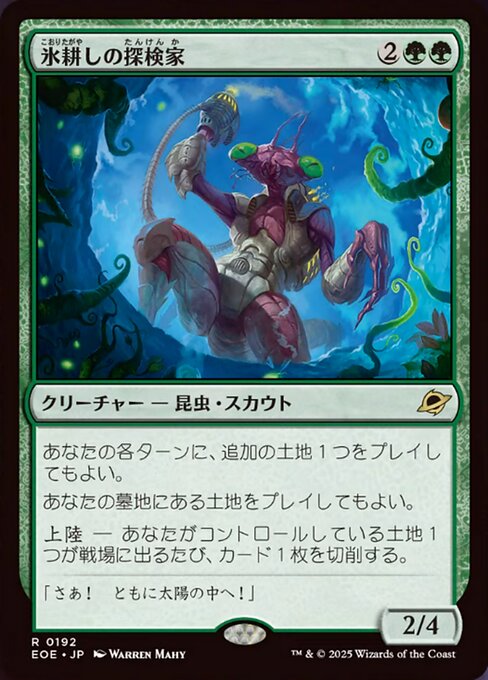
Icetill Explorer—I’m a big fan of Landfall decks, and a bigger fan of graveyard decks, but something about Icetill Explorer leaves me cold. There’s no challenge to it—it pays itself off, which makes it an incredibly good card, but one that doesn’t feel rewarding to play. Exploration costs G, Crucible of Worlds costs 3, and somehow the two stapled together for 2GG gives you a 2/4 body and a minor milling upside. Compare this to Conduit of Worlds or to Dryad of the Elysian Grove—Icetill Explorer holds your hand in its mantid claw, and I like to work a little harder than that. Don’t get me wrong: I’ll play Icetill Explorer until Hell freezes over, but it feels like I’m getting away with something, and it feels like it embodies in a single card a design trend within Wizards of which I’m suspicious. Icetill Explorer, Badgermole Cub, Elegy Acolyte (to a much lesser extent, although it feels all but unbeatable in Limited), and Vivi Ornitier are all setup and payoff in a single card, and we’ve seen the issue inherent in that trend. Once you have several lines of text outlining your optimal play pattern, you’re not a player making choices: you’re an operator doing predetermined tasks.

Cori-Steel Cutter—2025 was the year Wizards of the Coast dared to ask, “What if Umezawa’s Jitte was Bitterblossom?” Well, let’s answer that, Wizards: you would immediately ban it after it took over Standard and showed up as far back as Legacy. Cori-Steel Cutter is emphatically a mistake of a card, and yet, I can’t hate a card this beautifully busted. It requires a deck built around it, but the governing principle of that deck is “play cheap, efficient spells, often cantrips.” That’s not exactly Lutri-level restrictive, so Cutter rewards decks that existed long before it was printed. Were it Legendary and named Taigam’s Sidearm, or whatever, it would not have been as big of an issue—instead, it’s absurd in multiples and can help trigger earlier copies of itself. Is it fun to play against? Absolutely not. But it’s a fast kill, creates a fountain of cardboard, and is so comically over the top that I adore the audacity. May you grace Cube for decades, Cori-Steel Cutter, and periodically show up to keep folks honest in Modern.
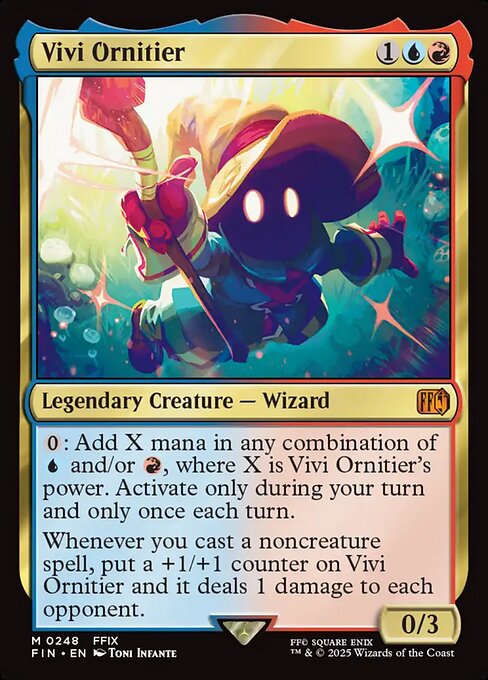
Vivi Ornitier—Vivi and Cori-Steel Cutter were meant to be legal in Standard at the same time. I can see the conceit, if I squint: a deck designed to cast a flurry of low-impact but cheap spells to power up Cutter and Vivi is theoretically prey to control and could gas itself out. But Vivi’s secret weapon was Agatha’s Soul Cauldron, which I don’t think Wizards was including in their calculations. Cauldron adds resiliency to Vivi while serving as a maindeck counter in the mirror match that just happens to also prey on other major Standard archetypes. Vivi’s ban in November was not a surprise in the slightest, although a case could also have been made to ban Cauldron—any card with an activated ability printed in the future will have to be considered as Cauldron fodder. Final Fantasy was Wizards’ most staggering financial success, and it’s unfortunate that it comes with an asterisk, when most of the other cards from the set are balanced and beneficial to Standard. Cecil, Yuna, Cloud, the Summons—all powerful, but all answerable, and all overshadowed by the little Wizard. The most important card of the year can’t be anything but the mana-producing, player-pinging, spellslinging Vivi Ornitier, and I dread seeing it hit the table.
It’s inarguable that Magic: the Gathering, for those who create and publish it, was a huge success in 2025. Final Fantasy became the game’s best-selling set before it was on the streets, every corporate metric has been met or exceeded per HASBRO’s earnings reports, and it certainly feels, from the ground, like Magic has hit a new point of cultural awareness. Even in my quiet city, I can’t play Magic in public without someone coming up and asking not “what are you playing,” but “who’s your Commander?” The thing that kills Magic, the vice inherent in its design or its social niche, has never felt further off. And yet, “entropic” doesn’t just apply to Battlecruisers.
Magic will live on, no matter what—incarcerated people play Magic on handwritten index cards, people who haven’t bought a card in half a decade still break out their Cubes, and our generation will be interred with their Magic tattoos standing out on their powdered and pallid skin—but it’s plausible that we look back on 2025 as an inflection point of some kind from a player’s perspective. In writing this article, I reviewed over 2,500 cards printed this calendar year—some of them were unfamiliar, overwritten by later cards or passing by unplayed in the rare week where I didn’t log a draft or two on the exercise bike. No one can have an encyclopedic knowledge of Magic anymore; as far as I can tell, some of these cards only exist as images on a screen, and I’m not just talking about Through the Omenpaths. There are signs of stress, the kind of things you have to squint and do corporate report haruspicy to read, from the revision of the Monster Hunter Secret Lairs to the muted and confused response to Marvel’s Spider-Man/Through the Omenpaths.
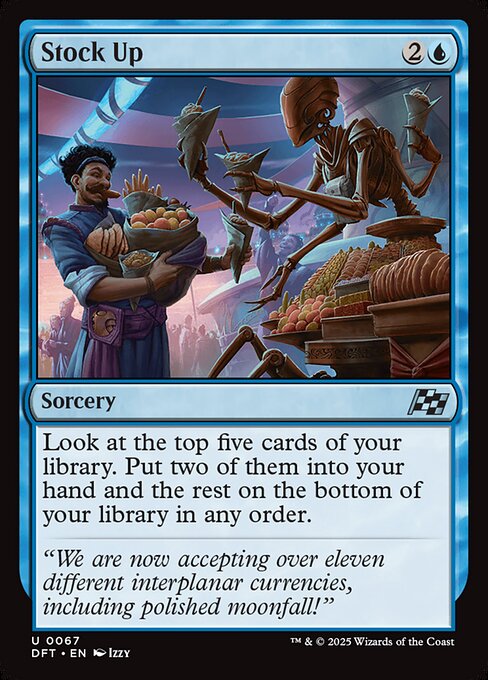
And yet, against all of that: I can now play an Edward Steed Demonic Consultation and my Cubes’ “to consider” lists are now almost as long as the Cube lists themselves. I have three dates on the calendar over the holidays to meet up with old friends over a flight and a draft. This was the year of Vivi and Cori-Steel Cutter and Omniscience combo, but it was also the year of white-bordered Cabal Coffers and Stock Up, which could have been printed in Tempest or Ravnica: City of Guilds, and the year of Monument to Endurance, which intersects with thirty years of Magic cards. There are dozens of other cards printed in 2025 that could have made the cut, from Herd Heirloom to Ouroboroid to Quantum Riddler to Anti-Venom, Horrifying Healer to Appa, Steadfast Guardian, but those are successful designs–maybe a bit overtuned or overpowered in smaller card pools, but successful nonetheless.
For 2025, as in the world beyond Magic, I think it’s most helpful to see where there is significant strain or stress–to look at the designs that test the limits of what’s allowable or acceptable. Those stress points, as the world continues to put pressure on us all, are where the cracks start; it’s our job to anticipate what happens when something breaks. 2026 may be the year when Magic exceeds even the high benchmarks set by 2025, or it may be the year when economic factors, a lapse in player attention spans or affection, and an overwhelming number of cards and crossovers start yielding decreased sales and diminished cultural cache. Here’s what we do know: there will be new cards, some of which we’ll obsess over, build decks to break and go 1-3 with, and slide into sleeves or binders with new joy that will eventually become comforting nostalgia. That’s what Magic offers, and it’s why we do it the respect of analyzing it.
Rob Bockman (he/him) is a native of South Carolina who has been playing Magic: the Gathering since Tempest block. A writer of fiction and stage plays, he loves the emergent comedy of Magic and the drama of high-level play. He’s been a Golgari player since before that had an official name and is never happier than when he’s able to say “Overgrown Tomb into [mtg_card]Thoughtseize,” no matter the format.